
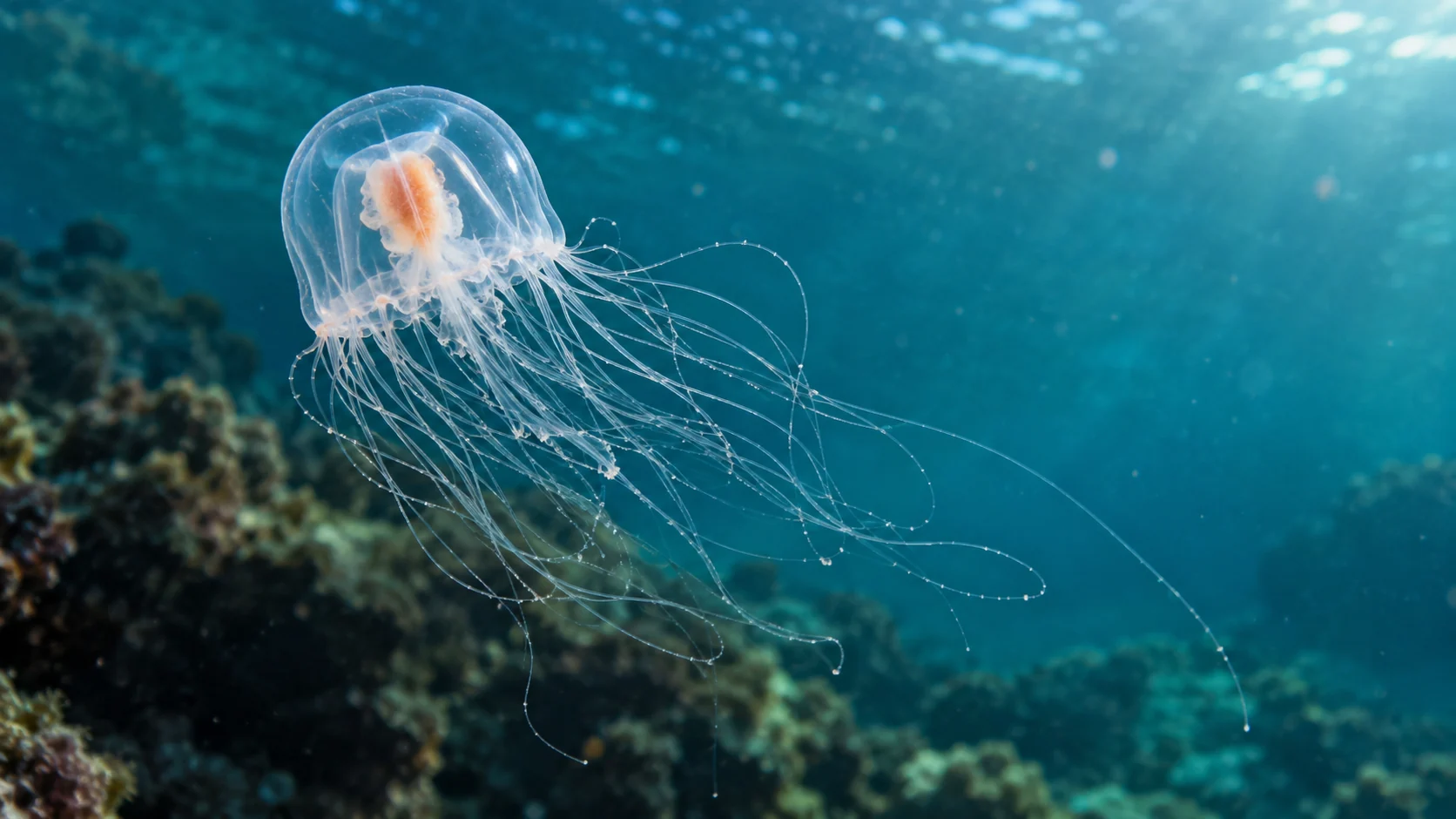
Turritopsis dohrnii has a trick that sounds like somebody found the reset button on aging: under the right conditions, the adult jellyfish can reverse its development and turn back into an earlier polyp stage.
That is why it gets called the “immortal jellyfish.” The nickname is irresistible. It is also easy to oversell.
The animal is not invincible, and scientists are not claiming it can dodge every possible cause of death forever. The weird part is specific and still astonishing: instead of continuing only in the normal direction from juvenile to adult, T. dohrnii can sometimes run part of its life cycle backward.
Most jellyfish are supposed to go one way
A typical jellyfish life cycle already looks like nature was experimenting with PowerPoint transitions.
The familiar free-swimming form is the medusa. Medusae reproduce sexually, producing larvae called planulae. Those larvae settle onto a surface and become polyps. The polyps then reproduce asexually and eventually produce new medusae. The Smithsonian Ocean Portal gives a clean overview of that medusa-to-larva-to-polyp-to-medusa cycle.
Normally, you do not finish adulthood and then decide to become the nursery-stage version of yourself again.
Turritopsis dohrnii did not get that memo.
The adult can collapse into a cyst and rebuild as a polyp
When the jellyfish is damaged, aging, or under adverse environmental conditions, the medusa can stop behaving like a medusa. It shrinks, loses its swimming ability, settles down, and forms a cyst-like mass of reorganizing cells.
From there, it develops structures associated with the polyp stage and eventually produces new polyps.
A 2019 transcriptome study described the process in detail and found that the cyst sits between the regressing medusa and the renewed polyp. During that transition, tissues are reorganized and cells change developmental identity through processes including transdifferentiation.
In human terms, this is not “getting younger” in the way a 70-year-old becomes 30. It is much stranger. The animal is remodeling itself into an earlier body plan and restarting the normal jellyfish sequence from there.
Scientists are looking for the molecular reset instructions
The obvious scientific question is: how is this even possible?
A 2022 comparative genomics study sequenced T. dohrnii and compared it with a related jellyfish that does not show the same mature-stage rejuvenation. The researchers found differences involving genes associated with DNA repair, telomere maintenance, stem-cell populations, cellular communication, redox balance, and other processes connected to aging and regeneration.
The same study also tracked gene activity during life-cycle reversal and found changes involving pluripotency and developmental reprogramming.
That does not mean scientists have discovered a single “immortality gene.” Biology rarely offers anything that convenient. The evidence instead points toward a coordinated system of repair, cell-state change, and developmental control.
“Immortal” is a nickname, not a warranty
The phrase “immortal jellyfish” makes it sound as if one individual can just shrug off reality indefinitely. What researchers actually mean is that T. dohrnii has the capacity for repeated rejuvenation rather than being locked into a one-way adult aging trajectory.
Laboratory work has documented repeated life-cycle reversal, and genomic researchers describe the species as having an unusual potential for biological immortality. That is very different from saying nothing can kill it.
It is also worth updating another old talking point: Turritopsis is no longer the only animal ever observed reversing development. In 2024, researchers reported reverse development in the ctenophore Mnemiopsis leidyi, a comb jelly relative that is not actually a true jellyfish. That PNAS study makes the broader biology even more interesting rather than less.
Nature has a disturbing number of reset buttons
The ocean is developing a pattern here.
BiggleBit already has axolotls rebuilding lost limbs and sea slugs stealing working chloroplasts from algae. Now add a jellyfish that can reorganize its adult body into an earlier life stage and start the cycle again.
Most animals get one developmental arrow pointing forward.
Turritopsis dohrnii apparently looked at the arrow and asked whether it was more of a suggestion.