
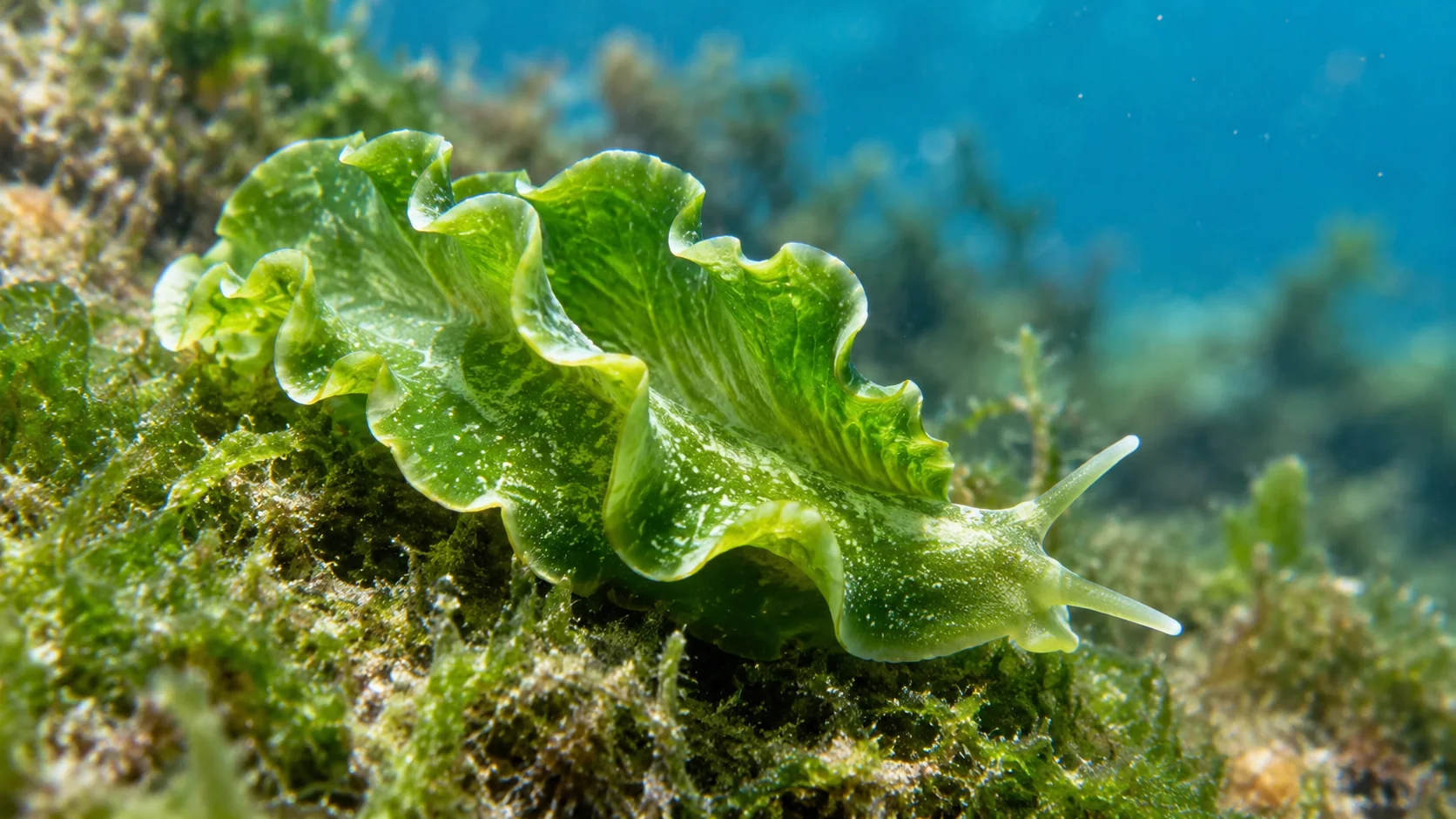
Some sea slugs do something that sounds less like biology and more like a stolen-superpower plot: they eat algae, keep the algae’s chloroplasts, and use those chloroplasts to harvest energy from sunlight.
The trick is called kleptoplasty—literally, “stolen plastids.” And yes, the “stolen” part is doing a lot of work here.
The slug doesn’t make chloroplasts. It steals them.
Chloroplasts are the light-capturing organelles that make photosynthesis possible in plants and algae. Animals do not normally have them. Certain sacoglossan sea slugs solve that technical problem by eating algae and selectively keeping the chloroplasts instead of digesting everything.
In the well-studied sea slug Elysia chlorotica, juveniles feed on the alga Vaucheria litorea. Researchers at Rutgers and collaborating institutions found that the slug sequesters the algal plastids inside cells lining its digestive system, where they continue to function. The slug is not growing its own chloroplasts. It is basically running somebody else’s hardware.
Rutgers researchers described the process as the animal acquiring millions of photosynthetic plastids from algae and maintaining them after feeding.
The stolen chloroplasts can keep working for months
This is where the story gets especially weird. A chloroplast removed from its original algal cell should have a maintenance problem. Chloroplasts normally depend heavily on the rest of the cell, including proteins encoded by genes in the nucleus.
Yet some sacoglossan sea slugs keep stolen chloroplasts photosynthetically active for months.
A 2025 study published in Cell examined this problem in the photosynthetic sea slug Elysia crispata. The researchers found that the slug packages foreign chloroplasts inside previously undescribed host-made compartments they called kleptosomes. Those compartments help maintain an environment in which the chloroplasts can keep functioning.
The study also found that the arrangement is even more practical than “slug with solar panels.” During starvation, the kleptosomes can digest stored chloroplasts for additional nutrients. Apparently if you steal the solar panel, you may also reserve the right to eat the solar panel.
Does the slug actually get food from sunlight?
Yes—but it is worth being precise about what that means.
Scientists have directly traced photosynthesis-derived nutrients from retained chloroplasts into sea-slug tissues. A study of Elysia viridis found light-dependent incorporation of carbon and nitrogen first around the digestive system and then in organs that did not themselves contain chloroplasts. In other words, products made through the stolen photosynthetic machinery were reaching the animal.
That does not mean every kleptoplastic sea slug can simply retire from eating and spend the rest of its life lying in the sun. Different species retain chloroplasts for different lengths of time, and the nutritional importance of photosynthesis varies. Feeding still matters.
But “an animal stole functioning chloroplasts and gets useful nutrition from photosynthesis” is already strange enough. There is no need to oversell it.
This is not a tiny plant wearing a slug costume
The chloroplasts are acquired during feeding. They are not a permanent, inherited organ of the slug in the way chloroplasts are part of a plant cell lineage.
That distinction makes kleptoplasty scientifically fascinating. The slug has to recognize foreign organelles, avoid immediately destroying them, maintain them inside its own cells, tolerate the chemical stresses associated with photosynthesis, and actually use the products they produce.
The 2025 kleptosome work suggests the animal host is much more active in that relationship than simply providing storage space. It builds specialized cellular machinery around the captured chloroplasts and regulates their survival.
So the chloroplast is stolen, but the maintenance contract is surprisingly sophisticated.
Evolution keeps finding loopholes
Sea slugs are already a strong contender for the ocean’s “who approved this design?” award. Some are spectacularly colorful. Some steal defensive stinging cells from prey. And some apparently decided that being an animal should not prevent them from outsourcing part of lunch to sunlight.
If that sounds like biology cheating, it fits nicely beside axolotls casually regrowing lost limbs. Evolution has rules. It also seems to enjoy finding every available edge case.