
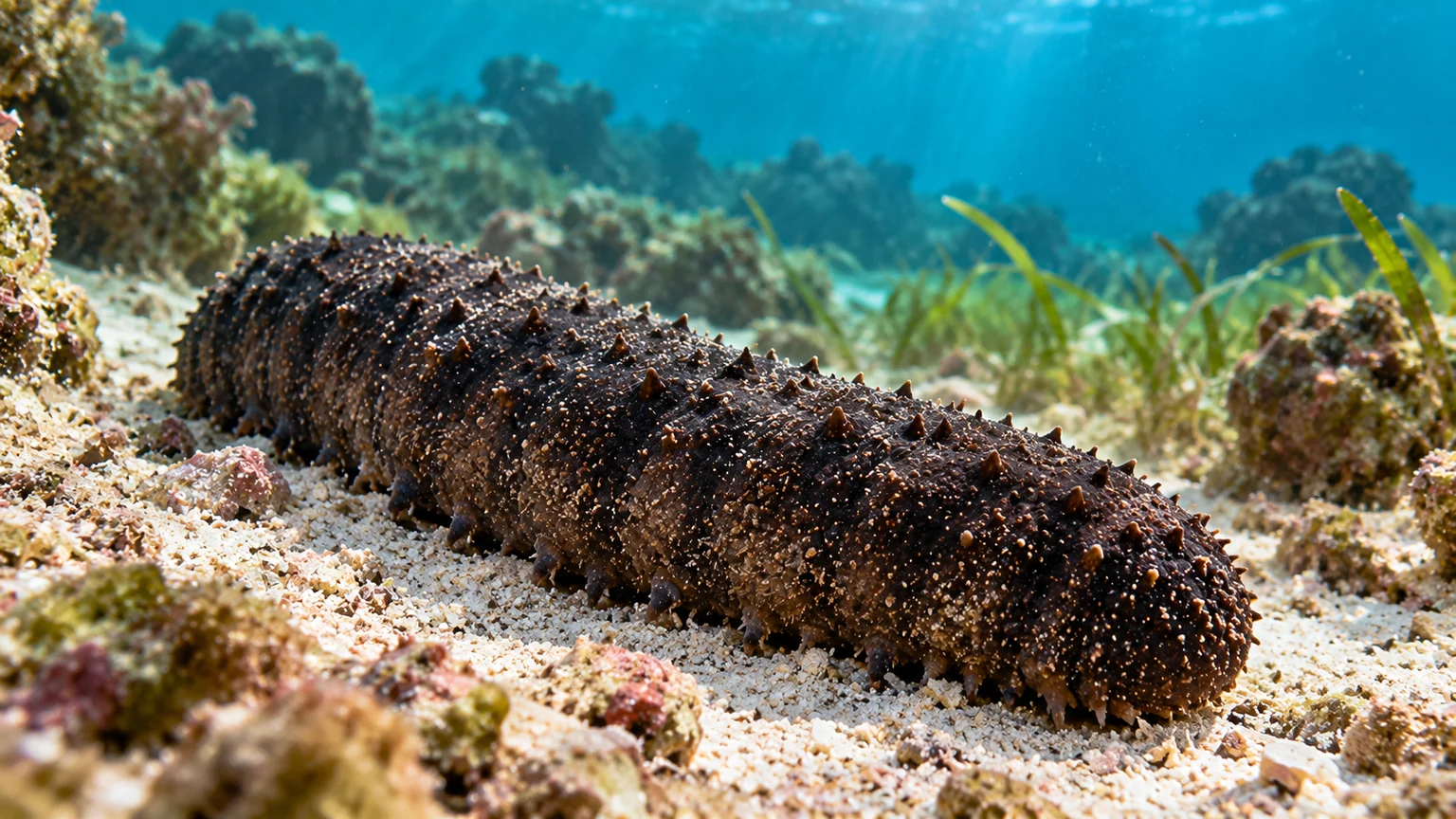
Some sea cucumbers have a defense that sounds impossible: when danger arrives, they can eject parts of their own internal organs and survive to grow them back. The biological name is evisceration. It’s less “throw away the entire animal” and more “sacrifice an expensive piece of equipment to avoid being eaten.”
But don’t imagine every sea cucumber firing the same emergency weapon. Scientists distinguish between species that expel parts of the digestive tract and others that deploy sticky defensive tubes. Both can involve regeneration, but they’re not interchangeable tricks.
What evisceration actually means
Sea cucumbers are echinoderms, relatives of sea stars and sea urchins. Their long, soft bodies creep across the seafloor, collecting edible particles and recycling organic matter. NOAA Ocean Service explains that some species can contract their muscles and force internal organs out of their bodies when threatened.
In some animals this defense includes portions of the gut. A predator may be distracted by the expelled tissue, leaving the sea cucumber a chance to escape. The animal remains alive, but it must pay the energetic cost of replacing what it lost. No free refill is included.
The sea cucumber isn’t necessarily making a deliberate choice in the human sense. This is a physiological defensive response, and which tissues are lost depends on the species and conditions.
Not all sea cucumbers throw the same thing
Some tropical species carry a specialized defensive structure called the Cuvierian organ: a mass of tubules that can be rapidly expelled through the rear opening. These threads stretch, become sticky and may entangle an attacker. That is different from discarding the intestine itself.
A 2023 study in PNAS analyzed the genome of Holothuria leucospilota, a species that deploys adhesive Cuvierian tubules. Researchers investigated proteins associated with the sticky defensive trap and the organ’s ability to regenerate. The work concerned that specific species and mechanism, not an anatomical feature shared by all sea cucumbers.
Meanwhile, Monterey Bay Aquarium describes Johnson’s sea cucumber as an animal that can shed internal organs during an attack, with the missing tissues growing back. Different species, different survival strategies—same very odd family reunion.
Growing a new intestine takes biological work
Regeneration is the second half of this story. Scientists studying Holothuria glaberrima have observed how a new intestine forms from tissue associated with the mesentery, the internal structure that normally supports the digestive tract. The rebuilding process includes changes in muscle cells and other cellular activity.
A study published in 2024 tested how cell death, cell division and muscle-cell dedifferentiation interact during early intestinal regeneration. In that species, a replacement intestine can develop within weeks, although the time and sequence depend on the animal and experimental conditions.
“Regenerate” does not mean the animal is instantly back to normal. Restoring functional tissue is an organized biological process, not a magical rewind button. The distinction matters because the ability to regrow one organ does not prove that the same animal could regenerate absolutely any missing body part.
Why a seemingly drastic defense can work
Sea cucumbers generally aren’t built for high-speed getaways. They have soft bodies and often move slowly, using tube feet or body contractions. Distraction, entanglement and the chance to hide can therefore be worth the serious cost of lost tissue.
The defense also has limits. The expelled structure may not reliably deter every predator, and the recovering sea cucumber needs time and resources. A fascinating emergency tactic should not be mistaken for a guarantee of safety.
Ocean cleanup crews with an unexpected superpower
Most of the time, these animals are doing something far less dramatic. They help turn detritus and organic scraps into processed sediment on the seafloor, a job NOAA compares to the work of earthworms on land. Their digestive systems are important to ocean habitats even when they aren’t being used as a decoy.
Another peculiar place on the ocean bottom is the underwater brine pool, where extremely salty water can form a lake-like boundary. The deep ocean is full of surprising adaptations and unusual environments without needing to exaggerate either one.
For some sea cucumbers, the strangest way to stay alive is to temporarily lose the very machinery that usually keeps them fed. The science behind growing it back is much more interesting than the gross-out headline.