
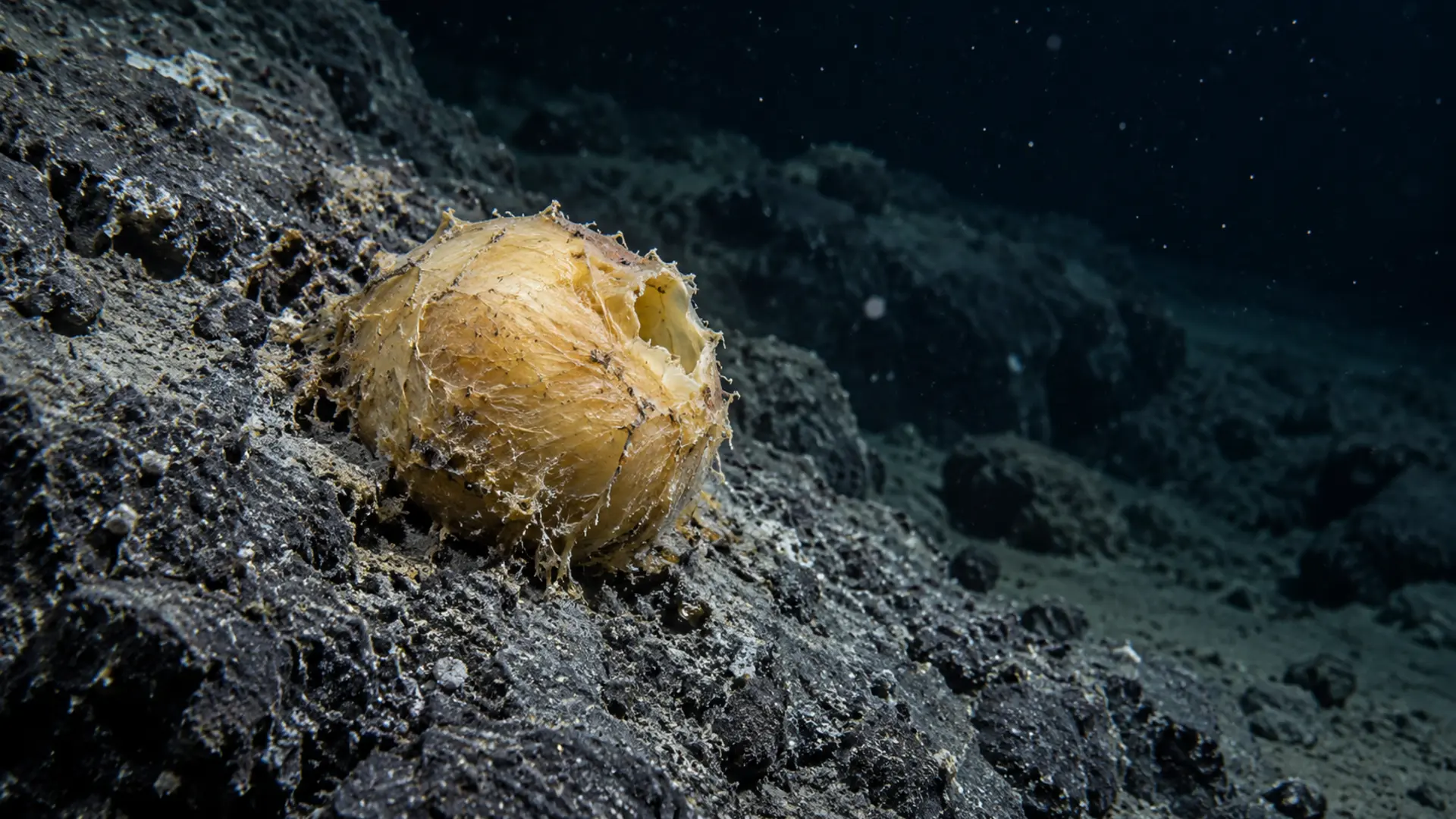
In August 2023, a remotely operated vehicle exploring the Gulf of Alaska found a golden, mound-shaped object attached to a rock more than three kilometers below the surface. It had a small opening and an unfamiliar texture. The crew collected it, but getting it aboard a ship did not make the object any easier to identify.
The specimen became known as the “golden orb.” For more than two years, scientists examined its structure and genetic material before concluding that it was a remnant of the base of a giant deep-sea anemone, Relicanthus daphneae. The answer was less exotic than some guesses, but the route to it shows how hard deep-ocean biology can be to classify.
A strange shape was only the first clue
The object was recovered during NOAA’s 2023 Seascape Alaska exploration. At a depth of roughly 3,250 meters, the team could not identify it from its shape alone. The sample was sent to the Smithsonian’s National Museum of Natural History and cataloged in its Invertebrate Zoology Collection as USNM_IZ_1699903.
Under closer examination, the orb appeared fibrous and layered rather than built like a familiar animal. Researchers found cnidocytes, the specialized cells associated with animals such as anemones and corals. A subset of those cells—spirocysts—helped narrow down the possibilities, but the physical evidence did not settle the species.
That mattered because a golden lump on a rock can be mistaken for many things from a camera view alone. The lab work gave researchers anatomical evidence to test instead of relying on visual resemblance.
Why the first DNA test did not solve it
DNA barcoding, which checks a short genetic segment, produced an inconclusive result. NOAA’s account notes that genetic material from microscopic organisms on the sample may have complicated the first analysis. The team then used whole-genome sequencing, a much more extensive approach.
The broader sequence contained a large amount of genetic material matching the giant deep-sea anemone Relicanthus daphneae. Researchers also sequenced mitochondrial genomes and compared the sample with a known reference. Those results strongly supported the identification. A similar specimen collected during a 2021 expedition aboard the research vessel Falkor offered another point of comparison.
The process combined more than one type of evidence: tissue structure, specialized cells, genome data and comparison with another sample. No single photograph or quick DNA test supplied the answer on its own.
The “orb” was the anemone’s attachment base
Scientists concluded that the golden material was the remnant of cells that formed the base of the anemone—the part that attached it to a rock. It was not an egg, a new species shaped like a ball, or a complete anemone preserved in miniature.
The result still leaves one part of the story unresolved. Researchers cannot say for certain what happened to the rest of the animal. It may have died or moved away, leaving the base behind, but the collected sample does not preserve that sequence of events.
The species itself has had a complicated taxonomic history, so the discovery did not erase every question about it. It did, however, explain what the 2023 specimen was and why it had the tissue structure researchers observed.
Why the mystery took more than two years to solve
The specimen needed specialists who could connect deep-sea observations with comparative anatomy and genomics. NOAA Fisheries and the Smithsonian National Museum of Natural History brought those skills together. Once the genetic evidence became more specific, the team could test a leading identification against known material instead of just comparing appearances.
That is why strange-looking objects recovered during ocean expeditions should not immediately be labeled a new animal or an unknown egg. A specimen can be genuinely unusual and still need several kinds of evidence before scientists can identify it. Another deep-sea puzzle, the brine pools found on the ocean floor, shows how much a camera can reveal—and how much it cannot tell us without samples and measurements.
The golden orb’s answer was a part of an animal that had already been difficult to classify. In this case, the breakthrough came from bringing the specimen back, studying its cells, and looking deeper into its DNA.