
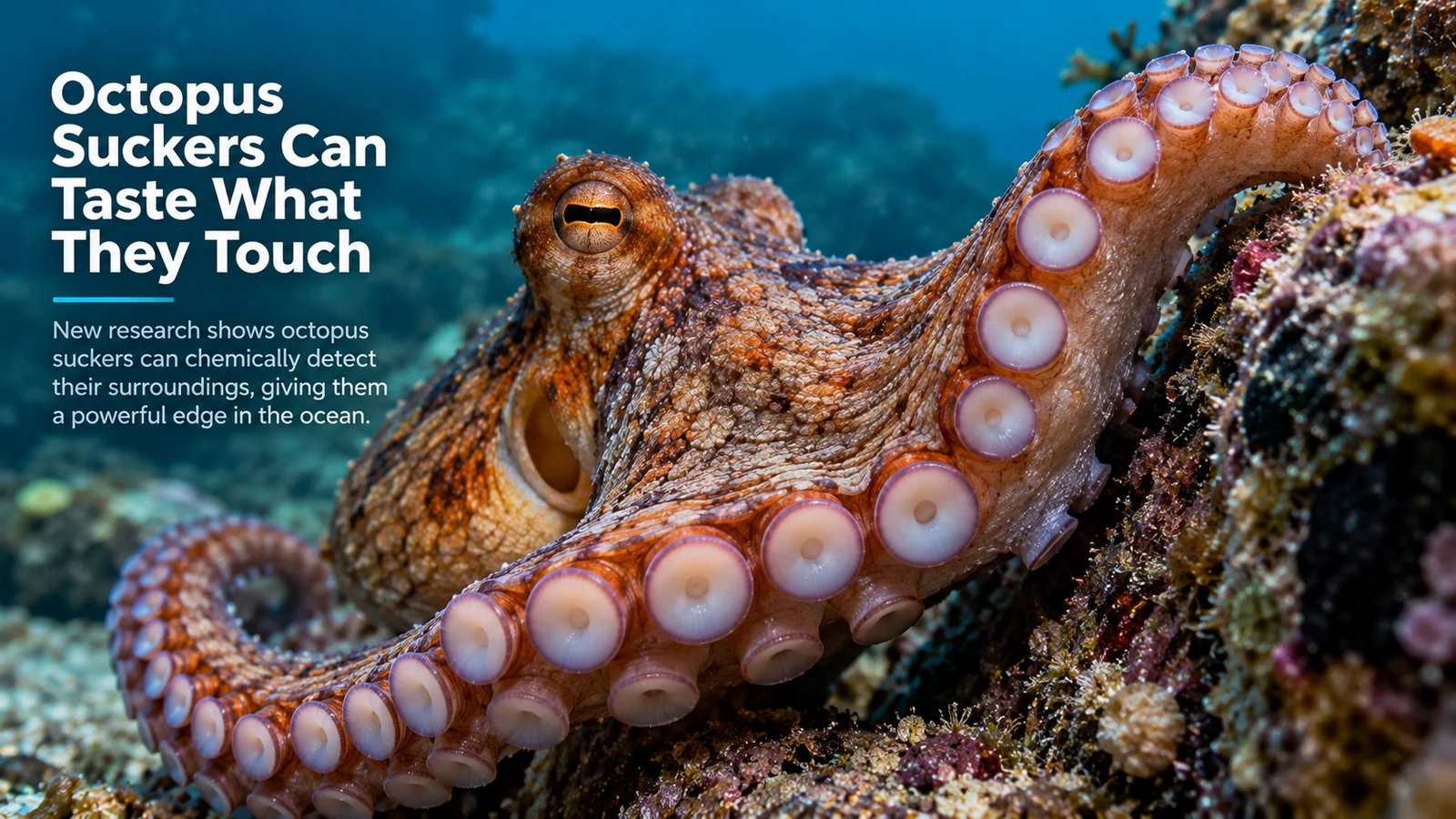
An octopus can learn something about an object without putting it in its mouth. The suckers along its arms do more than grab: specialized sensory cells can detect chemicals on surfaces the animal touches.
That ability helps make sense of all the poking and probing an octopus does around the seafloor. Researchers call it taste by touch, though the cells involved are not tiny human taste buds.
Suckers are sensors, not just suction cups
Each sucker has a practical job holding on to rocks, prey and other objects. But contact also delivers information. In a 2020 study in Cell, researchers described octopus-arm cells that respond to chemical signals and different cells sensitive to mechanical information. Those pathways let the animal register more than the pressure of whatever it has grabbed.
The research team identified a family of receptors called chemotactile receptors. They help detect certain natural substances that dissolve poorly in water. An octopus touching an object can therefore receive a local chemical signal without relying on the substance to drift through the sea first.
That does not mean every sucker recognizes every chemical, or that an arm is a complete substitute for the animal’s other senses. The experiments show specific receptor functions and sensory responses.
Why seawater makes contact chemistry useful
Chemicals behave differently in water. Some dissolve and spread readily; others are much less soluble. If a useful clue stays close to a surface, direct contact is one way to detect it.
Scientists took a closer look at the mechanism in a 2023 Nature study. Using structural and biophysical methods, they examined an octopus chemotactile receptor and found an unusually water-repelling, or hydrophobic, binding pocket. Its structure helps explain how the receptor can respond to poorly soluble compounds.
The researchers were investigating the molecular machinery, not claiming that an octopus can identify every object by a single touch. That distinction matters: the remarkable part is the specific chemistry these sensory cells can detect.
A squid’s receptors tell a different story
Octopuses are not the only cephalopods with specialized contact receptors. A second 2023 Nature paper compared octopus and squid systems and found differences in the types of molecules their receptors detect.
In the experiments, squid receptors were associated with sensing soluble bitter compounds, while the studied octopus receptors were adapted to compounds that are less soluble. Researchers connected those differences to the animals’ contrasting ways of exploring and catching prey.
The comparison is useful because it shows that similar-looking sensory equipment need not work in exactly the same way across related animals. Evolution can change what a receptor picks up without replacing the whole underlying system.
What the arms tell the octopus
Touch, pressure and chemistry reach the animal together as its arms explore. The 2020 study found local sensory processing in the arms, but it did not establish that each arm thinks or makes every decision independently. Exactly how the distributed nervous system coordinates all that information remains an active research question.
The suckers are a striking part of octopus anatomy: they can hold an object and sample its surface at the same time. And they’re only one oddity in an animal whose three-heart circulation is unusual in its own right.