
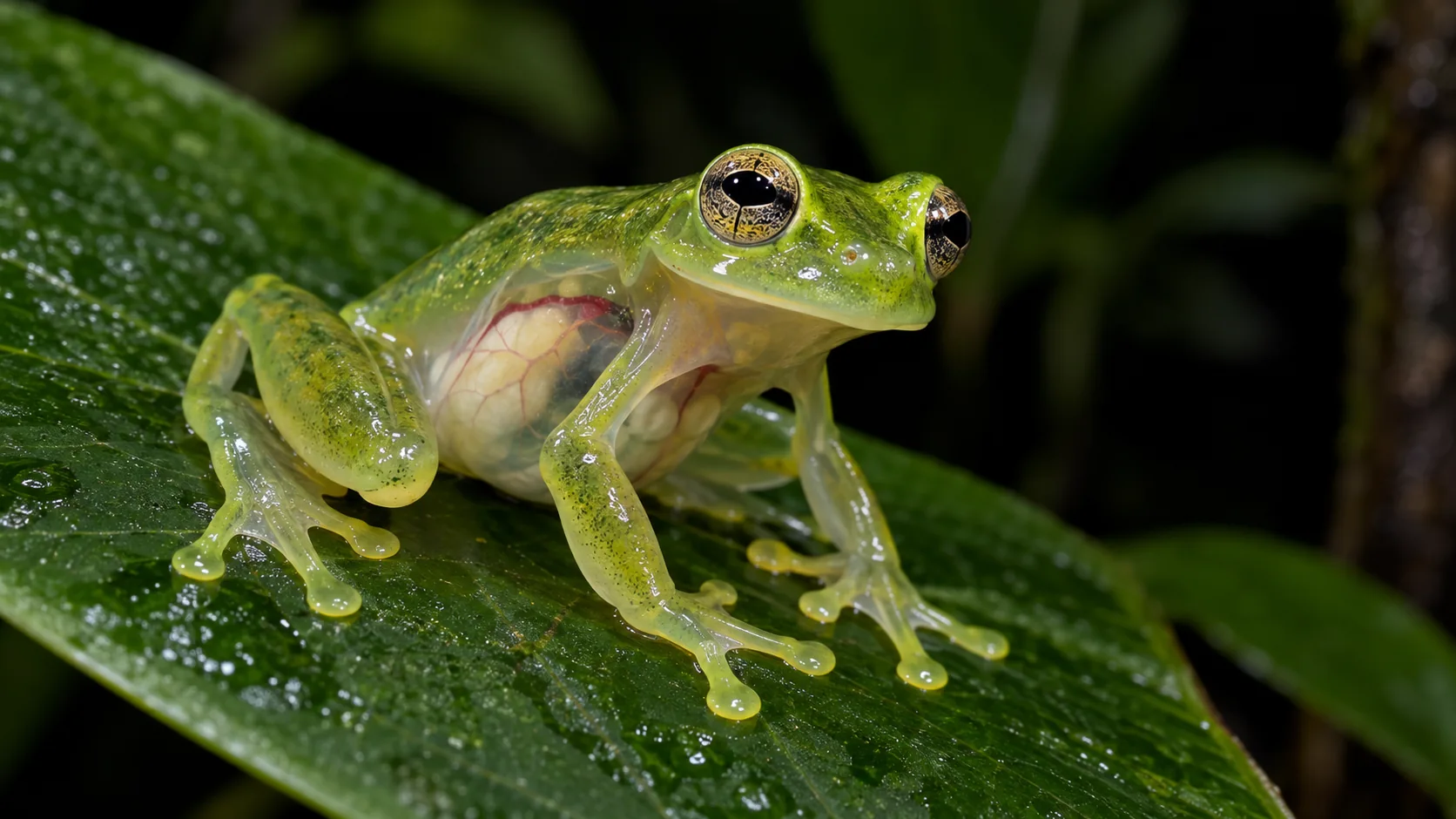
Glass frogs can become dramatically more transparent when they fall asleep. They do it by pulling most of their red blood cells out of circulation and packing them into the liver. In a 2022 study of one glassfrog species, scientists measured roughly 89 percent of circulating red blood cells being stored away during rest.
Other animals change color to hide. These little frogs apparently rearrange their blood supply.
Blood is a problem when you are trying to be see-through
Glassfrogs are small tropical amphibians famous for their translucent undersides. In some species, you can make out organs through the skin and muscle. But transparent tissue alone does not make an animal blend into the background.
Red blood cells carry hemoglobin, a pigment that absorbs light. Even a tiny animal with translucent skin has a fairly visible circulatory system when those cells are moving through its vessels.
The northern glassfrog, Hyalinobatrachium fleischmanni, spends much of the day resting beneath leaves and becomes active at night. Against a green leaf, a less conspicuous outline could be useful. Still, the evidence for the blood trick is stronger than a simple promise that no predator can see the frog.
During sleep, the liver becomes a red-cell hiding place
A 2022 study published in Science found that resting glassfrogs moved about 89 percent of their red blood cells out of circulation. Those cells were concentrated in the liver, which has reflective structures that help conceal the red pigment.
The researchers reported that the frogs became about two to three times as transparent during rest. That is a measurement of transparency, not a claim that the frogs literally vanish or become two to three times less likely to be eaten.
When the frogs became active again, their red blood cells returned to circulation. The cells were not destroyed and regenerated every morning; they were temporarily parked somewhere much less visible.
How do you watch blood move without waking the frog?
The team used a technique called photoacoustic imaging. Red blood cells absorb particular wavelengths of laser light and produce tiny ultrasonic signals. Sensors can detect those signals to map where the cells are inside a living animal.
That allowed researchers to distinguish a sleeping frog with most red cells concentrated in its liver from an active or disturbed frog whose bloodstream was more visibly red. The U.S. National Science Foundation’s account of the research explains why that distinction matters: simply handling or waking the frog can change the very physiology you are trying to measure.
This was careful experimental work on a particular species, not proof that every glassfrog uses exactly the same percentage or mechanism.
The strangest part may be what does not happen
In many vertebrates, squeezing a huge concentration of red blood cells into a small place would raise serious concerns about blocked vessels or clots. Yet the glassfrogs were able to store and release their cells without the kind of clotting researchers would normally fear.
The Duke University record of the original study identifies that as an important open question. Scientists have not established every step of how the frogs manage this safely. The finding offers a research puzzle, not a discovered human blood-clot treatment.
Transparent skin does not tell the whole story
The frogs are still visible, especially their eyes, bones and some organs. What changes is how much light their tissues and blood block while they rest.
BiggleBit has covered a very different blood oddity: Antarctic icefish that lost hemoglobin. Glassfrogs keep their red blood cells; they just hide most of them until it is time to move again.
Apparently the trick to being less conspicuous can be knowing exactly where to put your blood.