
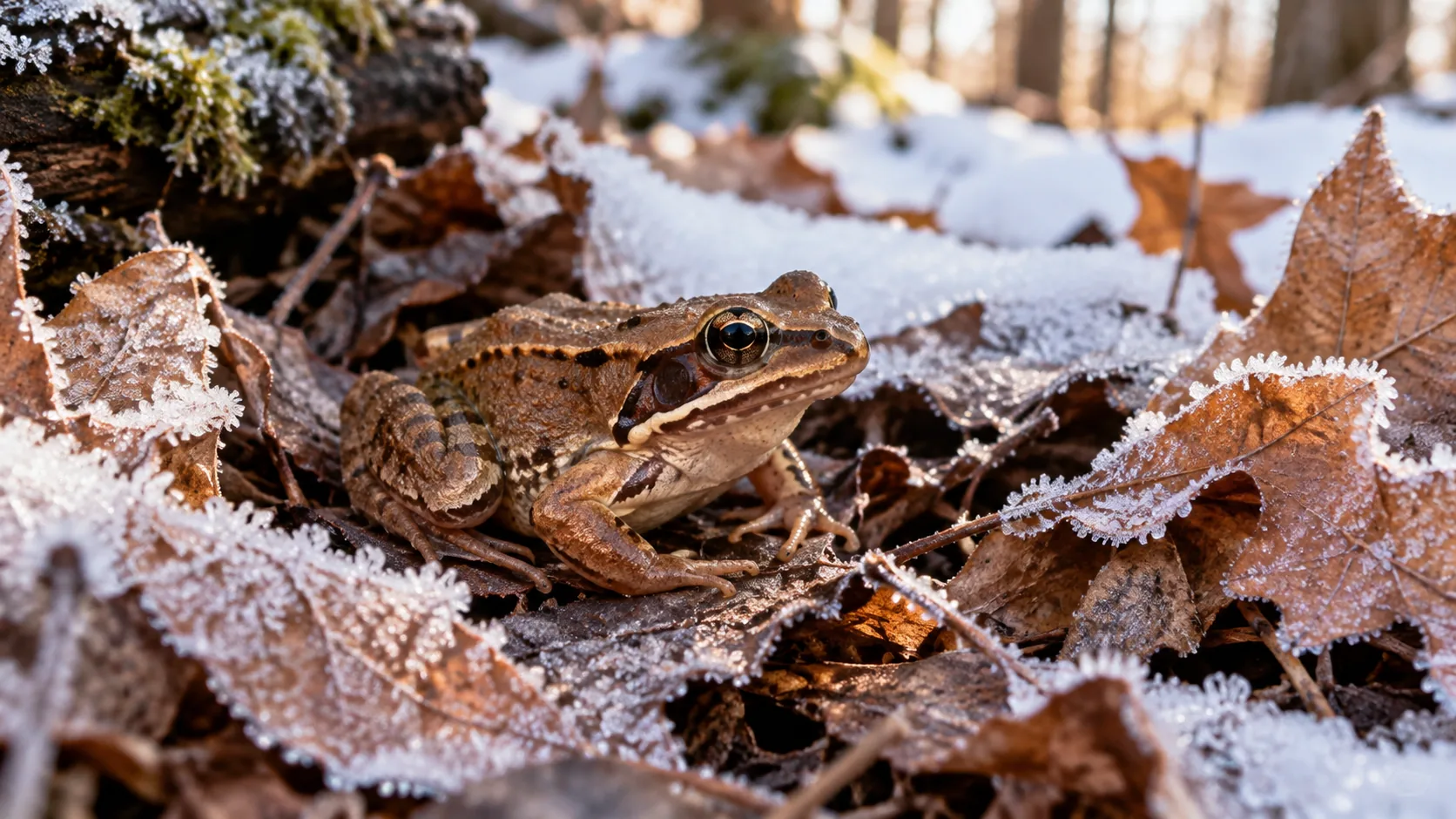
A wood frog can spend winter frozen, stop breathing, lose its heartbeat, and then thaw out in spring and get on with being a frog.
That sounds like the opening of a deeply questionable science-fiction movie. For this small North American amphibian, it is an actual survival strategy.
The species is the wood frog, Rana sylvatica, sometimes listed as Lithobates sylvaticus. Its trick is not that ice somehow misses the frog. Ice really does form in its body. The remarkable part is where the ice goes—and what the frog does to keep its cells alive.
Yes, the frog’s heart really stops
Most animals would not do well with a winter spent lying motionless beneath fallen leaves. Wood frogs embrace that particular lifestyle.
According to the National Park Service, wood frogs overwinter in leaf litter on the forest floor. As their bodies freeze, their breathing and heartbeat cease. Ice forms in spaces around tissues, and even their eyes can freeze and appear white.
This is not the same thing as a person getting dangerously cold, and it is not ordinary hibernation with a slightly slower pulse. A frozen wood frog enters a remarkable state in which circulation stops while protective chemistry helps its tissues endure the interruption.
The secret is sugar, but not because the whole frog stays unfrozen
When freezing begins, the frog’s liver converts stored glycogen into glucose. That sugar moves into its tissues and helps protect cells against freezing-related damage.
The critical distinction is between ice outside cells and ice inside them. Ice forming inside cells can wreck delicate structures. Wood frogs tolerate ice accumulating outside cells while glucose and other protective compounds help keep their interiors viable despite water loss and extreme stress.
The National Park Service’s Denali account describes this sugar response and notes that core organs such as the heart and liver freeze last and thaw first. In other words, the frog is not a tiny, perfectly solid ice cube from skin to cell nucleus. Its body has a complicated way of letting some water freeze while protecting the living parts that matter most.
Some Alaskan wood frogs stay frozen for months
Researchers studying free-living wood frogs in Interior Alaska tracked the animals through winter rather than relying only on short laboratory freezes. Their 2014 study in the Journal of Experimental Biology reported that the frogs remained frozen for an average of about 193 days. All 18 frogs in the spring-survival sample survived.
That is a finding from a particular study and region, not a promise that every wood frog can survive any temperature for six months. The researchers also found that naturally frozen Alaskan frogs accumulated much more glucose in several tissues than frogs frozen under laboratory conditions.
There is more going on than a single magical sugar switch. Research on wood-frog physiology describes a coordinated response to dehydration, lack of oxygen, reduced metabolism, and cellular stress. The animal is managing several biological emergencies at once.
Spring is the world’s strangest restart button
When conditions warm, the ice melts, circulation resumes, and the frogs return to normal activity. That early restart also gives them a head start on breeding in temporary spring pools before those pools dry later in the season.
It is worth resisting the tempting headline that wood frogs “come back from the dead.” They do not. They survive a state that would be fatal to most vertebrates through highly specialized physiology. The distinction makes the science more interesting, not less.
Scientists study these systems partly because the mechanisms of freezing, dehydration, and revival can tell us about how cells survive extreme stress. That does not mean anyone has figured out how to freeze and revive a human being. The frog has had a very long evolutionary head start.
BiggleBit has also covered Antarctic icefish that survive with almost colorless blood. Those fish keep oxygen moving through an unusual circulatory system. Wood frogs take the other route: for part of the year, they stop most of the machinery and somehow make it to spring.