
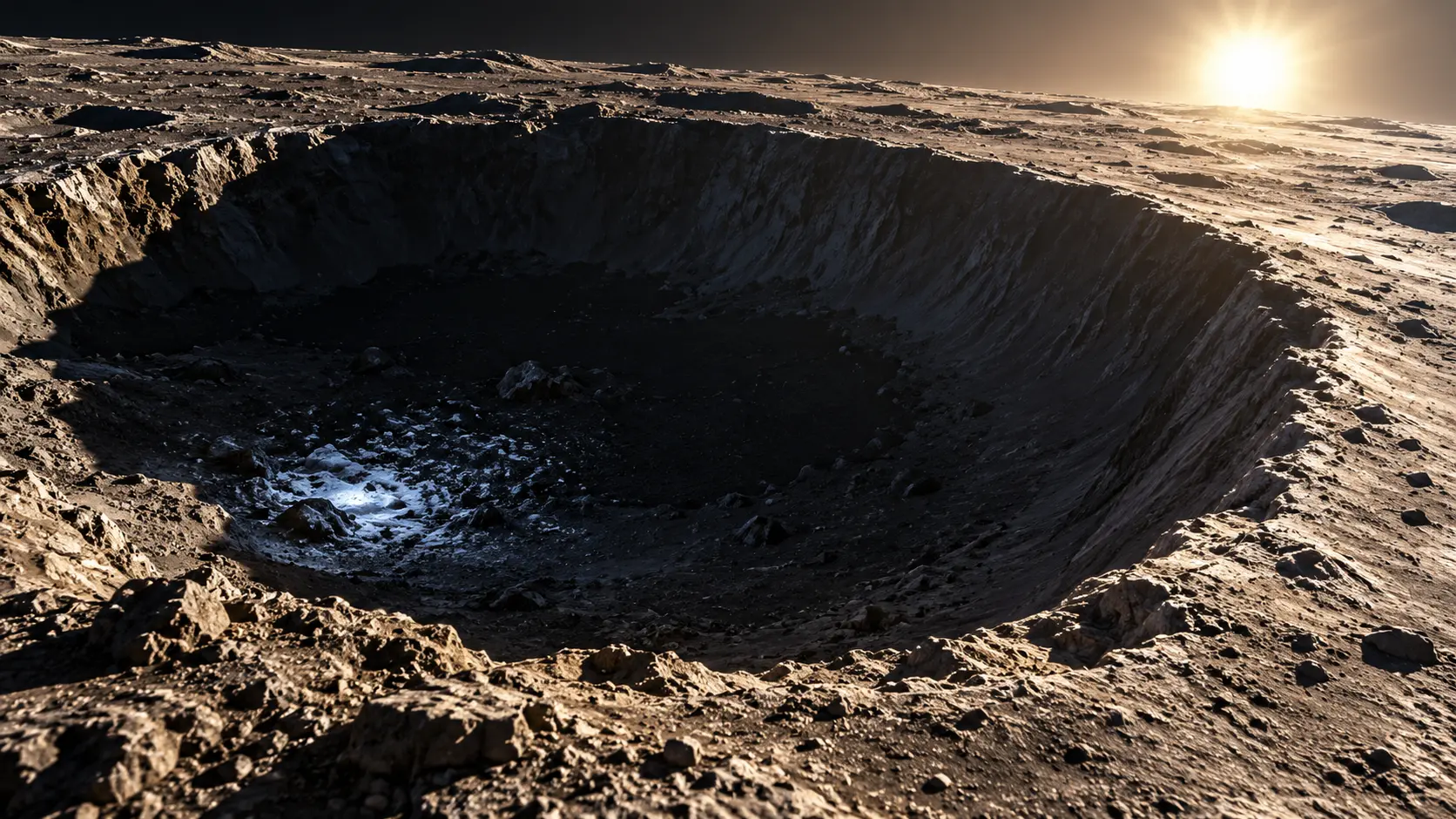
Mercury is the closest planet to the Sun, and it has water ice. The ice isn’t spread across the planet like a snowy landscape. It is tucked into deep craters near the poles, where parts of the ground never receive direct sunlight.
That gives Mercury a remarkable temperature split. Sunlit ground can reach about 430°C (800°F). Inside certain polar craters, temperatures remain cold enough for ice to last. The same world can host blistering rock and a natural deep-freeze.
How can anything stay frozen that close to the Sun?
Mercury’s position is only part of the story. Its rotation axis is tilted by about two degrees, according to NASA’s Mercury facts. The Sun therefore stays low on the horizon near the poles. Inside some impact craters, tall walls block it altogether.
Those sheltered pockets are called cold traps. They do not go through an ordinary sunrise and sunset. Without direct sunlight heating the floor, some remain below roughly 100 kelvins, about −173°C (−280°F). NASA’s analysis of the polar temperatures identifies the coldest places as suitable for exposed water ice.
Mercury also has scarcely any atmosphere to redistribute heat. Its sunlit and shadowed surfaces can end up at dramatically different temperatures. Calling the entire planet “too hot for ice” overlooks the places where sunlight cannot reach.
Radar spotted something odd decades before the spacecraft did
In the early 1990s, Earth-based radar observations revealed unexpectedly reflective patches near Mercury’s poles. Water ice was a serious possibility, but radar brightness alone was not proof. Other materials can reflect radar strongly, too. NASA’s 2012 archive of the radar evidence traces the first detections to 1992.
NASA’s MESSENGER spacecraft, which began orbiting Mercury in 2011, brought several kinds of evidence together. A neutron spectrometer measured a signal consistent with abundant hydrogen in the radar-bright deposits. Hydrogen is part of water, making that result especially useful. Radar observations, topography and temperature modeling pointed toward the same answer.
NASA announced the combined findings in November 2012, describing compelling evidence for substantial polar water ice. No probe scooped up a block of Mercury ice. Instead, separate measurements reinforced an explanation scientists had suspected for years.
Some ice is exposed. Other deposits are buried.
The coldest craters may keep ice stable right at the surface. In Prokofiev crater, for example, researchers mapped shadowed terrain where the temperatures and bright radar returns support surface ice. Elsewhere, the conditions are a little warmer, even without direct sunlight.
In those slightly warmer places, water ice can remain stable under a layer of darker material. NASA’s explanation of MESSENGER’s neutron measurements describes an insulating cover roughly 10 to 20 centimeters thick across many north-polar deposits. A separate NASA look at Berlioz crater explains why ice there is expected beneath the surface rather than sitting out in the open.
Scientists have suggested that the darker covering includes carbon-rich compounds, but its composition is less certain than the evidence for ice itself. Mercury’s poles are not one uniform frozen region. Small changes in crater shape and temperature can change where ice survives.
Where did Mercury’s water come from?
One possibility is that comet and asteroid impacts delivered water-bearing material. NASA scientists have discussed that explanation, while leaving room for more than one source and a complicated history of delivery and loss. The MESSENGER team’s announcement connected the dark material with impact-delivered volatile compounds, but it did not date every patch of ice or identify a single delivery event.
Nor does the discovery mean liquid water is flowing across Mercury today. These deposits survive because certain places stay cold. The difference between a sunny surface and the dark bottom of a crater is enough to change the chemistry and history of the ground.
Mercury shares the solar system with another planet that defies a familiar expectation: on Venus, one rotation takes longer than one trip around the Sun. On Mercury, the surprise is closer to the ground. At the right location, even the nearest planet to the Sun can hold ice.