
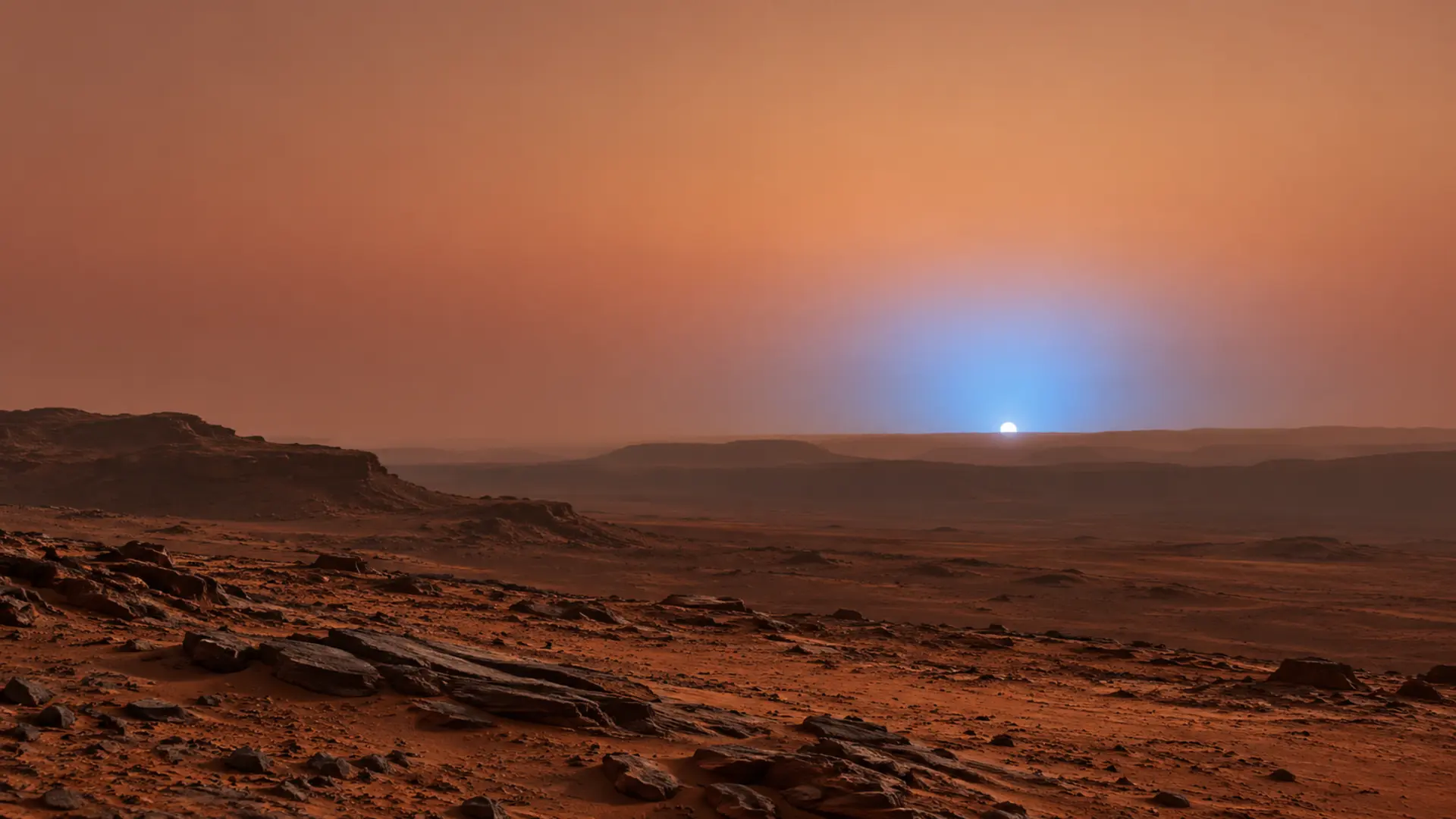
Mars has spent centuries building a reputation around one color. Its soil is rusty, its daylight sky is dusty, and even its nickname is the Red Planet. Then the Sun drops toward the horizon and a cool blue glow gathers around it.
That does not mean the entire Martian sky flips blue at sunset. The effect is concentrated close to the Sun, surrounded by a much broader sky of muted yellow, orange and rust. It is a small patch of color with a surprisingly useful story to tell.
Blue, but only near the Sun
Earth’s clear atmosphere scatters short blue wavelengths widely, which is why our daytime sky looks blue. Mars runs on a different combination of atmosphere and particles. Its air is thin, but it carries extremely fine dust. According to NASA’s guide to Martian sunrises and sunsets, blue light passes through that dusty air slightly more efficiently and stays closer to the direction of the Sun when it scatters.
Yellow and red light spread more broadly across the sky. The result is not a simple color reversal of an Earth sunset. It is a blue halo near the Sun inside a larger, warm-toned sky.
Several robots have watched the show
NASA’s Viking 1 lander returned an early surface view of a Martian sunset in 1976. Spirit photographed a blue glow above the setting Sun in 2005, and Curiosity recorded a color sunset from Gale Crater in 2015. That Curiosity sequence was calibrated so the colors would resemble what a person standing on Mars might see.
The observations did not stop there. Perseverance’s Mastcam-Z captured its first Martian sunset in November 2021. InSight later photographed a sunrise and sunset on April 10, 2022; NASA produced versions calibrated to approximate human-eye color.
The amount of dust changes the view
The blue is not equally vivid every evening. Perseverance’s 2021 sunset looked more subdued than average because the atmosphere contained less dust. Local weather, particle size and the quantity of suspended material can all change how much light is scattered.
Camera processing matters too. Rover images may be white-balanced or color-calibrated to remove instrument effects and approximate human vision. That is why a scientifically useful caption is more valuable than a dramatic image shared without context.
A sunset can double as an atmosphere test
For planetary scientists, twilight images are not just postcards. NASA uses them to estimate how high dust extends into the Martian atmosphere and to look for dust or ice clouds. High-altitude particles can scatter sunlight around toward the night side of Mars, leaving a faint twilight glow for as long as two hours before sunrise or after sunset.
That long afterglow turns a quiet landscape into a remote-sensing experiment. The colors reveal what is floating overhead, while their intensity hints at how conditions have changed. Mars still earns its red nickname, but near sunset, its dust makes room for blue.
Planetary clocks can be just as counterintuitive as planetary colors: on nearby Venus, one rotation takes longer than one trip around the Sun.