
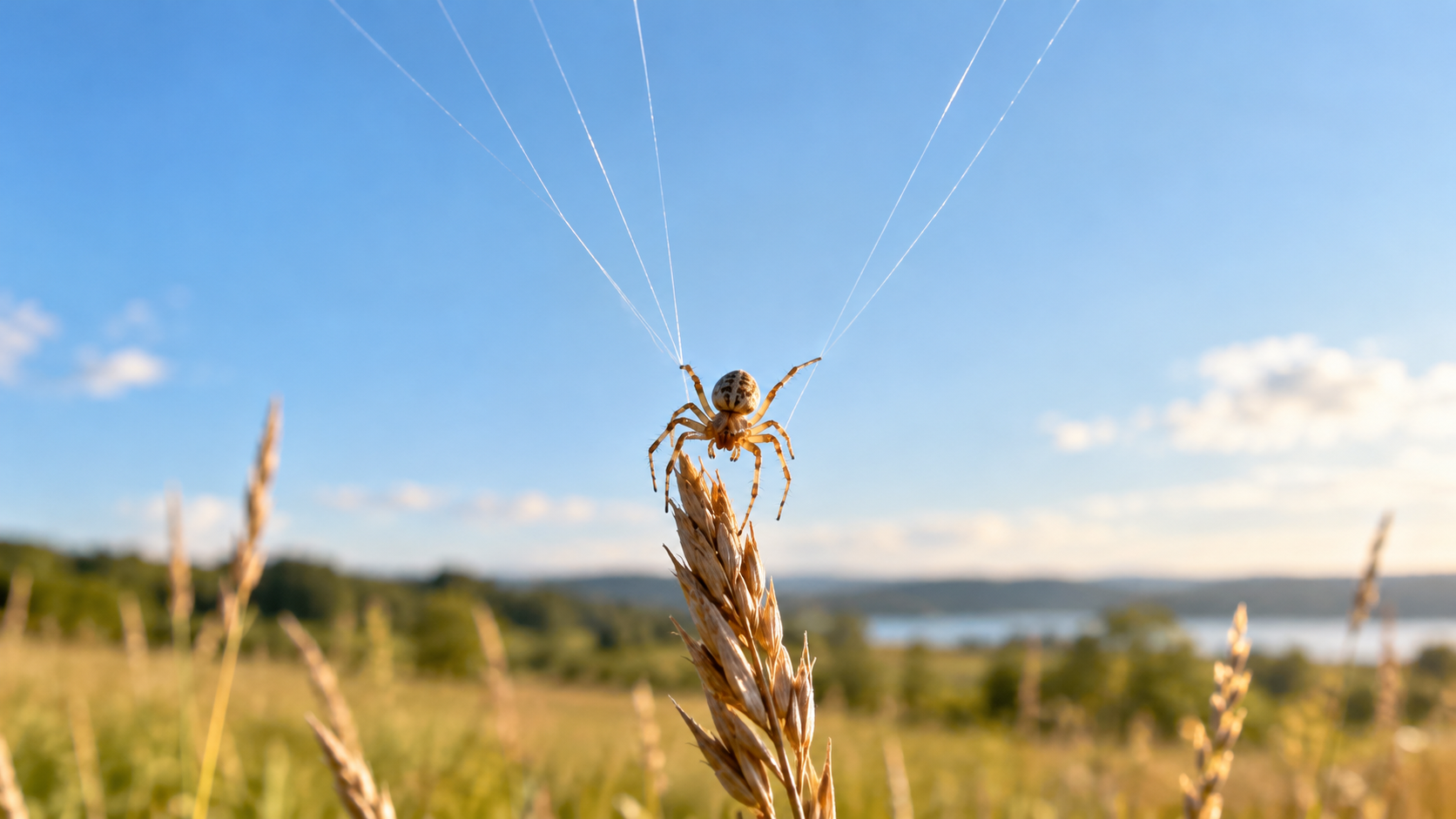
Spiders can take to the sky without wings. Some climb to the top of a plant, lift their bodies, release strands of silk and drift away. This trick is called ballooning. The surprising part? Moving air is not the only force that can help get them off the ground. Electricity in the atmosphere can play a role, too.
Yes, the air has an electric field. And at least some spiders appear able to sense it. Researchers have even shown that electric fields alone can trigger takeoff in the laboratory. The weather forecast, apparently, has an invisible chapter.
Spiders do not fly. They balloon.
Unlike insects with wings, a ballooning spider cannot flap its way upward. Instead, it climbs onto a raised surface, adopts a tiptoe-like posture and lets out fine silk threads. Forces acting on those threads can lift the spider into the air and carry it elsewhere. The silk does not turn into a conventional parachute, and the spider does not steer like a bird.
This is a dispersal strategy: moving away from a crowded or unsuitable location may help spiders reach new habitat. Tiny spiders are especially well known for ballooning, although this behavior is not limited to one species. Wind is an important part of the process, but it has long been difficult to explain every observed takeoff using air movement alone.
There is electricity in ordinary outdoor air
Even beneath clear skies, the atmosphere carries an electrical potential gradient between Earth and the air above it. This is part of the planet’s global atmospheric electrical circuit, not a miniature lightning storm following every spider around.
A spider releasing several silk strands creates an unusual setup: each strand is extremely light, and electrical forces can act on silk. Scientists wanted to know whether natural-strength electrical fields might influence the animal’s decision to launch, as well as provide forces that contribute to lifting it.
What the University of Bristol experiment found
In a 2018 study published in Current Biology, researchers Erica Morley and Daniel Robert tested small linyphiid spiders under controlled electrical conditions. They applied vertical electric fields comparable to those present in the atmosphere and observed the spiders’ ballooning behavior.
When the researchers switched the electric field on, spiders adopted takeoff behavior and could become airborne even without moving air. Switching the field off affected their vertical movement. That was strong experimental evidence that atmospheric electricity could be more than background scenery.
The team also studied the fine sensory hairs on the spiders, called trichobothria. Those hairs moved in response to weak electrical fields, giving the animals a potential means of detecting conditions that humans cannot feel. The University of Bristol’s account of the research describes the spiders responding to the field rather than simply being blown around.
Does that mean spiders can fly without wind?
Under the experimental conditions, electric fields could trigger ballooning and contribute enough force for takeoff without airflow. That does not mean every airborne spider rides electricity alone, or that wind has suddenly been fired from its job. In the wild, moving air, atmospheric electrical conditions, spider size, silk geometry and local weather may all matter.
The distinction matters because laboratory demonstrations do not automatically tell us how much of every real-world journey is powered by each force. The research adds an electrical mechanism to an already complicated biological story; it does not replace aerodynamics with magic.
An invisible signal with real consequences
Why would a spider care about electric fields? The researchers suggested that electric conditions could give spiders useful information about when to launch. Their work helped explain why ballooning sometimes occurs under surprisingly calm conditions and opened new questions about how small animals detect atmospheric forces.
There is plenty more to learn about how frequently spiders rely on those signals outdoors, across species and changing weather. But the central discovery is odd enough on its own: a wingless animal can sense electricity in the air, release silk and start an aerial journey.
For another small-animal behavior that turned out to be more complicated than expected, researchers have also observed bumblebees rolling wooden balls without a food reward. Nature has a rather deep bench of surprises.