
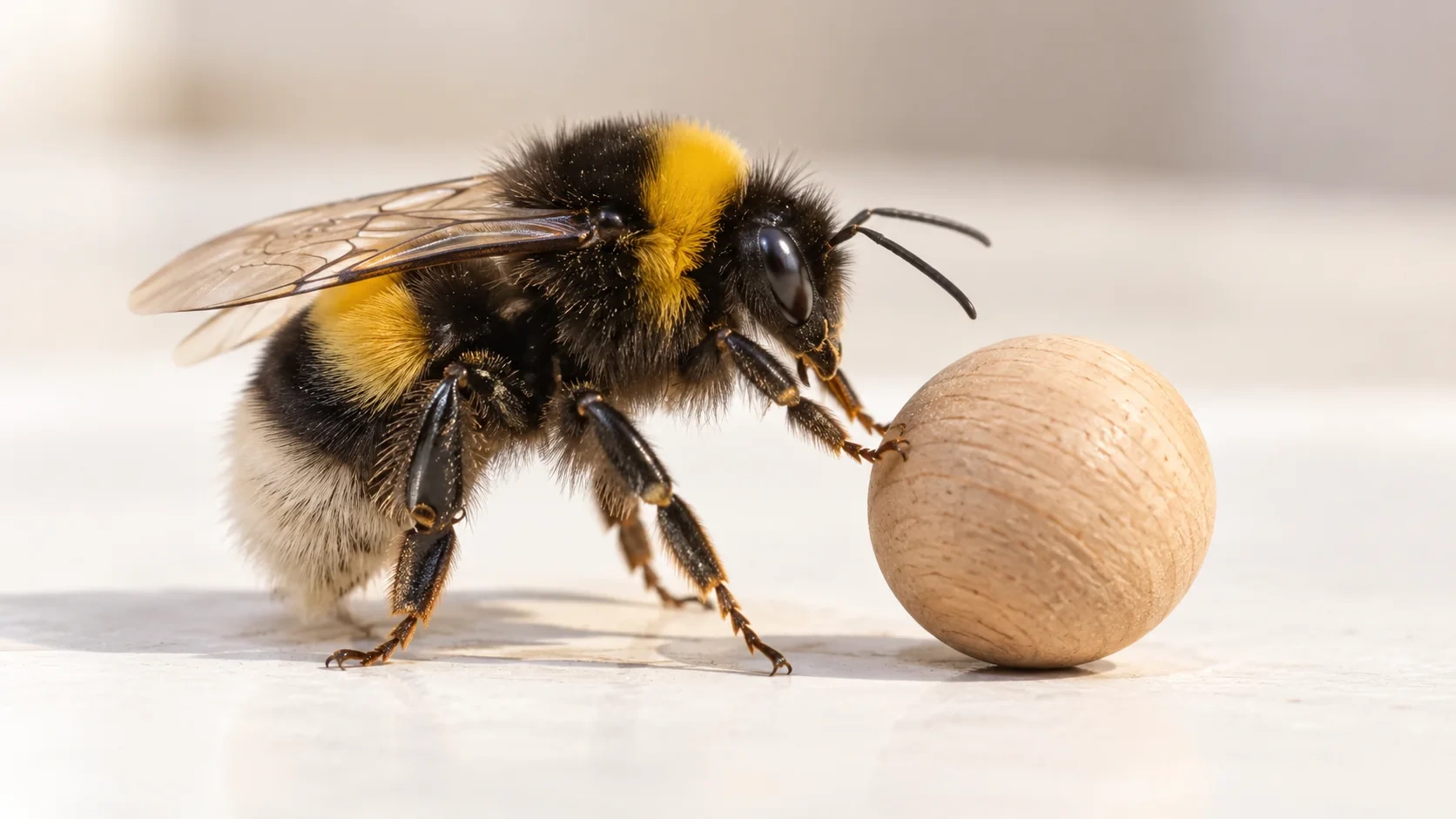
Bumblebees will roll tiny wooden balls even when there is no sugar reward waiting at the end. In laboratory experiments, bees sometimes left a clear route to food just to push little balls around. Scientists wanted to know whether this was a rare example of an insect playing.
It looks like miniature soccer practice, except the bees were not trying to score a goal. The researchers deliberately made sure the balls were optional.
The bees did not need to touch the balls
In a 2022 paper in Animal Behaviour, researchers studied buff-tailed bumblebees (Bombus terrestris) in an experimental arena. The bees could walk directly between their nest and feeding area. Alongside that route were small wooden balls, some of which could be moved.
The insects were not trained to roll the balls and received no food for doing it. Nevertheless, 45 bees collectively performed 910 ball-rolling actions. Individual bees rolled balls repeatedly, sometimes across several days. One bee recorded as many as 117 rolls over the study.
The setup mattered: a bee accidentally bumping into something while searching for nectar tells us little. A bee taking an optional detour to move an object again and again is a different puzzle.
How do scientists decide what counts as play?
The researchers compared the behavior with five established behavioral criteria for animal play. It had no apparent immediate survival function, appeared rewarding in itself, differed from ordinary functional actions, was repeated without becoming a rigid ritual, and occurred in relaxed conditions.
They also checked alternatives. The bees had enough space to get past the objects, so this did not look like necessary housekeeping. Rolling did not get them food. Nor did the observations fit normal mating or defensive behavior.
That is more evidence than simply watching a funny-looking insect video and declaring the bees had invented bowling.
A room-color test offered another clue
In another experiment, bees encountered two differently colored chambers. One was associated with balls they could roll. Later, when both chambers were empty, the bees favored the color previously linked to rolling.
The authors interpreted that learned preference as evidence that the activity was rewarding. It strengthened the case for play because the attraction was not tied to getting a meal.
It does not, however, allow anyone to interview a bumblebee about how much fun it had. The experiments measured behavior and preferences, not a private emotional experience.
Young bees got more turns
Younger bees rolled more balls than older ones, and males spent longer rolling individual balls than females. Those differences echo some patterns of play observed in mammals and birds, though the researchers were studying one bumblebee species under laboratory conditions.
There is a useful distinction here. A 2017 study in Science had already shown that bumblebees could learn to move a ball into a target location for a sugar reward. The 2022 work tested something more surprising: ball rolling without the prize.
Does this mean bees play in the wild?
Not necessarily. The study did not establish that wild bumblebees routinely find round objects for recreation, nor did it settle the larger debate about insect consciousness. Its narrower finding is impressive enough: in a controlled experiment, the bees’ voluntary ball rolling met recognized criteria for play.
BiggleBit has already covered another insect surprise: butterflies can taste with their feet. Between that and a bumblebee’s enthusiasm for moving a tiny wooden sphere, insects clearly have more going on than their size suggests.
The bees were not lining up for a championship. They just kept rolling, even when the sugar was somewhere else.