
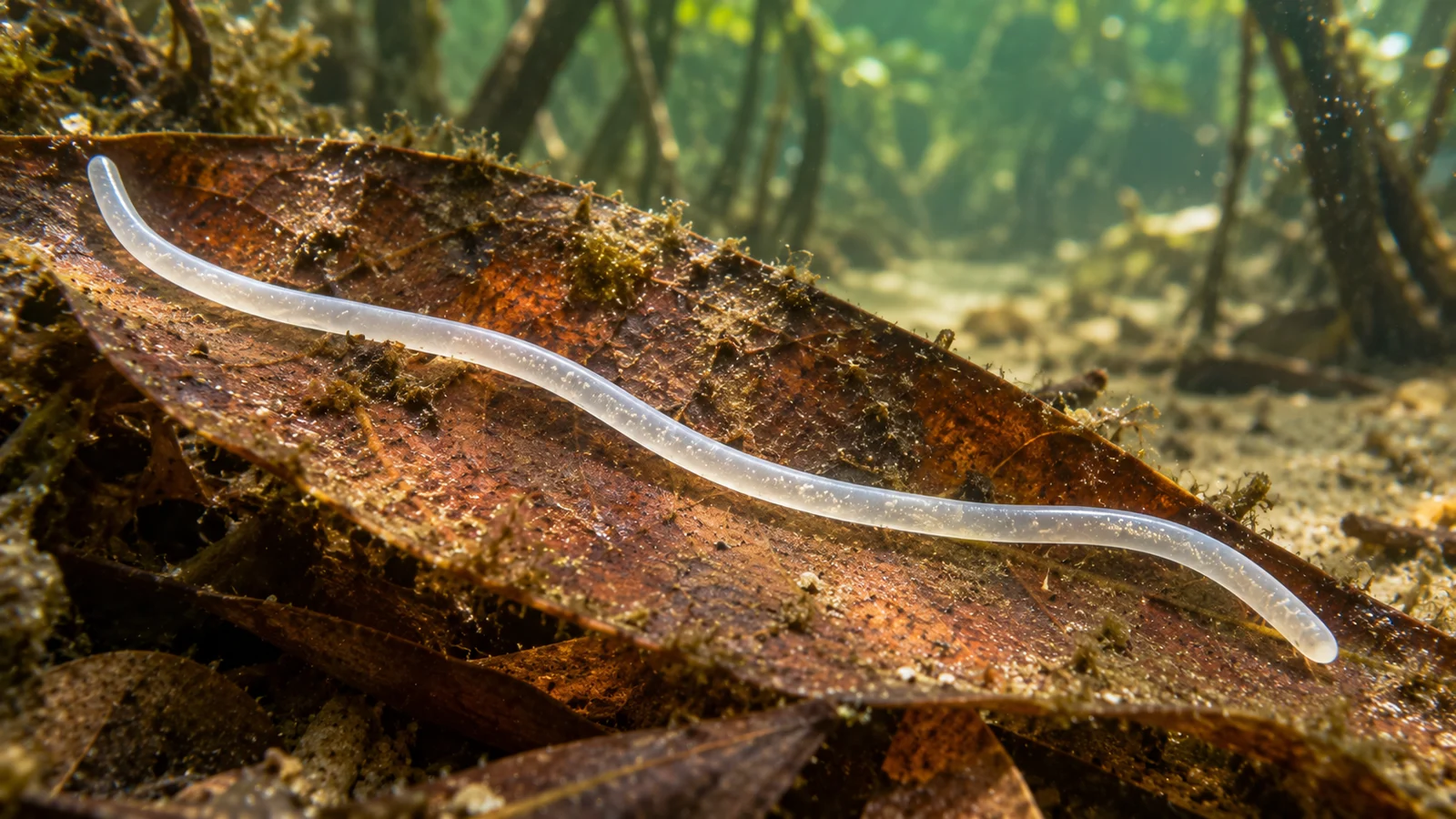
Most bacteria disappear into the background until a microscope gets involved. Thiomargarita magnifica breaks that expectation. One of its cells can be roughly a centimeter long, and some specimens grow even longer. That’s big enough to spot with the naked eye.
The organism was identified in mangrove waters in Guadeloupe, in the Caribbean. At first, its pale, thread-like shape looked like something you might mistake for a fiber on a leaf. Scientists eventually established that each filament was a single bacterium.
One thread can be one enormous cell
In a 2022 study in Science, researchers reported an average cell length greater than 9,000 micrometers, or about nine millimeters. The Natural History Museum describes specimens reaching around two centimeters.
That is extraordinary for a bacterium, but size alone doesn’t make something multicellular. A long filament could be a chain of many cells. The scientists needed to know whether they were looking at a colony or one continuous living unit.
They used fluorescence, electron microscopy and X-ray imaging to examine the structures. The Berkeley Lab team’s account explains that the long white filaments were indeed individual bacterial cells. Some could be handled with tweezers.
The first clue came from a mangrove swamp
Marine biologist Olivier Gros first noticed the unusual white filaments while investigating sulfur-rich mangrove sediments in Guadeloupe in 2009. They were associated with submerged plant material. At the time, the appearance alone didn’t reveal what kind of organism he had found.
Follow-up work helped identify it as a sulfur-oxidizing bacterium in the genus Thiomargarita. Researchers then studied its genetic material, internal organization and life cycle. The scientific description appeared in Science in 2022, more than a decade after that first encounter.
It’s an instructive gap between noticing something strange and understanding it. A visible white thread was easy to collect; explaining the biology inside it took years and several kinds of laboratory equipment.
Its DNA is stored in tiny compartments
The size was only half the surprise. Bacteria generally lack a membrane-bound nucleus like the ones found in animal and plant cells. But this giant species keeps much of its genetic material inside numerous smaller membrane-bound structures spread through the cell.
The researchers nicknamed those compartments pepins, after small fruit seeds. According to the original study record from the U.S. Department of Energy’s Joint Genome Institute, the cells can contain more than half a million genome copies. Those structures also contain machinery involved in making proteins.
That doesn’t turn the bacterium into an animal cell or mean the pepins are identical to a true cell nucleus. It shows that bacterial cell organization can be more elaborate than the usual textbook sketch suggests.
Why a giant bacterium still raises questions
The species lives in a chemically busy mangrove environment and uses chemical energy rather than sunlight to make organic material, a process known as chemosynthesis. But researchers are still investigating exactly how it interacts with other organisms and how its unusual internal compartments develop.
The same broad lesson applies to other overlooked microbial habitats. Scientists studying Antarctica’s iron-rich Blood Falls brine, for instance, have also found unexpected biology in a place that looks unpromising from the outside. The organisms and environments are different; the reminder is that there is a lot of microbial life we have barely described.
Thiomargarita magnifica is big enough to see without magnification. Understanding why a bacterium gets that large, and what its internal structures are doing, still requires looking much closer.