
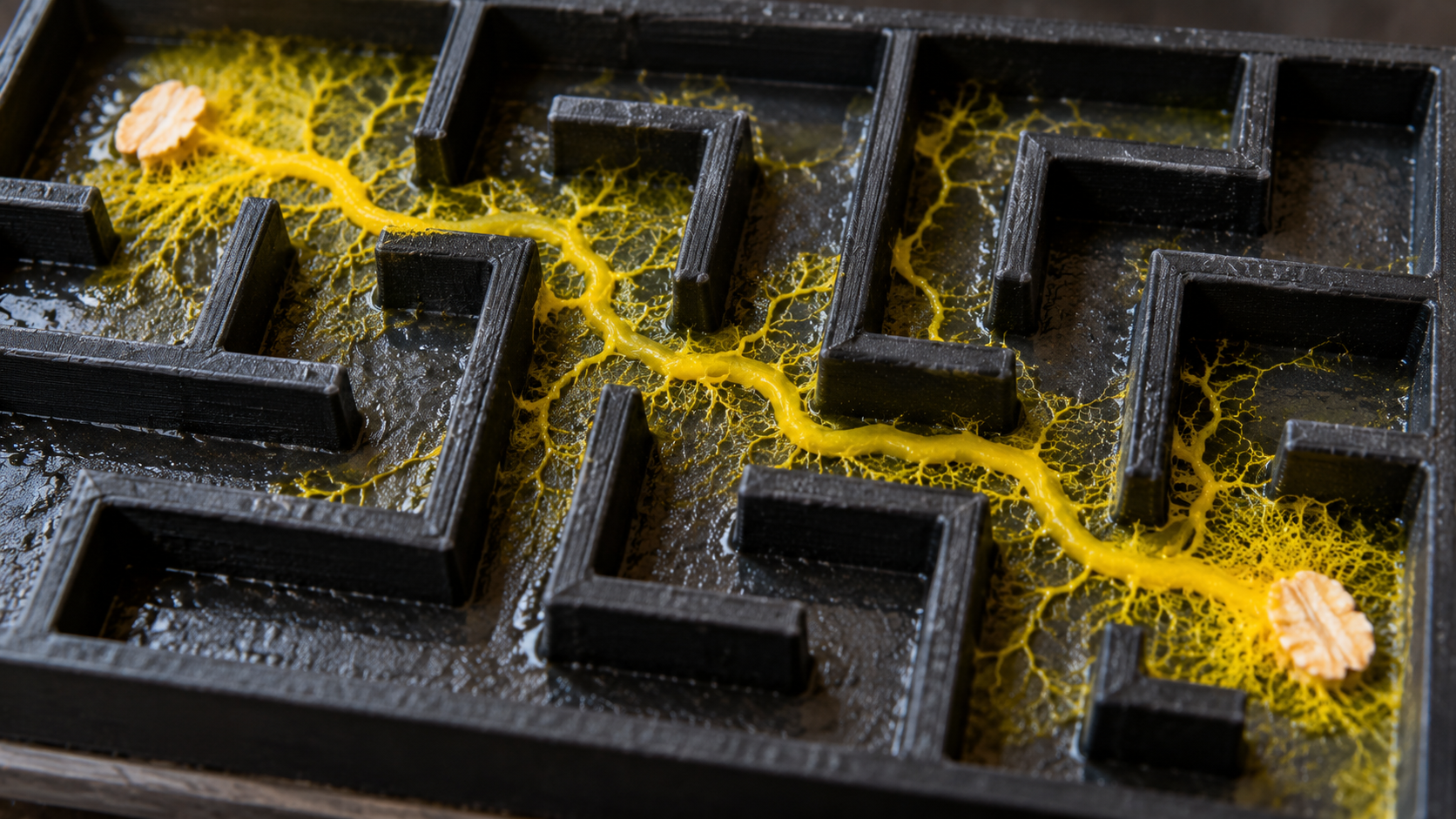
A slime mold can work through a maze without a brain, a nervous system or even a pair of eyes. It does not think its way around the walls. It changes its body until a short connection remains.
That distinction makes the experiment more interesting, not less. A sprawling living cell can solve a physical routing problem by growing and retracting its own network.
Researchers put one organism into a maze
In a 2000 Nature experiment, researchers used Physarum polycephalum, a slime mold that forms a branching network of tubes across a moist surface. They let the organism occupy a maze on agar and then placed food at two positions.
Over time, the network changed. Much of the material in longer or less useful corridors withdrew, while a connection along the shortest available route remained. The result looked like pathfinding, but it was achieved by a living network rather than a computer running directions.
The slime mold rearranges its plumbing
The flowing material inside Physarum travels through tubes whose thickness and layout change with conditions. In a follow-up 2001 Biophysical Chemistry study, the researchers described how dead-end portions shrank and a short, thick tube remained between the nutrient sites.
The organism did not receive a bird’s-eye view of the maze. The setup allowed its network to expand and then favor pathways that proved useful for transporting material. That is very different from giving it a puzzle book.
Shortest isn’t always the safest
Later experiments complicated the story. Physarum generally avoids light. In a 2007 Physical Review Letters study, illuminating parts of a test area changed the network’s route between food sources. The organism could favor a less exposed path rather than a strictly shortest one.
Researchers described this as minimum-risk pathfinding in their experimental setup. It is evidence that the network responds to conditions, not proof that the slime mold has a conscious opinion about danger.
What the experiment does and doesn’t show
A slime mold is not secretly doing geometry homework. Its growth, internal flow and response to food and light produce an efficient shape under the conditions researchers created. Different mazes and environments can produce different patterns, so no one should claim it finds the best path in every possible puzzle.
Still, the result matters to biologists and engineers. A natural system can optimize a network through local changes, without a central control room issuing instructions.
No brain, still useful
BiggleBit has covered how crows can plan a specific number of calls, which involves a very different nervous system. The slime mold’s achievement is stranger in its own way: it makes the map by becoming the map.
Sources: Nakagaki et al., Nature (2000); Biophysical Chemistry (2001); Physical Review Letters (2007).