
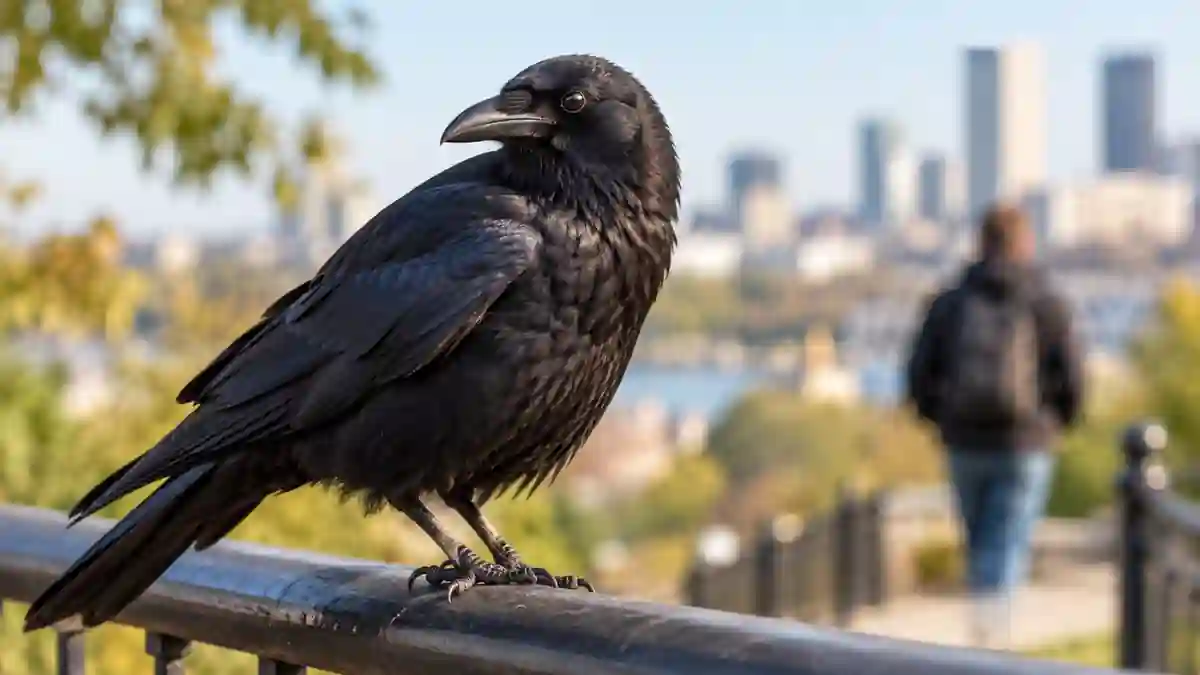
If you annoy a crow badly enough, there is a decent chance the crow will remember your face. Worse for your reputation, other crows can learn about you too.
That sounds like folklore invented by someone who got yelled at in a parking lot by a black bird. It is not. Experiments with wild American crows found that the birds can learn a specific human face associated with a bad experience, recognize it later, and spread that information socially.
So, no, science did not prove that a crow sits on a power line plotting revenge. But it did prove something almost as unsettling: your face can become useful neighborhood information.
The crow face-recognition experiment was wonderfully weird
Researchers at the University of Washington tested wild American crows using distinctive human masks. In the best-known experiment, researchers wore a particular “dangerous” mask while trapping, banding and releasing crows. That gave the birds a very memorable reason to associate that face with trouble.
Later, the crows reacted to the dangerous mask by scolding it. The important part is that the response was not limited to the birds that had personally been captured.
In a Proceedings of the Royal Society B study, researchers found evidence for several kinds of learning. Crows that had been trapped learned directly. Other crows appeared to learn by watching their neighbors. Young crows also learned from their parents.
At one study site, scolding of the dangerous face doubled in frequency and spread at least 1.2 kilometers from where the experiment began over a five-year period.
That is not just memory. That is a bad Yelp review with wings.
Crows can distinguish familiar human faces
The obvious question is whether the birds were merely reacting to a vague category such as “human wearing strange mask.” Brain-imaging work suggests the recognition is more specific than that.
A separate PNAS study exposed crows to familiar human faces they had previously associated with either capture or caretaking. The birds showed different patterns of brain activity when viewing threatening versus caring faces, including activity in regions involved in attention, learning, fear and motivation.
The researchers concluded that crows can discriminate among familiar human faces, associate those faces with previous experiences, and remember the connection. The University of Washington’s summary of the research notes that the birds can retain these associations for years.
In other words, “all humans look alike” is apparently not a defense that works on crows.
Do crows really hold grudges?
“Crows hold grudges” is the fun version of the story, but it goes a little beyond what the experiments actually measured.
The research shows long-lasting recognition of people associated with danger and a defensive response to those faces. It also shows that information about a dangerous person can spread through a crow community. What it does not measure is a human-style emotional grudge involving resentment, spite or a tiny crow notebook labeled PEOPLE I HATE.
The safer description is also plenty strange: crows remember threat-associated human faces and change their behavior when those faces appear again.
Your reputation can spread to crows that never met you
This may be the strangest part. Social learning means a crow does not necessarily need its own unpleasant encounter with a person to decide that person is worth yelling about.
A bird can pick up the warning from other birds. Parents can pass the response to young crows. Over time, knowledge of a particular dangerous-looking person can move beyond the birds involved in the original event.
For animals living around people, that makes a lot of evolutionary sense. Humans can be food sources, harmless background noise, caretakers, or genuine threats. Remembering which individual belongs in which category is useful. Learning from another crow is even cheaper than finding out personally.
Cities keep producing examples of animals adapting to surprisingly specific human environments. Even Manhattan rats form distinct uptown and downtown genetic clusters. Apparently urban wildlife is paying much closer attention to us than we are to it.
So yes, a crow might remember you
If a crow has a bad experience with a particular human face, it can remember that face for years. Other crows can learn the warning. Young birds can pick it up from their parents. The information can spread through the local population.
Call it a grudge if you want. The scientists would probably prefer “long-term recognition of a learned threat.”
The crow does not care what you call it. It knows what you look like.