
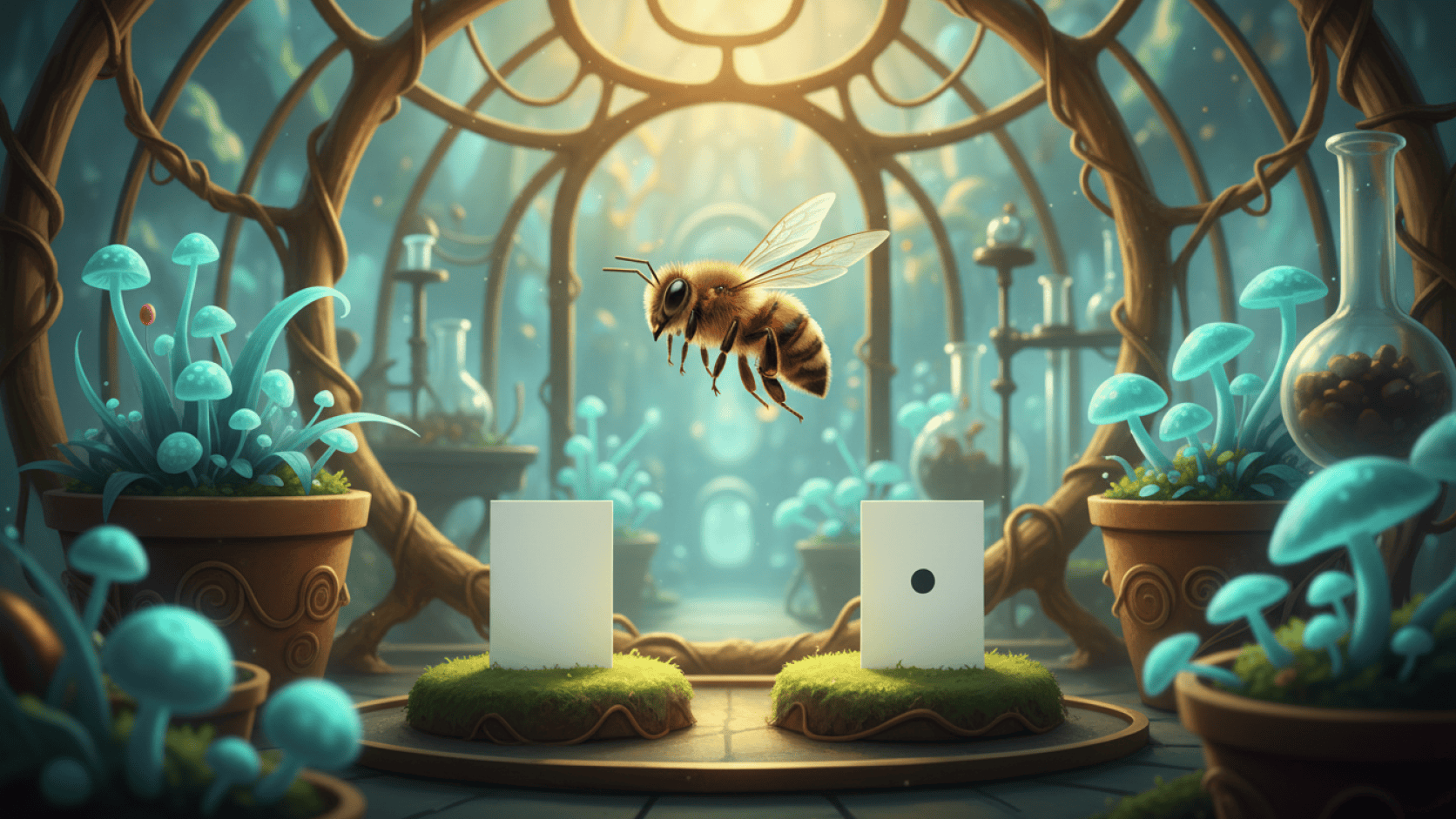
Honeybees can learn to treat zero as less than one. In experiments, the insects picked out empty displays as representing a smaller quantity than displays containing one or more shapes.
No, they weren’t writing equations on a honeycomb. But recognizing that an empty set belongs at the bottom of a number sequence is a surprisingly sophisticated feat for an insect.
Researchers taught bees to compare quantities
In a 2018 study published in Science, researchers trained individual honeybees to choose the larger or smaller quantity from displays containing one to six shapes. The visual patterns varied, so the bees couldn’t simply memorize one picture.
After training, the scientists introduced a new situation: an empty display with no items at all.
Bees trained with the less-than rule extended their learned ordering to the empty set, treating zero as smaller than a positive quantity. That was a behavioral test of ordering, not written numerals or human-style arithmetic.
What exactly does “understand zero” mean?
The evidence supported a basic, nonsymbolic concept of zero. The bees could place an empty set in a relationship to other quantities.
That is not the same as understanding the written numeral 0 or doing advanced mathematics. The researchers were measuring behavior in a controlled choice task, not giving bees a school exam.
A Nature account of the experiments noted that this put bees alongside a small group of animals shown to handle an abstract notion of nothingness.
Why might counting-like abilities help a bee?
Bees make repeated decisions while exploring flowers and navigating complicated surroundings. Discriminating quantities or visual patterns may help them choose among options, even though the laboratory setup was not a natural flower patch.
Scientists investigate such tasks because they show how much a small nervous system can learn and generalize.
A 2026 analysis in Proceedings of the Royal Society B revisited a broader debate: are bees responding to quantities, or just to visual patterns in the tests? After accounting for the spatial frequencies that bees can actually see, researchers found evidence favoring numerical processing over that particular visual-pattern explanation. The 2026 work did not directly repeat the empty-display experiment, so the specific zero result still comes from the 2018 study.
An empty box is still information
BiggleBit has covered another surprising numerical trick: crows can deliberately produce a chosen number of calls. The bee experiment explored a different part of the story—whether zero belongs on the same mental scale as one and two.
For these bees, a display containing absolutely nothing wasn’t just blank. It was the smallest answer.