
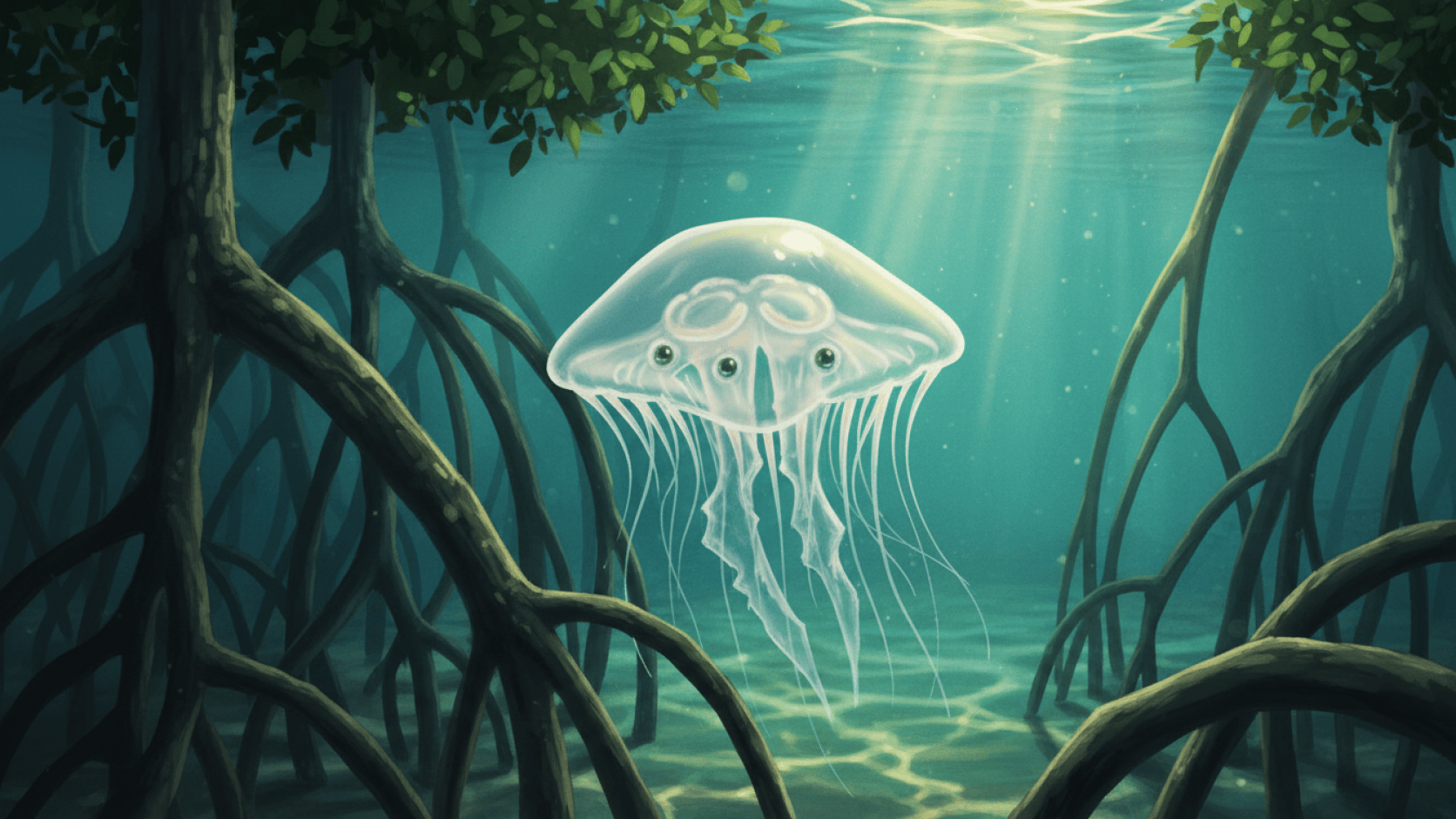
A box jellyfish can learn to avoid obstacles, despite having no conventional centralized brain. Researchers watched tiny Caribbean box jellyfish change how they swam after repeated collisions in a laboratory tank.
That does not make a jellyfish a floating genius. It does mean learning can happen in a nervous system arranged very differently from ours.
Life among mangrove roots is an obstacle course
Tripedalia cystophora is a small box jellyfish that hunts in mangrove habitats. It needs to navigate around roots while finding food, and it has surprisingly sophisticated eyes for an animal without a centralized brain.
Researchers created a test tank with striped walls that visually resembled mangrove roots at different distances. The jellyfish had to decide when to turn instead of swimming into a barrier.
Getting bumped changed what the jellyfish did next
In a 2023 study in Current Biology, the animals gradually improved their obstacle-avoidance behavior when visual patterns were paired with physical collisions.
In the research team’s account of the tank experiments, the jellyfish took only a few minutes to adjust. They kept roughly 50 percent farther from the striped walls and bumped into them about half as often. The researchers described just three to five failed evasive attempts as enough to change the animals’ behavior. These are laboratory results for one species, not proof that every jellyfish learns every task.
The scientists also tested an isolated rhopalium, one of the jellyfish’s sensory centers, which houses six eyes. After the researchers paired moving stripes with weak electrical pulses that mimicked a collision, the structure began producing avoidance signals in response to those stripes alone. That helped locate the learned response in the jellyfish’s nervous system, rather than relying only on what happened in the tank.
That sensory hardware is stranger than the phrase “six eyes” suggests. A March 2026 study in Scientific Reports described four rhopalia with six eyes each, or 24 eyes altogether. Alongside the lens eyes are smaller pit and slit eyes. The researchers examined how light-sensitive proteins are distributed in these lesser-understood eyes. That adds detail about the jellyfish’s visual system; it was not another test of learning or memory.
No brain does not mean no nervous system
Jellyfish have neurons and sensory structures, even if they do not have a vertebrate-style brain directing everything from one place. That distinction makes the result scientifically interesting.
The team described the behavior as associative learning: the animal’s response to a visual cue changed after that cue was repeatedly linked with a bump.
A Nature report on the research emphasized that the experiment tested a specific jellyfish species under controlled conditions. It did not demonstrate human-like memory or conscious problem-solving.
Sometimes a small circuit is enough
Learning is useful whenever a creature encounters the same hazard again. For a jellyfish moving between underwater roots, even a modest adjustment to when it turns could matter.
BiggleBit has covered another creature with a peculiar nervous system: octopus suckers that sense chemicals by touch. The box jellyfish offers a different surprise.
There is no need for a big head when a little sensory circuit can learn not to hit the wall.