
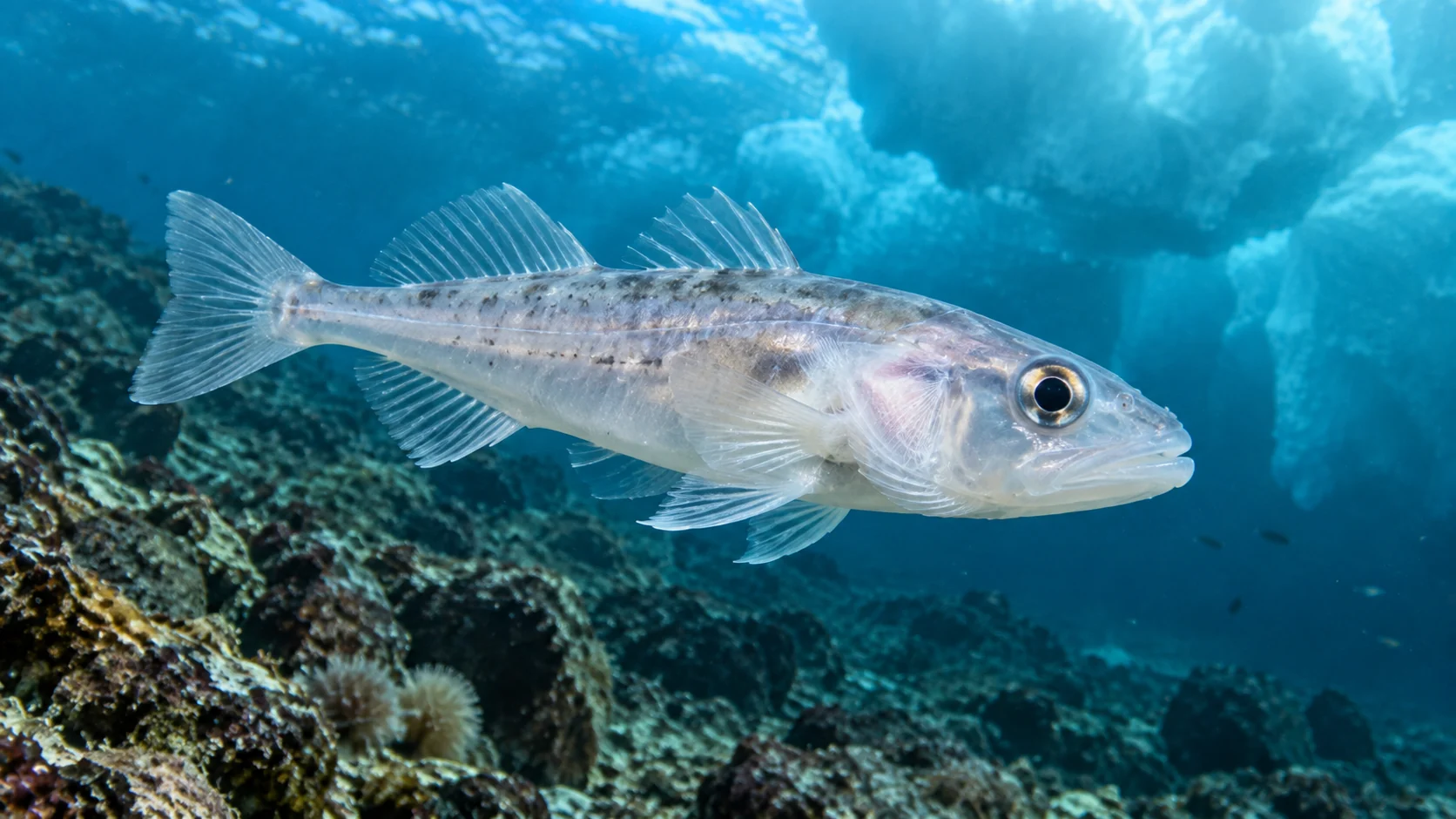
Antarctic icefish have blood so pale it can look almost colorless.
That is not because somebody forgot to turn the saturation up. These fish are the only known vertebrates that have completely lost hemoglobin, the oxygen-carrying protein that gives red blood cells their color.
Most vertebrates would take that development as a fairly serious design problem. Antarctic icefish responded by rebuilding the rest of the circulatory system around it.
Their blood is missing the thing that normally makes blood red
Icefish belong to the family Channichthyidae, a group of Antarctic notothenioid fishes. Unlike other vertebrates, they do not have functional hemoglobin circulating in red blood cells.
The British Antarctic Survey describes icefish as the only vertebrates known to have completely lost their hemoglobins. Without that red respiratory pigment, their blood appears white or nearly colorless.
This is not a cute pigment trick. Hemoglobin normally does the heavy lifting of carrying oxygen through the body. A fish without it has to solve the oxygen-delivery problem some other way.
Cold Antarctic water makes the impossible slightly less impossible
Very cold water can hold more dissolved oxygen than warm water. That matters enormously.
Icefish live in the cold, oxygen-rich Southern Ocean, where oxygen can dissolve directly into their blood plasma. A review of Antarctic notothenioid physiology notes that oxygen carried only in plasma gives icefish roughly a fraction of the oxygen-carrying capacity of their red-blooded relatives.
So the environment gives them a break, but not a free pass. Their blood may contain enough dissolved oxygen to survive, but the fish still need to move an awful lot of plasma to deliver it.
They compensate with oversized plumbing
The solution is basically: if each unit of blood carries less oxygen, move much more blood.
Peer-reviewed work on icefish physiology describes several compensations: enlarged hearts, higher cardiac output, greater blood volume, wide capillaries, and dense vascular networks. A review of Antarctic notothenioid physiology reports that icefish hearts can be much larger than those of comparable red-blooded relatives and that their circulatory systems push substantially greater volumes of blood.
That gives the fish a high-volume, low-pressure delivery system. It is less “efficient oxygen courier” and more “we are sending five trucks because each one is mostly empty.”
Evolution did not necessarily choose the elegant solution
It is tempting to describe hemoglobin loss as a brilliant cold-water adaptation, but researchers are more cautious.
A 2009 review of the hemoglobinless icefish describes the trait as a possible disaptation: the fish lost something normally useful and then evolved compensatory traits that let them survive the consequences.
More recent genomic work has also emphasized that scientists are still investigating exactly how and why the loss persisted. A 2023 British Antarctic Survey summary of a Nature Communications genomics study notes that the loss was only survivable because of the unusual Antarctic environment plus additional physiological changes.
Evolution is not an engineer drawing the cleanest blueprint. Sometimes it breaks a part, then keeps modifying everything around the break until the organism works well enough.
The strangest part is that it works at all
Icefish are not weak prototypes barely hanging on. They are a successful Antarctic lineage with a circulatory system built around a condition that would be catastrophic for most vertebrates.
They have pale blood, enormous cardiovascular compensation, and an environment cold enough to make the whole arrangement possible.
BiggleBit has already covered a jellyfish that can reverse its development and sea slugs that steal chloroplasts. Antarctic icefish bring a different lesson: apparently you can remove one of vertebrate physiology’s most famous proteins and then just redesign the plumbing.