
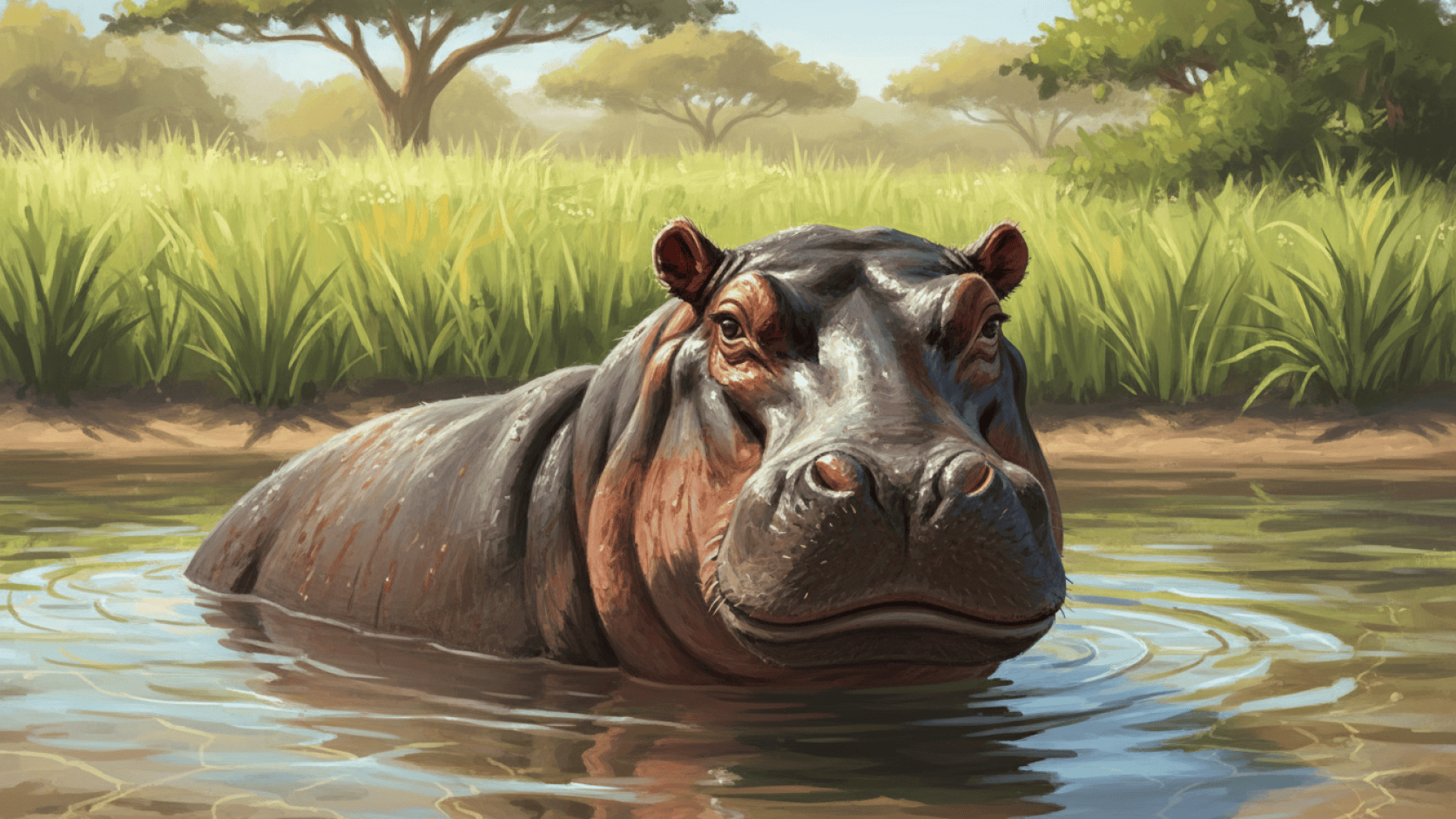
Hippos do not sweat blood. Their skin releases a fluid that can turn bright red, then brown, as unusual pigments change chemically. The color is dramatic enough to inspire the blood-sweat nickname, but it isn’t blood.
The chemistry behind it is more interesting than the myth.
The secretion changes color after it appears
Fresh hippo skin secretion can begin nearly colorless. Within minutes, the fluid develops a reddish hue; later it turns browner as the pigments polymerize, meaning the reactive molecules link into larger structures. Researchers also found that the compounds were unstable when isolated, while something in the hippo’s own mucus appeared to slow that change for hours.
Researchers isolated and studied the pigments responsible, identifying a red compound called hipposudoric acid and an orange compound called norhipposudoric acid.
A 2004 study in Nature described the chemistry and the pigments’ protective properties.
It’s not a version of human sweat
The fluid is often called sweat in headlines, but hippos do not use ordinary human-style sweat glands to cool themselves in the same way people do. Their skin secretion is a different biological system.
That distinction matters when the story gets shortened to “hippos sweat blood.” Neither half is a good literal description.
The pigments help protect the skin
Researchers found that the unusual pigments could absorb ultraviolet and visible light, suggesting a sunscreen-like function.
Experiments also showed antibacterial properties for at least one of the compounds under laboratory conditions. That combination may be useful for an animal whose sensitive skin spends time both in water and exposed to the Sun.
An American Chemical Society account explains how scientists collected and analyzed the fluid to understand its unusual color.
Evolution made its own skincare product
It’s tempting to give the fluid a human cosmetic label, but the laboratory findings don’t mean a hippo is applying a bottle of SPF 50 or that its skin never suffers damage.
They show that a biological secretion can serve protective functions in an unusual environment.
Not every dramatic red color comes from blood. BiggleBit has also covered Antarctica’s Blood Falls, where iron-rich brine makes a glacier look as if it is bleeding.
The hippo’s secret is not bleeding through its pores. It is producing its own reddish chemistry, and some of that chemistry helps protect its skin.