
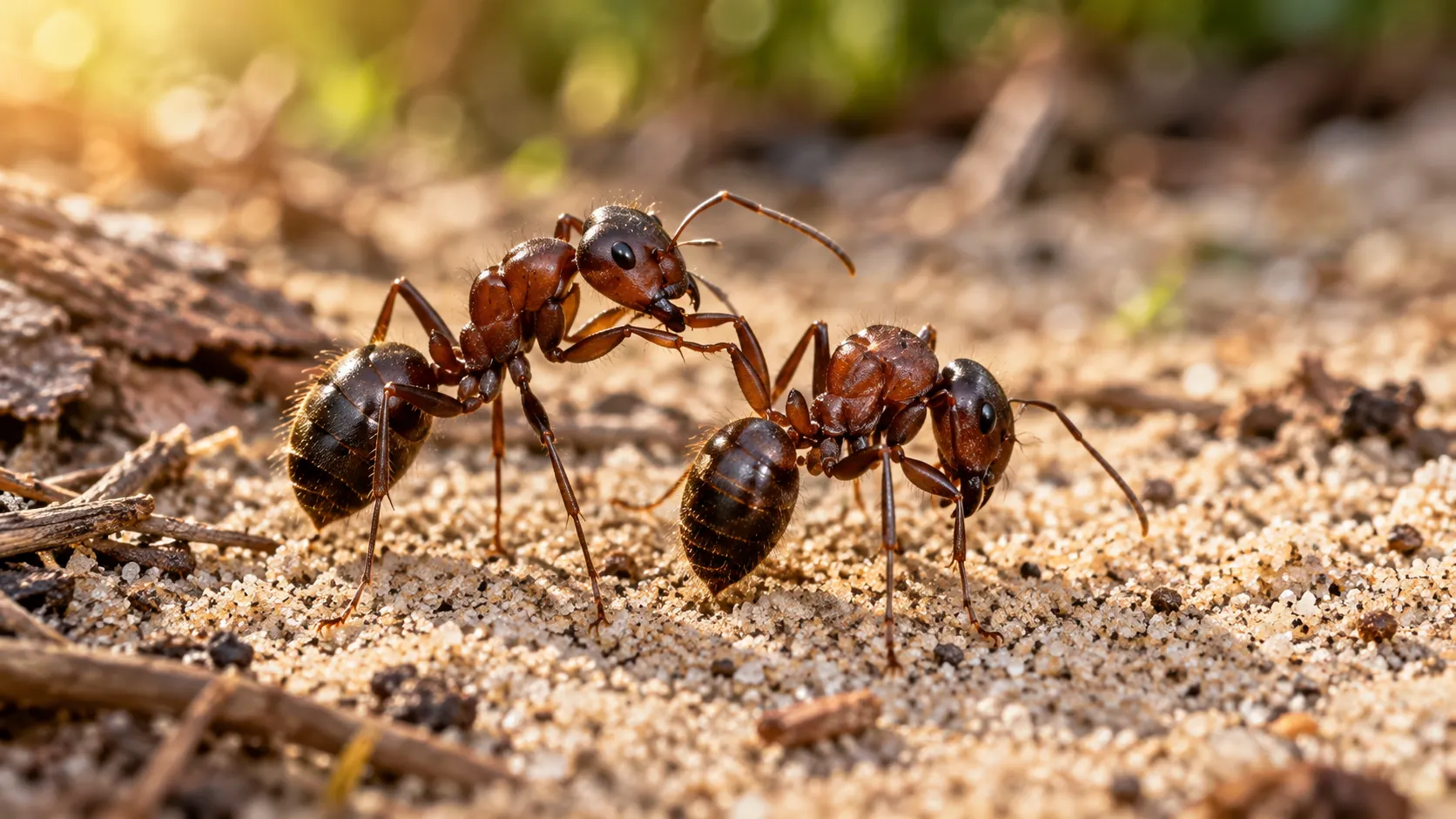
Florida carpenter ants sometimes treat an injured nestmate by biting off its leg. In a controlled study, that drastic response improved survival for certain wounds.
In a 2024 study published in Current Biology, researchers found that workers of Camponotus floridanus treated injured companions in two strikingly different ways. Some wounds were cleaned. Others were followed by a full leg amputation. The difference wasn’t random: it depended on which part of the leg was hurt.
This wasn’t a viral video dressed up as science. Researchers injured and, in some trials, experimentally infected ants under controlled conditions, then observed what their nestmates did. It is evidence about this particular species under study conditions—not a claim that every ant runs a field hospital.
When an Ant’s Thigh Is Hurt, Nestmates May Remove the Leg
The researchers compared injuries to two leg segments. The femur sits closer to the ant’s body; the tibia is farther down.
When a worker had a femur injury, nestmates cleaned the wound with their mouthparts and then bit through the leg at its base. It wasn’t a quick snip. According to Okinawa Institute of Science and Technology, which participated in the research, the process took at least 40 minutes.
The injured ant did not have the luxury of a pharmacy, but it did have colleagues willing to spend much of an hour on one damaged leg. That’s an unusual form of workplace support.
The experiment’s survival results were substantial. Among experimentally infected ants with femur wounds, those receiving the treatment survived at roughly 90–95%, compared with less than 40% among unattended counterparts in the research team’s reported comparisons. Those are experimental findings, not a universal survival guarantee for ants in the wild.
Lower-Leg Wounds Got Different Treatment
Here’s where the story becomes more interesting than “ants perform surgery.” The workers did not routinely amputate when the injury was on the tibia. Instead, they concentrated on cleaning it.
In the study’s infected-wound comparisons, that approach was associated with roughly 75% survival, versus about 15% for unattended tibia injuries, according to the research team’s institutional explanation.
So these ants don’t just remove legs at the first sign of trouble. They appear to adjust their care to the location of the damage. The observations establish the different responses; they do not prove the ants consciously understand infection or anatomy the way human clinicians do.
Why Might Location Matter So Much?
Researchers used micro-CT imaging to study the leg’s structure. Much of the muscle associated with circulating hemolymph—the insect fluid that performs some blood-like functions—lies in the femur. Damage there may slow fluid movement enough to give nestmates time to remove a contaminated limb before an infection spreads.
An injured tibia appears to offer less of that time advantage. By the time a 40-minute amputation is finished, the same tactic may be too late. The team tested this possibility with experimentally infected wounds and amputations; the detailed circulation explanation remains a proposed biological mechanism, not a demonstration that ants calculate how quickly bacteria move.
There’s also a reason the species is worth studying. Florida carpenter ants lack a gland that many other ants use to produce antimicrobial secretions. Their mechanical wound care offers another way that social insects may limit infection.
This Is Ant Medicine, Not Ant Medical School
The study is a remarkable example of injury-specific care among social insects. It doesn’t show tiny surgeons planning an operation, and it certainly doesn’t establish that all ant species do this. It shows something stranger and better: a species whose nestmates behave differently toward different wounds, in ways that improved survival in controlled experiments.
For another peculiar animal response to injury, axolotls can regenerate an entire lost limb. These ants take the opposite route. Sometimes keeping the rest of the ant means letting the leg go.