
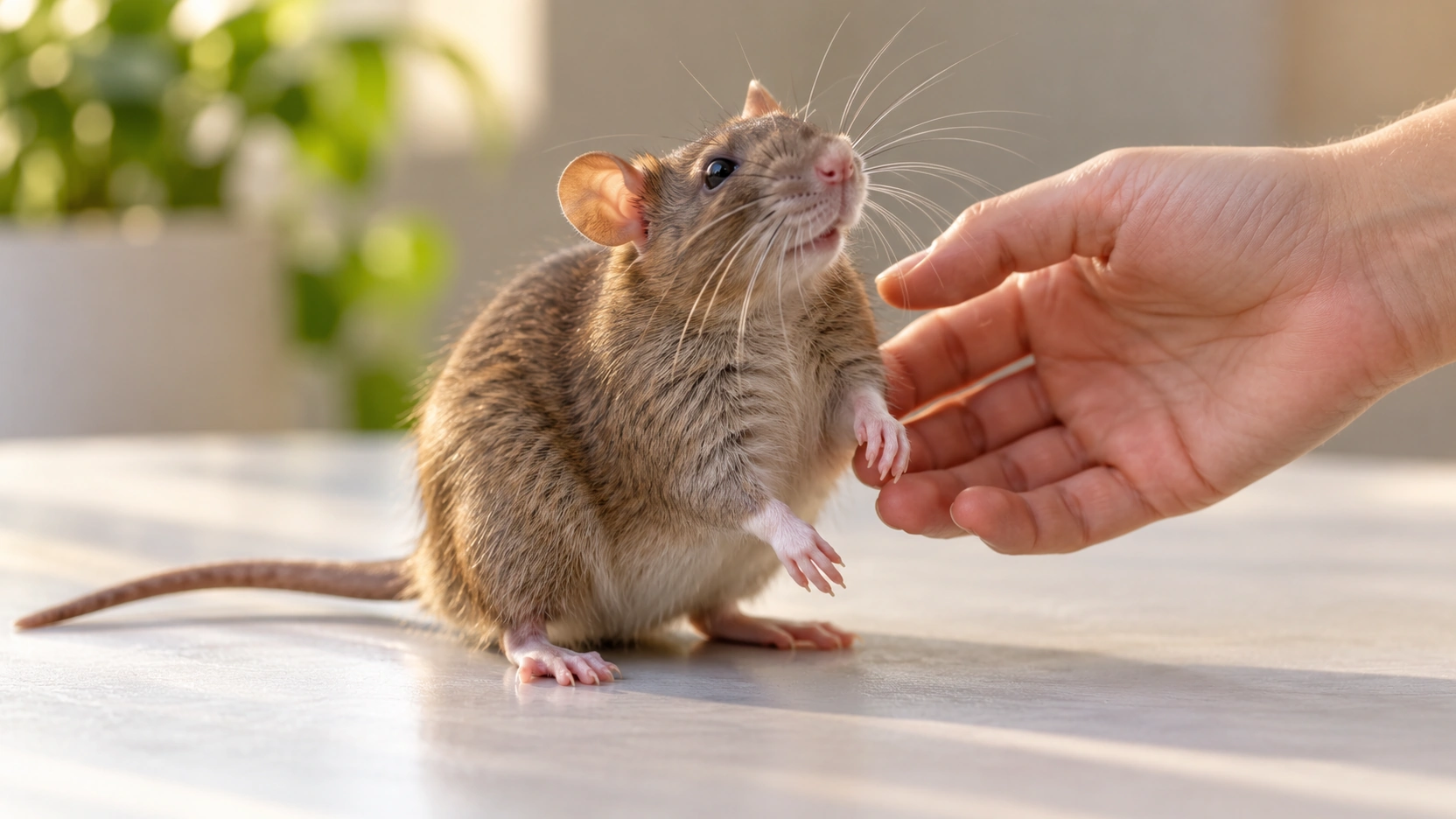
Rats make high-pitched chirping sounds when researchers tickle them. The calls are around 50 kilohertz—above the range of human hearing—and scientists have spent years testing whether they work like a rodent version of laughter.
Yes, this means serious neuroscience research has involved people playing with rats. No, it does not mean the laboratory has a tiny comedy club.
The “giggles” are ultrasonic
In a 2016 study published in Science, researchers gently tickled rats and recorded ultrasonic vocalizations, or USVs. The animals made more of the roughly 50-kilohertz calls during tickling than during gentle touch. Some also approached the researcher’s hand and made excited little jumps.
Normal human ears cannot hear 50-kilohertz sounds. Researchers need special recording equipment, and recordings played for people are typically shifted into an audible range. So the squeaky sound in a demonstration is not exactly what you would hear by standing beside the cage.
The interesting part is not just the sound. Rats also vocalize during social play, and the experiment found that responses to playing with the researcher’s moving hand overlapped with responses to actual touch.
Researchers looked inside the brain, too
The 2016 team recorded activity in a touch-processing brain area called the somatosensory cortex. Certain neurons became more active during tickling and play. Stimulating part of that circuitry could trigger vocalizations without a tickle.
Then a 2023 study in Neuron investigated a deeper brain region called the periaqueductal gray, or PAG. It found that cells in the lateral PAG were particularly responsive during play and tickling. Temporarily disrupting those columns reduced playful behavior and ticklish responses.
That does not make one tiny brain region a magic laughter button. It does show that the sounds are connected to measurable networks involved in social play, rather than being a random noise rats make whenever somebody touches them.
Even rats aren’t always in the mood
Here’s an unexpectedly relatable detail: context matters. In the 2016 research, anxiety-provoking conditions reduced tickling-evoked calls and brain responses. The 2023 work also found less play and vocalization in an unfamiliar, anxiety-provoking environment.
Individual rats differ as well. A 2020 study in Current Biology found that 50-kilohertz calls tracked positive emotional responses to tickling, but emphasized that some rats experience the interaction as more rewarding than others.
In other words, a scientist cannot declare every rat happy by tickling it and counting squeaks. The whole point of studying the calls is to better understand the animals’ responses, including when an interaction is not welcome.
So do rats really laugh?
They make laughter-like ultrasonic calls during enjoyable play and tickling. That’s the supported claim. Scientists commonly call the sounds “rat laughter” as shorthand, but there is no evidence that a rat is appreciating a punch line the way a person does. The 2020 researchers cautioned that these calls may not correspond as closely to human laughter as the nickname suggests.
The calls matter because they give researchers another clue to an animal’s emotional state. They may help scientists study play and welfare without pretending rats have our exact sense of humor.
BiggleBit has already covered Manhattan rats splitting into Uptown and Downtown genetic clusters. Apparently rats can supply material for both a geography lesson and a neuroscience lab.
The punch line is real, but most of it happens at a frequency we cannot hear.