
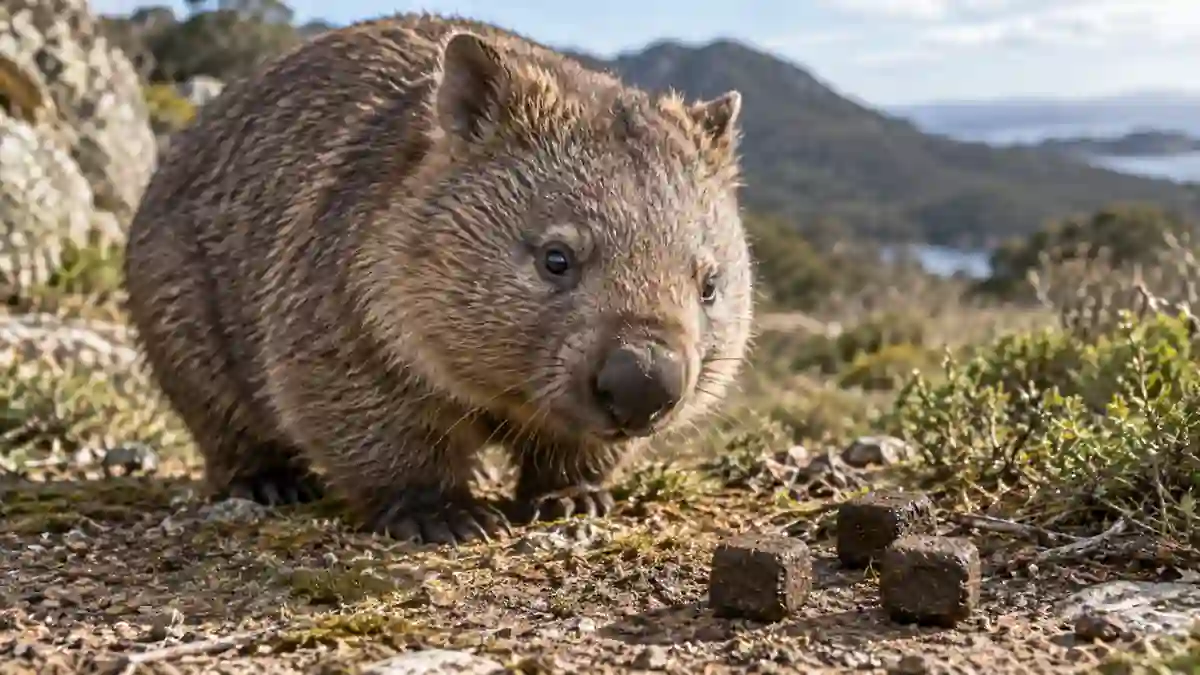
There are plenty of strange things in nature that sound made up.
Then there are wombats.
Wombats produce poop that is shaped like little brown cubes. Not “sort of square if you squint at it.” Actual flat-sided, cornered droppings that look surprisingly close to something made in a tiny biological brick factory.
And, naturally, scientists decided they needed to know how this was happening.

No, Wombats Do Not Have Square Butts
The most obvious explanation would be that something near the end of the process is shaping the poop. Perhaps wombats have an unusually shaped anus.
They don’t.
Researchers found that the cube shape forms inside the final portion of the wombat’s intestine, before the feces reach the exit. In dissections, the cubes took shape within roughly the last 17 percent of the digestive tract.
The researchers also found that the intestinal wall is not equally stretchy all the way around. Some regions are thicker and stiffer than others. As the intestine contracts, those differences help create flat faces and corners instead of the rounded shapes produced by most animals.
In other words, the poop isn’t cut into cubes.
It’s molded into them.
Wombats Are Also Extremely Good at Drying Their Poop
Shape is only part of the trick. The material also gets much drier as it moves through the digestive tract.
In the same study, fecal material in the proximal colon was still a high-moisture slurry. Near the end of the intestine, the water content was much lower and the flat faces and beveled edges had become more obvious.
That matters because a wet blob is not particularly interested in maintaining sharp corners.
A drier one can.
Put the drying together with repeated intestinal contractions and sections of gut that have different mechanical properties, and somehow evolution ends up manufacturing tiny poop bricks.
But Why Would a Wombat Need Cube-Shaped Poop?
This part is less settled than the mechanics.
Wombats leave droppings at recognizable sites, often around their burrows and on prominent objects such as rocks or stumps. Researchers even use wombat droppings to study the animals’ habitats and gut microbes. The Australian Museum has documented how much information scientists can get from wombat poop.
You’ll often hear that cubes evolved because they do not roll away as easily when a wombat leaves them on a raised surface. It is a wonderfully tidy explanation.
It is also better treated as a hypothesis than a settled answer. Scientists have done a much better job explaining how wombats make cubes than proving exactly why natural selection favored the shape.
And Yes, Scientists Won an Award for This
The research was strange enough—and serious enough—to earn members of the team a 2019 Ig Nobel Prize, the awards that celebrate research designed to make people laugh and then think.
Which seems appropriate.
Some scientists spend their careers studying distant galaxies. Others investigate the mysteries of the human brain. And a few looked at a pile of square wombat poop and said: We need to understand this.
Thankfully, they did.
Australia’s animals seem unusually committed to giving us stories like this. The country also imported camels for Outback transport and eventually ended up with a huge feral camel population, because apparently Australia does not do animal stories halfway.