
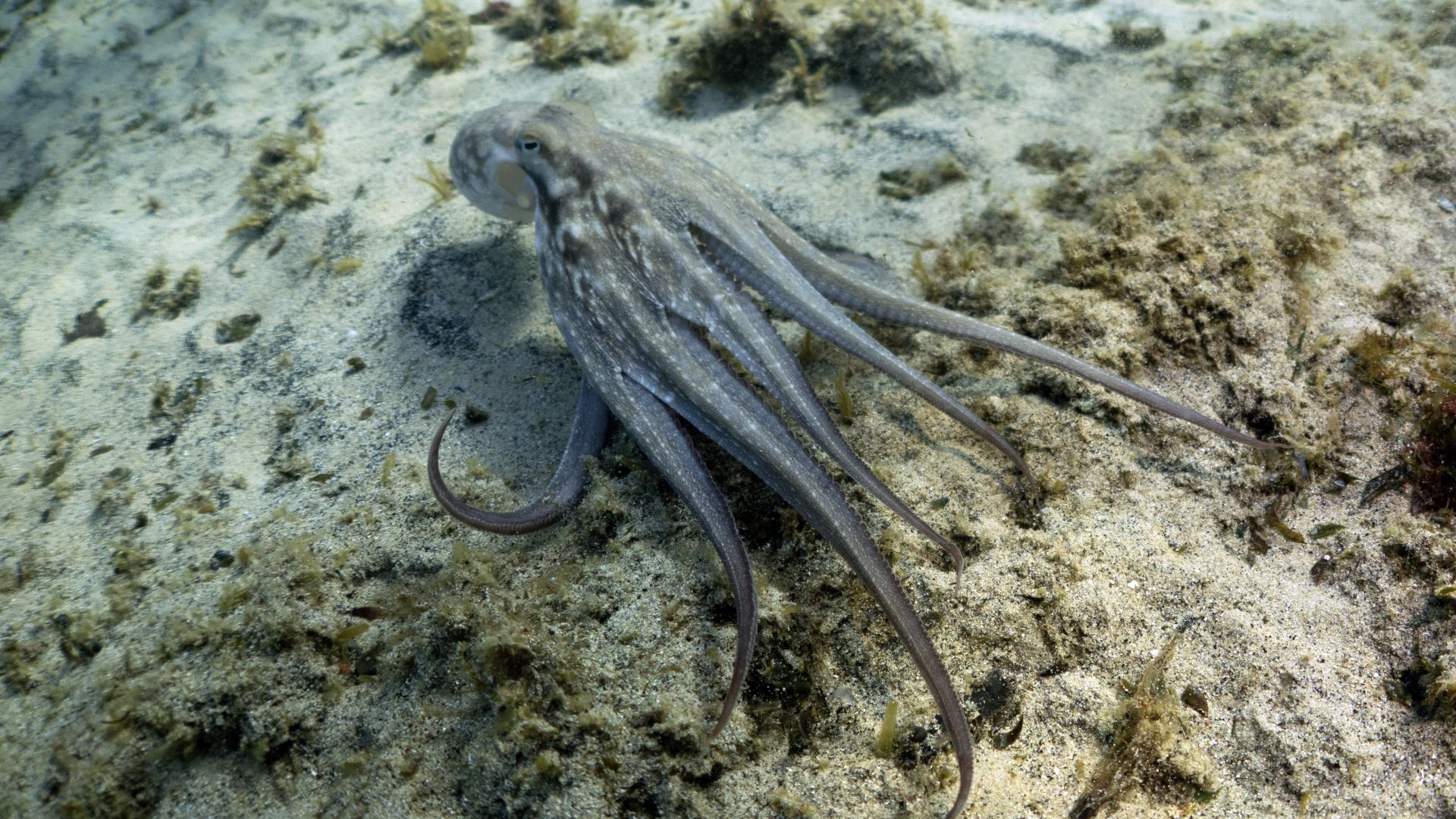
An octopus has three hearts.
Which sounds excessive until you learn that one of them basically clocks out when the octopus starts jetting through the water.
Evolution apparently looked at the octopus—a boneless animal with eight arms, blue blood, a beak, camouflage and an alarming number of opinions about aquarium security—and decided that one heart simply wasn’t weird enough.
If wombats pooping cubes didn’t already convince you that nature operates without adult supervision, welcome back.

Why Does an Octopus Need Three Hearts?
The three hearts do different jobs.
Two are called branchial hearts. Each sits near a gill and pumps oxygen-poor blood through that gill so it can pick up oxygen.
The third is the systemic heart. That’s the big distribution pump. Once the blood has been oxygenated at the gills, the systemic heart sends it around the rest of the octopus.
So this isn’t an octopus walking around with two backup hearts in case Heart No. 1 has a rough afternoon. It’s more like a three-pump plumbing system.
Smithsonian Ocean describes the same arrangement: two hearts serving the gills and one circulating oxygenated blood through the body.
Swimming Makes the Main Heart Stop
Octopuses can move around by crawling across the seafloor with their arms. They can also move much faster using jet propulsion.
To do that, the octopus pulls water into its mantle and then contracts the mantle hard, blasting the water through a siphon. The result is essentially an underwater biological jet engine. Monterey Bay Aquarium describes the same system in giant Pacific octopuses.
Very useful when something wants to eat you.
Not particularly convenient for your cardiovascular system.
Researchers studying freely moving common octopuses found that jet propulsion is accompanied by cardiac arrest of the systemic heart. The increased pressure inside the mantle interferes with the return of blood needed to keep that heart pumping normally. The research was published in the Journal of Experimental Biology.
So the accurate version of the internet fact is not that two octopus hearts stop when it swims.
It’s weirder in a more specific way:
The two gill hearts keep working. The systemic heart—the one supplying the body—stops during jet propulsion.
This is also one reason an octopus is much better suited to short emergency bursts than swimming around endlessly like a tuna. The same research found that jet-propelled movement could only be sustained over relatively short distances.
Basically, octopus swimming comes with a design flaw that would have generated some uncomfortable meetings if evolution had an engineering department.
And Yes, Its Blood Is Blue
Because apparently three hearts weren’t enough material for one animal.
Octopus blood is genuinely blue.
Humans use iron-containing hemoglobin to transport oxygen. Cephalopods instead use hemocyanin, which contains copper. That copper-based oxygen transport system gives their blood its blue color. Smithsonian Ocean explains the chemistry.
So an octopus has three hearts pumping blue blood around a body with no bones while eight arms feel and chemically sense the environment.
And when it needs to make a fast getaway, the heart responsible for supplying most of that body temporarily stops.
Which makes crawling along the ocean floor suddenly seem like an extremely reasonable lifestyle choice.