
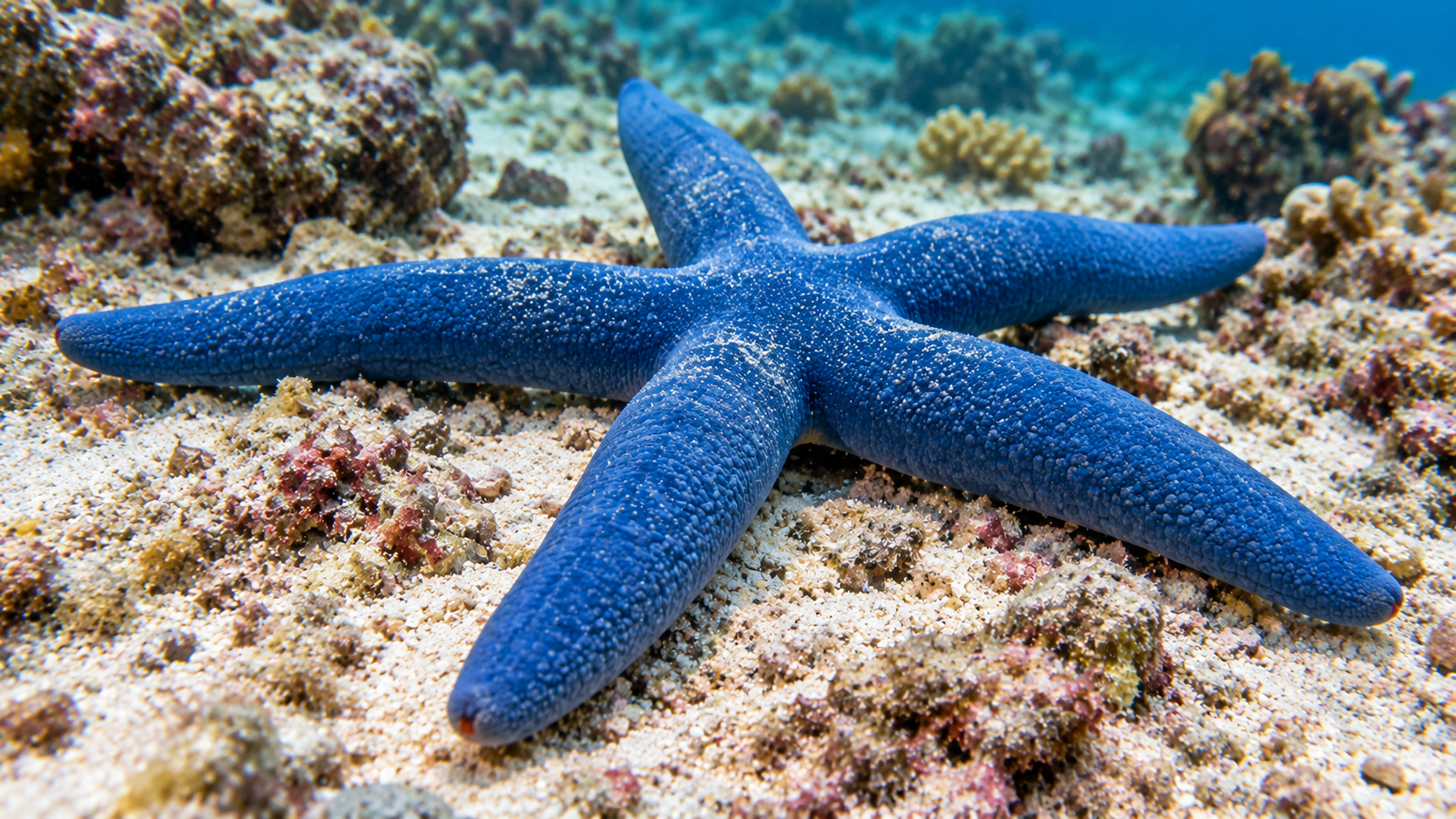
Starfish have eyes at the tips of their arms. Not the cartoon kind with blinking pupils, but small light-sensitive structures that can help at least some species work out where to go.
Scientists knew about these eyes for a long time. The harder question was whether a starfish could actually use them to navigate.
Look at the end of each arm
Many known starfish species have a compound eye near the tip of each arm. The eyes contain multiple light-sensing units rather than the single lens-and-retina arrangement in a human eye. Their construction varies across species, and they should not be treated as miniature human eyeballs.
In a 2014 Proceedings of the Royal Society B study, researchers examined the reef-associated blue sea star Linckia laevigata. They measured how its eyes respond to light and tested whether intact eyes mattered when the animals were moved away from their reef.
The reef is visible, even if it’s blurry
The researchers found that the sea stars’ visual system supports low-resolution image formation. These eyes are slow and color-blind in the studied species. They do not need to resolve individual coral branches to distinguish a dark reef shape from the surrounding open water.
That crude information is enough to give the animal a useful direction. Think broad shadow and contrast, not sharp detail.
What happened when the eyes were covered?
In the behavioral tests, sea stars with functional eyes could orient back toward a reef when displaced. Animals without intact eyes lost that visually guided navigation ability.
This was direct evidence of a practical job for starfish eyes, not simply a description of anatomy. It also means the careful species-specific result matters: the experiment was about Linckia laevigata, not a guarantee that every sea star everywhere navigates in exactly the same way.
Starfish experience the world differently
Sea stars also detect chemical and mechanical cues through other body structures. Their tube feet help them move, attach to surfaces and interact with their surroundings. Eyes complement those senses; they do not replace them.
To navigate an environment, an animal may need little more visually than a reliable light-dark contrast. A crisp photograph would be nice, but it isn’t necessary for finding a broad patch of reef.
Five arms, several places to look
Starfish have no central head where a typical vertebrate eye would sit. Their eyes’ location on the arm tips is one of the details that makes their body plan so unusual.
BiggleBit has another story about octopuses sensing chemicals with their suckers. Underwater animals keep finding new places to put sensory equipment.
Source: Garm and Nilsson, Proceedings of the Royal Society B (2014), behavioral and vision experiments on Linckia laevigata.