
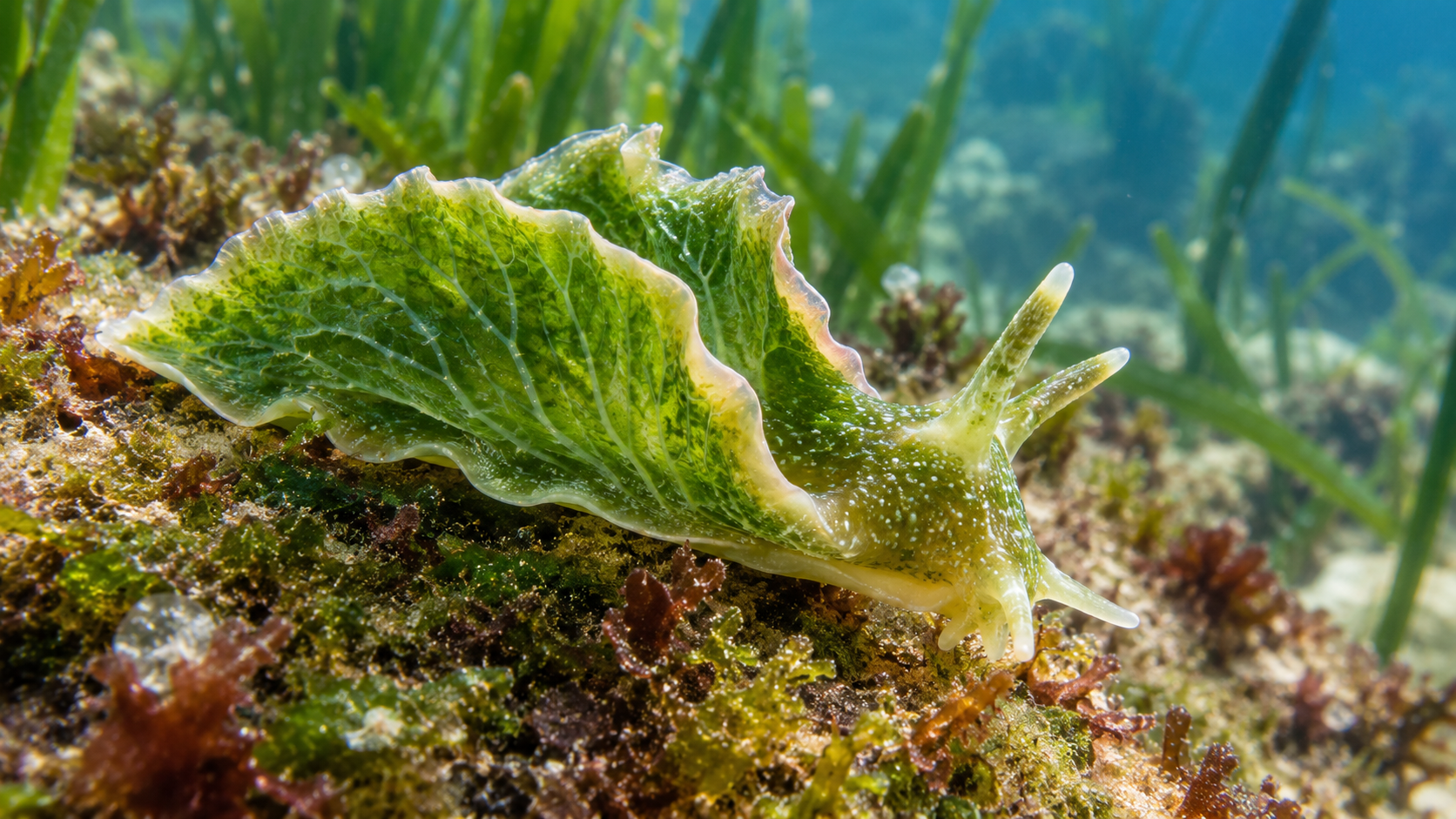
Lizards drop tails. Starfish can regenerate arms. Certain sea slugs apparently looked at those tricks and decided they were not ambitious enough.
Researchers studying two sacoglossan sea slug species found that the animals can shed the main body below the head—including the heart—and then regenerate a new body from the head that remains.
The head keeps moving after the body is gone
The discovery came from a lab at Nara Women’s University in Japan. Researcher Sayaka Mitoh found a sea slug whose head and body had separated, yet the head was still crawling around.
Instead of dying, the detached head began feeding again. In relatively young animals, regeneration of a new body followed.
The original 2021 Current Biology paper described the behavior in two sacoglossan species and called it an extreme form of autotomy—the deliberate shedding of a body part.
They are not regenerating a tail. They are replacing the body.
The cast-off portion included the heart and most internal organs. The surviving head regenerated those structures as a new body formed behind it.
According to the researchers’ report and a Cell Press summary, young slug heads could begin feeding on algae within hours. Heart regeneration became visible within about a week, and the new body was largely complete in roughly three weeks.
The abandoned body did not pull the same trick in reverse. It could move and react for a while, but it did not regenerate a head.
The age of the slug mattered
Not every detached head successfully rebuilt itself. The researchers reported that heads from older individuals did not resume feeding and died within about ten days.
That makes the phenomenon impressive without turning it into comic-book immortality. These animals have an extraordinary regenerative ability under particular biological conditions. They are not endlessly swapping bodies whenever one becomes inconvenient.
Photosynthesis may help the head survive the rebuild
These sacoglossan slugs have another unusual trick: they steal chloroplasts from the algae they eat and keep those chloroplasts working inside their own tissues, a process called kleptoplasty.
The researchers proposed that this photosynthetic ability may help the detached head survive long enough to regenerate. The paper did not claim photosynthesis is the entire explanation, and the cellular machinery that drives whole-body regeneration is still a major question.
BiggleBit has already covered the related oddity in sea slugs that steal chloroplasts and keep them photosynthesizing. This body-regrowth story is the next level of “that should not be a thing, but it is.”
Why would an animal ditch almost its entire body?
The researchers considered whether the behavior might help the slugs remove parasites from the old body. Some individuals carrying parasites were associated with autotomy, making parasite removal a plausible benefit.
But the study did not reduce the behavior to one simple universal cause. What researchers can say directly is that extreme autotomy occurs, the head can survive it, and younger animals can rebuild a functional body.
It raises a very basic question: where is the rebuild program?
If the heart and most of the body are gone, the surviving tissues at the neck have to restart an astonishing amount of development. The researchers suggested that stem-like cells near the cut surface may be involved, but exactly how the process is controlled remains open.
For now, the verified weirdness is enough. In these sea slugs, losing your body can be a temporary condition.
Sources: Current Biology (2021); Cell Press / EurekAlert; Nara Women’s University.