
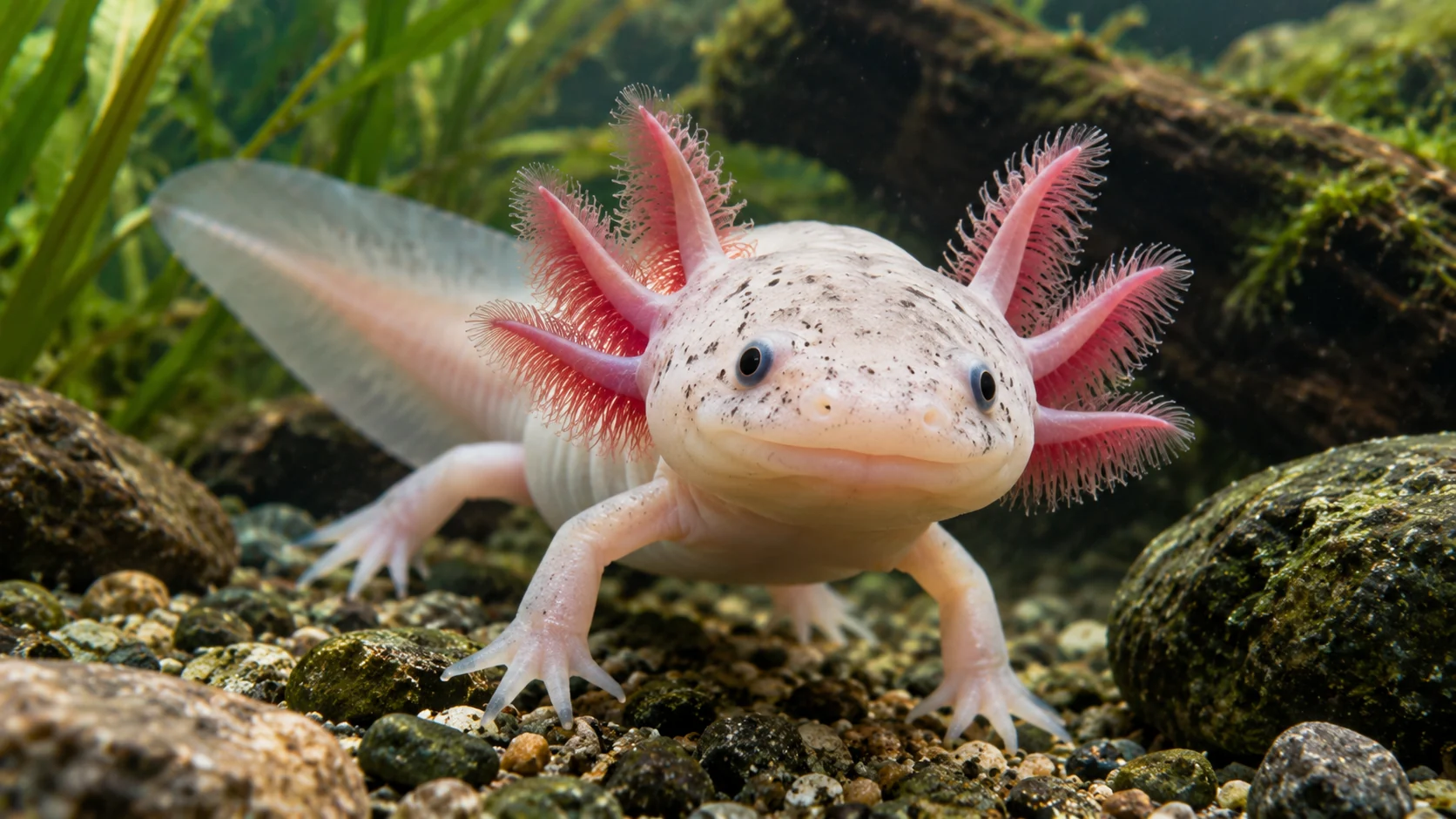
Lose a limb, and an axolotl does something humans find deeply unreasonable: it grows another one.
Not a scar-covered stump. Not a simplified replacement. A new limb with bone, muscle, skin, nerves and digits arranged where they are supposed to go.
Axolotls are Mexican salamanders, and their regeneration ability is so broad that researchers use them as a model for understanding how complex tissues can rebuild themselves. The National Institute of General Medical Sciences notes that axolotls can regenerate limbs as well as tissues from structures including the spinal cord, heart, skin, tail and other organs.
Basically, biology gave one salamander access to a repair menu the rest of us cannot find.
A lost limb does not just heal. It starts rebuilding.
After an axolotl limb is amputated, the wound closes rapidly and a specialized wound epidermis forms over the injury. Under that covering, cells begin organizing into a structure called a blastema.
The blastema is the temporary rebuilding zone. Cells proliferate there, respond to signals from the surrounding tissue, and eventually produce the structures needed for the replacement limb.
This is where the popular version of the story can get sloppy. The animal does not simply unleash a blob of magical all-purpose stem cells and hope for the best. Research on salamander limb regeneration shows that many blastema cells retain information about what tissue they came from and contribute to particular tissues in the new limb. A 2024 review in the Annals of the New York Academy of Sciences describes the blastema as a coordinated population of progenitor cells operating through tightly regulated developmental programs.
In other words, the axolotl is not improvising. It is running a construction project.
The replacement limb has to know what is missing
Regrowing tissue is only half the problem. The animal also has to rebuild the correct amount of it in the correct places.
If the limb is lost near the wrist, the axolotl does not casually grow a second shoulder. The regenerating tissues use positional information from the remaining limb to reconstruct the missing structures beyond the injury.
That means making joints, cartilage, muscle, skin, blood vessels and nerves in a coordinated pattern. Studies of axolotl limbs have shown that regeneration depends on interactions among cells carrying different positional identities inside the blastema. Recent work continues to examine how signaling systems help those cells establish the axes and proportions of the new limb.
This is one reason regeneration researchers are so interested in axolotls. Growing cells is one thing. Convincing those cells to rebuild a correctly organized body part is a much harder problem.
Axolotls can repair more than legs
The limb trick gets the headlines because it is extremely visible and slightly rude to every mammal that has ever needed stitches.
But it is not the whole story.
The NIH Office of Research Infrastructure Programs describes axolotls as capable of regenerating lost or damaged tissues that include whole organs, limbs and parts of the central nervous system. The same research community studies repair in the tail, spinal cord, heart and other tissues.
That does not mean an axolotl is indestructible. Regeneration depends on the type and severity of the injury, the animal’s condition, developmental stage and the tissue involved. But compared with humans, the range of structures they can rebuild is extraordinary.
The species is useful experimentally for another absurd reason: its genome is enormous. NIH-supported work produced a chromosome-scale axolotl genome assembly of roughly 32 billion base pairs—about ten times the size of the human genome. Apparently the animal that can regrow a leg also needed a genome with the storage footprint of a small apartment.
Scientists want to know why humans mostly scar instead
Humans repair wounds. We can regenerate limited tissues, and organs such as the liver have substantial restorative capacity. But a severed human arm does not form a blastema and start printing a replacement hand.
Axolotls give researchers a living comparison for asking what changes after injury: which genes switch on, how immune cells behave, how nerves influence regrowth, how cells avoid excessive scarring and how the replacement tissue knows what shape to make.
The goal is not necessarily to turn people into salamanders or promise somebody a lab-grown arm next Tuesday. Regenerative medicine is more likely to advance in smaller steps: improving wound healing, limiting fibrosis, restoring damaged nerves or heart tissue, or learning how to coax human cells into repair programs they normally do not use.
That is why NIH-supported centers maintain axolotl genetic stocks for researchers. The weird animal fact is also a serious biomedical research platform.
The impressive part is not just regrowth. It is accuracy.
An axolotl does not merely fill a hole with new material. It can rebuild a complex structure with the right tissues arranged in a functional pattern.
That makes the animal less like a creature with unusually good healing and more like a creature whose body kept access to an old developmental instruction manual.
BiggleBit has already dealt with shark ancestors that predate the first known trees and pufferfish that build geometric mating arenas. The axolotl contribution is simpler.
Lose a leg.
Grow a leg.
Try not to make the mammals feel bad about it.