
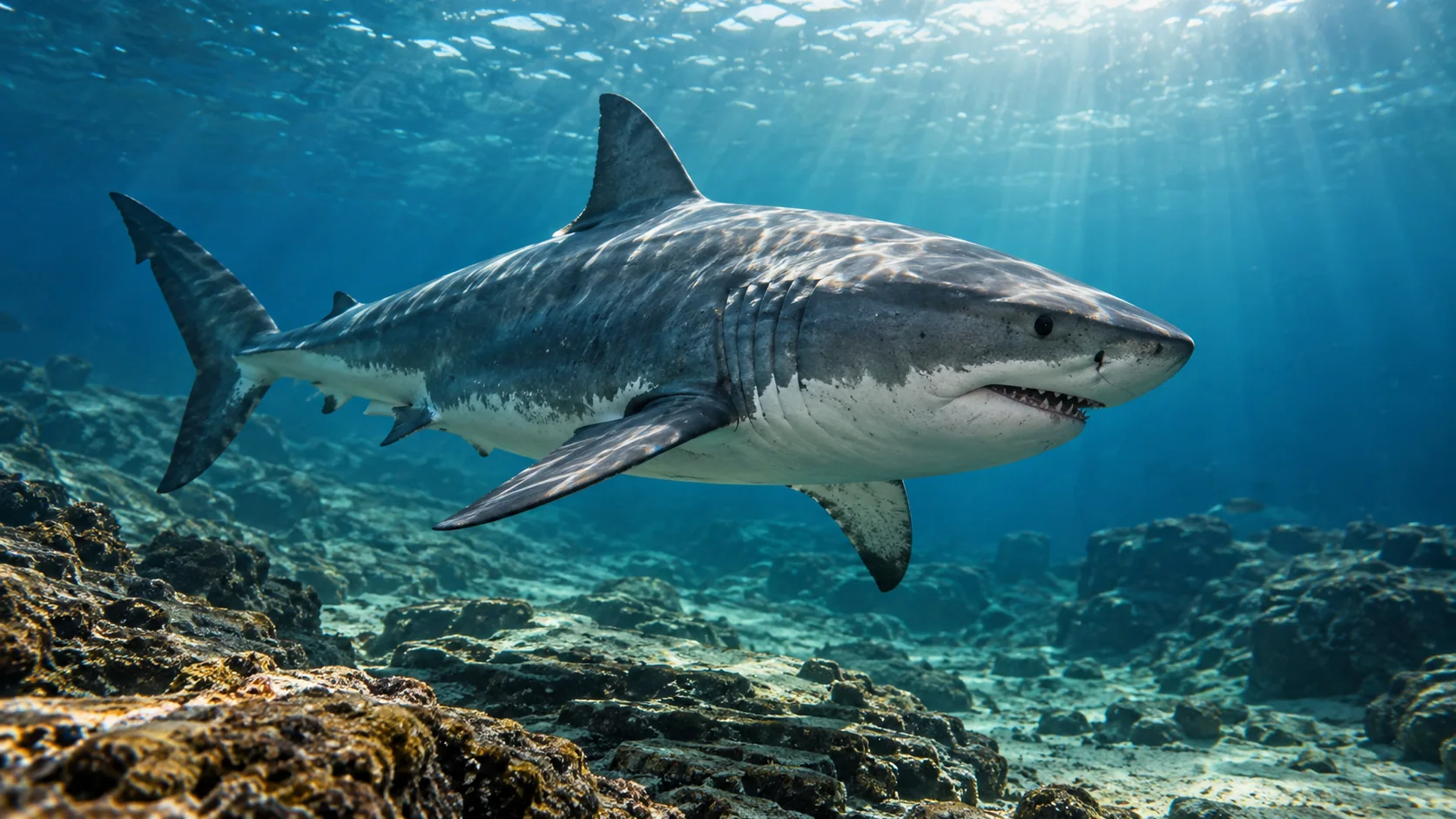
The shark family tree got into the ocean before actual trees got onto land.
That sounds like one of those internet facts designed to make your brain briefly stop accepting time, but the fossil record backs up the basic idea. The important caveat is that we are talking about the shark lineage and its early relatives—not modern great whites cruising around unchanged for 400 million years.
Even using a conservative date, confirmed shark scales are about 420 million years old. Trees appear later in the fossil record, during the Middle Devonian, roughly 398 to 385 million years ago.
So yes: shark ancestors were already doing ocean things while the land was still working toward inventing a proper tree.
The conservative shark date still beats trees
The shark fossil record is annoyingly incomplete because shark skeletons are made mostly of cartilage, which does not preserve as readily as bone. Researchers therefore lean heavily on teeth, scales called denticles, vertebrae and occasional body impressions.
The Smithsonian Ocean describes the oldest confirmed shark scales as roughly 420 million years old, from the Silurian Period. The museum notes that shark evolution goes back more than 400 million years.
There may be even older evidence. The Natural History Museum in London discusses shark-like scales from about 450 million years ago in the Late Ordovician. But those fossils are debated: scientists cannot say with certainty that the scales came from true sharks rather than shark-like ancestors.
That makes 420 million years a useful conservative number. It is still absurdly old.
Trees showed up tens of millions of years later
Land plants existed before trees, so Earth was not simply bare rock waiting for somebody to install landscaping.
But trees were a later evolutionary innovation. A Nature study of the famous Gilboa fossil forest places the origin of trees in the Middle Devonian, about 398 to 385 million years ago.
More recent fossil work has pushed the record for an actual forest slightly farther back. In 2024, researchers from Cambridge and Cardiff universities reported a fossil forest in southwest England dating to about 390 million years ago. The University of Cambridge describes it as the oldest fossilized forest currently known.
Compare that with the Smithsonian’s 420-million-year-old confirmed shark scales, and the shark lineage has a head start measured not in centuries or millennia, but in tens of millions of years.
No, modern sharks have not been frozen in time
This is where the fun fact usually gets mangled.
Saying sharks existed before trees does not mean today’s shark species have been swimming around in their present form since the Silurian. The shark branch has split, diversified, lost lineages, gained new ones and survived enormous changes in Earth’s oceans.
The Natural History Museum explicitly warns against treating sharks as simple “living fossils.” Early shark-like animals could look dramatically different from familiar modern species, and some fossils once casually described as sharks are now placed elsewhere on the cartilaginous-fish family tree.
Great whites, whale sharks and hammerheads are not 420-million-year-old species. Their much deeper evolutionary lineage is what is ancient.
The planet looked very different when early sharks appeared
At around 420 million years ago, dinosaurs were nowhere close to existing. Mammals were hundreds of millions of years away. Forest ecosystems had not yet spread across the continents.
The seas, however, were already busy with ancient fishes and other marine animals. Shark relatives were becoming part of an evolutionary experiment that would keep producing new forms through multiple mass extinctions.
That longevity is impressive enough without pretending evolution stopped.
Deep time is mostly an attack on human intuition
We tend to mentally file sharks, trees and dinosaurs into one drawer labeled “really old stuff.” The drawer is wildly inaccurate.
Shark lineage: more than 400 million years. Trees: around 390-ish million years in the earliest forest record. Dinosaurs: much later, first appearing roughly 230 million years ago.
And BiggleBit’s ocean department keeps getting stranger. The same planet that produced a shark lineage older than trees also produced male pufferfish that build giant geometric sand circles to attract mates.
Earth has had a very long time to get weird.