
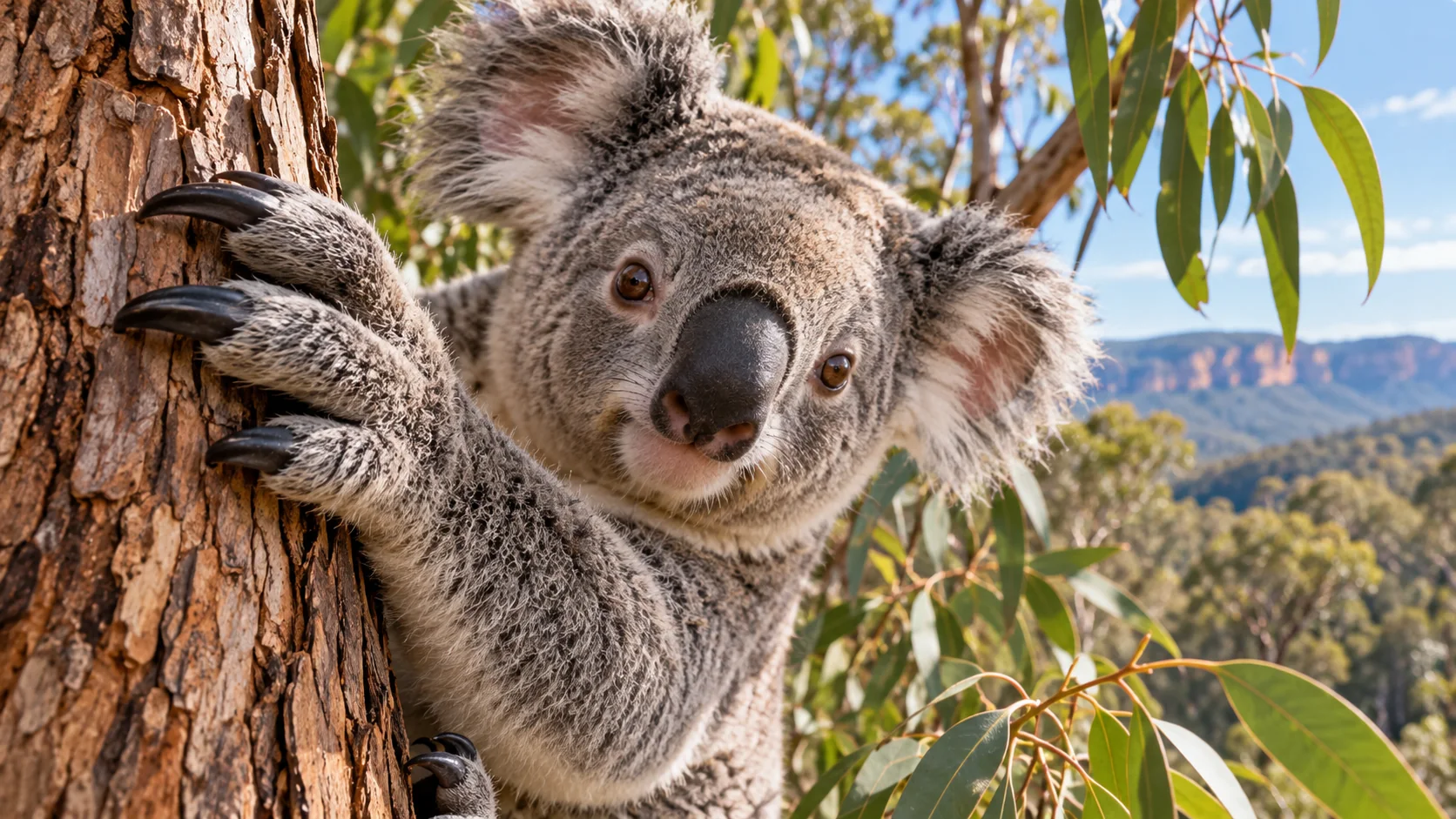
Koalas spend their days climbing eucalyptus trees, gripping branches with small, strong hands. Look closely at their fingertips, though, and you’ll find something unexpectedly familiar: ridged patterns much like the ones that make human fingerprints recognizable.
Researchers documented the resemblance in the 1990s. The surprise wasn’t that a koala has textured skin; it was that a marsupial’s ridge patterns can look so much like ours, despite the long evolutionary distance between the two species.
Scientists spotted the pattern on a koala’s hand
In a 1997 paper, biological anthropologist Maciej Henneberg and colleagues described fingerprint-like ridges on the fingers and toes of koalas. They noted that these patterns were microscopically and macroscopically similar to human dermatoglyphs—the ridges on the skin of fingertips and other gripping surfaces.
Koalas are marsupials, while humans are primates. Their lineages have evolved separately for tens of millions of years. Yet both have developed detailed ridge patterns on the parts of their hands and feet they use to grip objects.
The researchers called this fingerprint homoplasy: similar features appearing in different evolutionary lineages, rather than being inherited from a recent shared ancestor.
They look similar—but that doesn’t mean they’re identical
Human and koala fingerprints can show familiar loops and whorls, along with smaller branching and ending ridges. That similarity is striking enough to make the prints an interesting comparison under magnification. It does not mean every print matches, or that the animals have hands built exactly like ours.
Scale, ridge detail and the condition of the print matter. Koalas have smaller digits, and the texture of a print can be affected by wear and how it was collected. A partial or smudged impression is different from a clear, complete fingerprint examined alongside a known sample.
Could a koala fool a crime-scene investigator?
The story is often retold as if koalas have repeatedly sent police chasing the wrong suspect. That version gets ahead of the evidence. The underlying research documents a remarkable resemblance; it does not establish a confirmed case in which a koala’s print was mistaken for a human’s in a criminal investigation. PBS has likewise noted that no such mix-up has been documented.
That distinction matters: an eye-catching similarity is not the same as a demonstrated forensic failure. Fingerprint examination compares the detail available in the actual impression, not simply whether two patterns look alike in a picture.
Why would a tree-climbing marsupial have fingerprints?
The leading explanation is functional, not mysterious. Koalas grasp tree trunks and branches as they climb, and friction ridges may help the skin make and maintain contact with surfaces. A 2020 study of fingerprint ridges examined how they regulate moisture and friction during contact; its introduction identifies koalas as one of the few non-primate animals known to have these features.
That research does not prove every detail of how koala ridges evolved. It does support a plausible connection between ridge patterns and the practical mechanics of gripping. Similar challenges can favor similar structures in animals whose ancestors took very different evolutionary paths.
A small clue about convergent evolution
Koala fingerprints are a neat reminder that evolution doesn’t always produce an entirely new solution for every species. Sometimes separate lineages develop similar features when those features suit a similar job. The result can be unexpected—even, briefly, a koala with fingertips that remind us of our own.
Other animals have abilities that look familiar until you learn the biology behind them. Crows, for example, can recognize human faces and pass information about perceived threats to other crows. In both cases, the interesting part is the evidence behind the headline.
So yes, koalas have human-like fingerprints. The genuine science is surprising enough without needing a fictional police mix-up to make it stranger.