
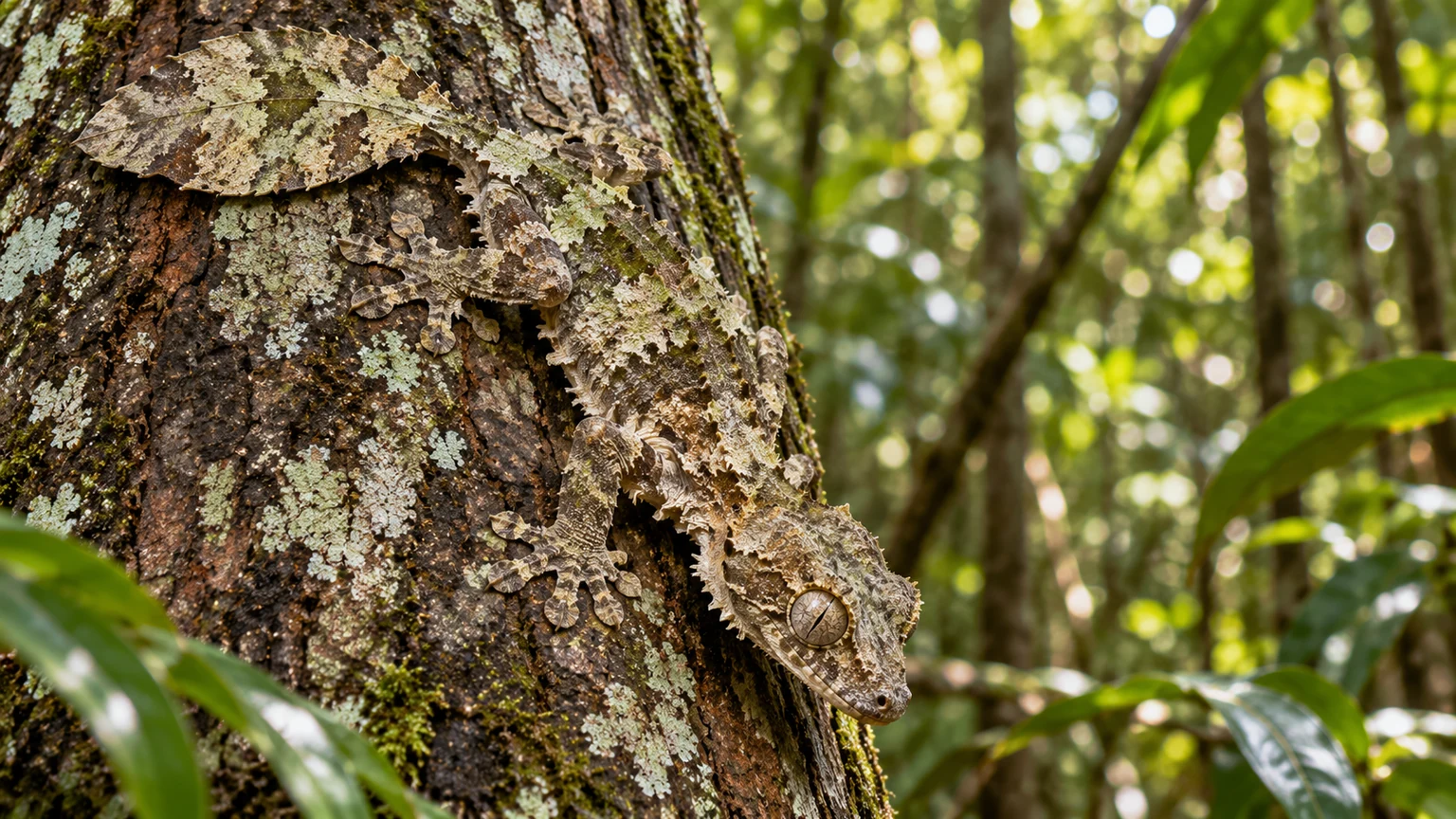
There is a lizard in Madagascar that can be right in front of you on a tree, and your eyes still insist you’re looking at bark. A leaf-tailed gecko doesn’t need a magical invisibility cloak. It needs mottled skin, a flattened body, a conveniently shaped tail and a very good tree.
The finest trick isn’t the color. It’s how the animal makes the line between gecko and trunk nearly disappear.
How a lizard erases its own outline
Leaf-tailed geckos belong to the genus Uroplatus, a group native to Madagascar. Several species specialize in matching the mottled bark and lichen of their forest homes. According to Smithsonian’s National Zoo, the giant leaf-tailed gecko (Uroplatus fimbriatus) has a long, flattened body, broad tail and fringes of skin around its lower jaws and sides.
When those fringes press against a tree, they obscure the animal’s outer edge. Less of a silhouette means fewer clues for a predator looking for lunch. The gecko’s textured, mottled coloring does the rest: it can look less like scales and more like another patch of bark.
A patterned shirt would help you blend into wallpaper. The gecko takes the extra step of trying not to look like a separate object in the first place.
Not every leaf-tailed gecko looks like the same leaf
The common name lumps together animals with genuinely different disguises. Uroplatus fimbriatus is a giant, bark-mimicking species with a relatively broad flattened tail. The much smaller phantastic leaf-tailed gecko (U. phantasticus) has a tail that can resemble a dead, damaged leaf, complete with edges that look as though insects nibbled them.
One impersonates a tree. Another looks like the thing that fell off a tree. Both are leaf-tailed geckos, but treating every member of the genus as the same tiny leaf with legs would miss the interesting differences.
Why holding still can be a survival skill
Many leaf-tailed geckos are nocturnal. They are most active in the dark, hunting small invertebrates, and can rest against bark during daylight when a motionless, camouflaged body is particularly useful. Smithsonian’s account of giant leaf-tailed geckos describes their daylight resting positions against trees and their varied invertebrate diet.
Camouflage is not instant shapeshifting. The effect depends on the individual’s patterns, the surface, the angle of light and whether it stays still. A gecko perfectly matched to one trunk might look much more obvious against a different backdrop.
And camouflage isn’t its only defense. When threatened, some leaf-tailed geckos open their mouths to reveal brilliant red tissue and may call loudly. Apparently the backup plan after “be invisible” is “be startlingly conspicuous.”
Madagascar’s forests are part of the trick
Smithsonian keepers describing Henkel’s leaf-tailed geckos note how varied bark-and-lichen patterns and fringed skin combine to make them difficult to distinguish from a trunk. Their hiding place is not interchangeable with any wall in the world; the habitat matters.
The forests these reptiles depend on also face logging and habitat loss. That isn’t just a conservation talking point pasted onto the end of an animal story. If camouflage works by matching a particular landscape, losing that landscape changes the animal’s odds of surviving.
The trick works because the details agree
A bark-colored body, a blurred edge, a flattened tail and a still posture all tell a predator the same misleading story: nothing to see here. It isn’t perfect invisibility. It’s several small anatomical details working so well together that a gecko can be harder to spot than the tree it’s sitting on.
We’ve covered another reptile doing something improbable: water anoles that reuse an air bubble while submerged. That lizard deals with the underwater world; the leaf-tailed gecko solves the opposite problem of staying hidden in plain sight.
Somewhere on a Madagascar tree, a gecko may be having a very successful day doing absolutely nothing.