
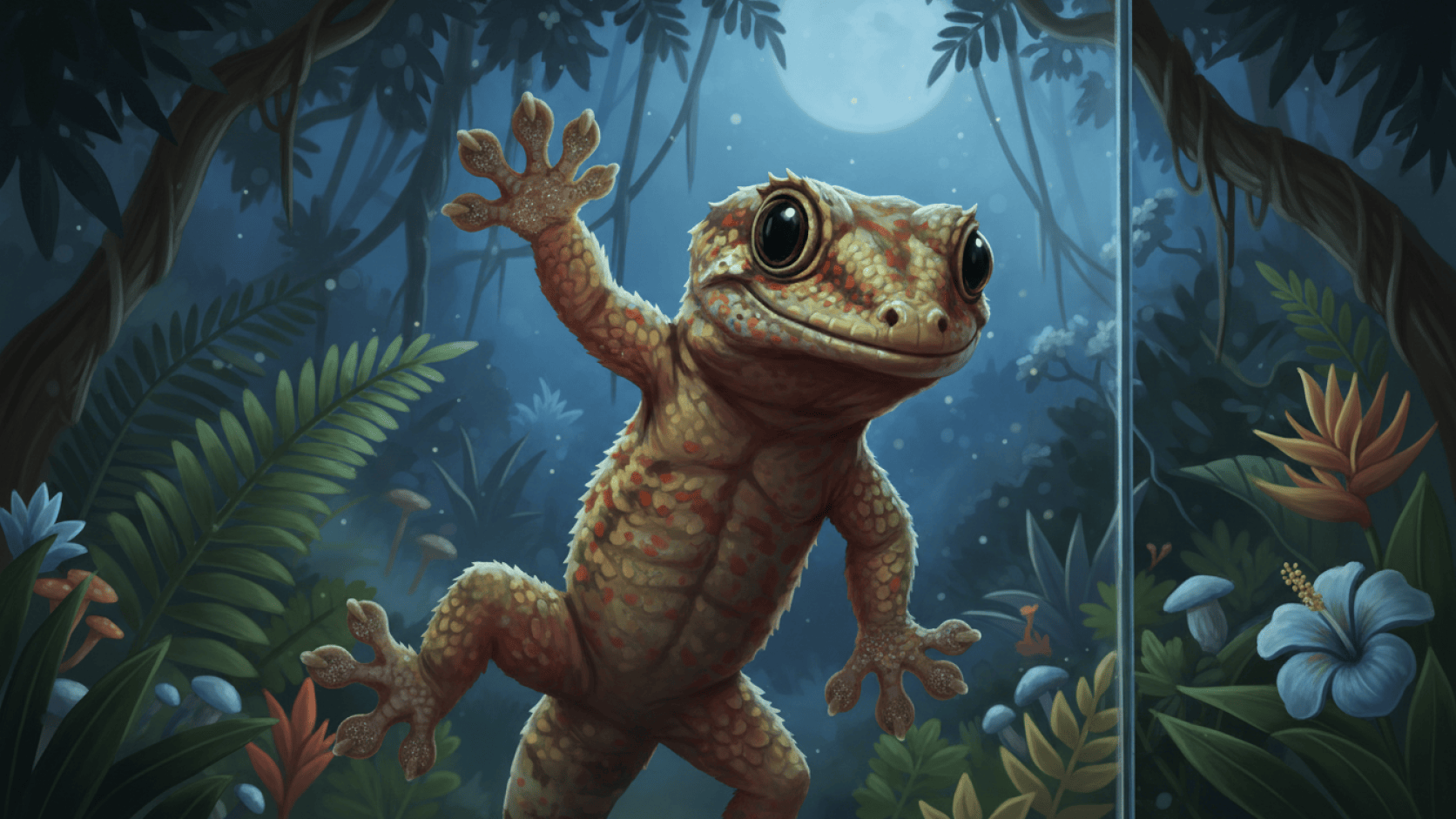
Many gecko species can cling to walls and ceilings without glue. Their toes are covered with tiny hair-like structures that create close contact with surfaces, allowing weak molecular forces to add up to a remarkably strong grip.
They don’t need sticky tape. Their feet are the tape, except they can peel themselves loose whenever they want.
It’s all about the tiny contact points
The underside of a gecko’s toes contains many microscopic setae. Each seta branches into hundreds of flattened tips called spatulae, creating vast numbers of contact points. A 2005 study of Tokay geckos described those tips as roughly 200 nanometers across.
Individual molecular attractions are weak. But when enough tiny contacts work together, their combined effect can hold an animal against a wall.
Scientists tested what makes the grip work
In a 2002 study in PNAS, researchers measured gecko adhesion and found experimental support for van der Waals forces—weak attractions between nearby molecules.
They tested isolated toe hairs and living Tokay geckos on surfaces with different properties. Their results argued against the idea that suction or ordinary liquid glue explained the animals’ remarkable grip.
But molecular attraction is not the only force researchers have investigated. A 2014 study of gecko footpads on polymer surfaces found that contact electrification could also make a substantial contribution. How much each force matters can depend on the surfaces and conditions; calling gecko adhesion purely a van der Waals trick would oversimplify the evidence.
Why geckos don’t get stuck forever
The arrangement of the toe structures matters as much as the attraction. Geckos can change the angle of contact as they place and lift their feet, switching between grip and release. In a study of toe attachment and detachment, researchers described geckos rolling their toes upward and backward to peel the spatulae from the surface. That breaks close contact without needing to turn off the molecular attraction.
That makes the adhesion useful for running and climbing, not just clinging motionless to a window.
The physics has inspired engineered dry-adhesive materials, although a laboratory strip doesn’t automatically reproduce all the abilities of a living gecko foot.
Not every gecko has sticky feet
Even within the gecko family, this ability is far from universal. A 2012 evolutionary study of gecko adhesive toe pads found that the feature had evolved and been lost repeatedly. The researchers estimated that roughly 60 percent of gecko species described at the time had functional adhesive pads. The rest did not all share this particular climbing equipment.
Not every climbing animal uses the same trick
Frogs and insects can rely on other combinations of structures, moisture and forces. Gecko toes are an especially elegant example of dry adhesion.
And different geckos have other remarkable adaptations. BiggleBit has covered leaf-tailed geckos that seem to vanish against tree bark. Camouflage hides the animal; its feet help keep it there.
Millions of microscopic contacts make the difference between sliding off the wall and strolling across the ceiling.