
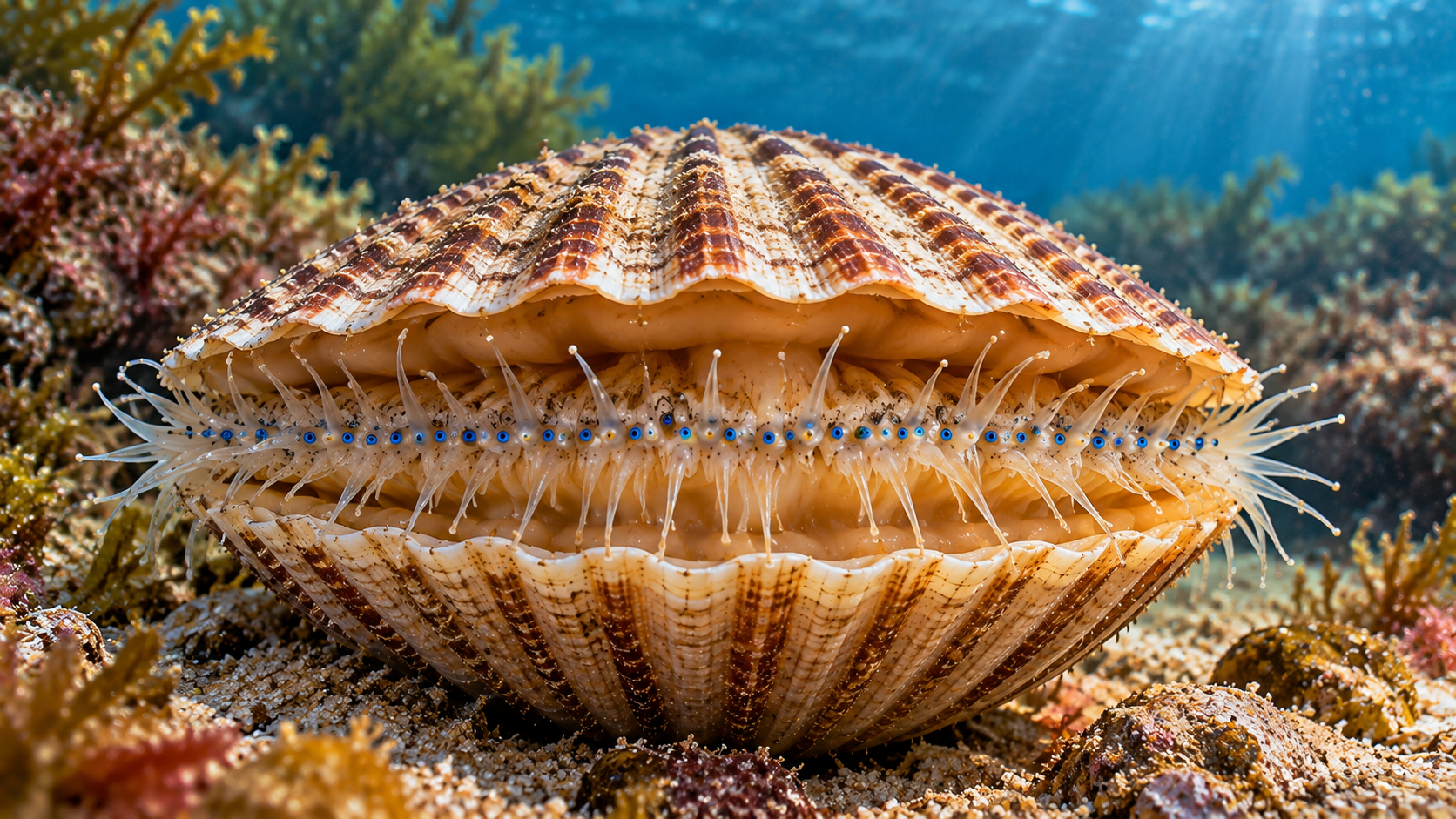
A scallop sitting on the seafloor does not look like an animal that needs an elaborate visual system. Then you look closely at the edge of its mantle and discover rows of tiny blue eyes staring back.
Some scallops have as many as 200 of them. Stranger still, the eyes do not focus light the way ours do. Their key optical component is a concave mirror built from microscopic guanine crystals.
A scallop can have an absurd number of eyes
Scallop eyes sit along the edge of the mantle, the soft tissue just inside the shell. Different species vary, but a 2017 Science study described the scallop visual system as containing up to 200 eyes.
These are not decorative blue dots. Behavioral research has shown that scallops respond visually to moving particles, and their eyes can form images.
A 2008 study in the Journal of Experimental Biology estimated that scallop vision has much better angular resolution than the eyes of many other bivalves.
The focusing system is a mirror, not the usual lens trick
Human eyes rely mainly on a cornea and lens to bend light toward the retina. Scallop eyes take a different route. Behind the retinas sits a curved reflective structure that focuses incoming light.
The 2017 Science study found that this mirror is made from layers of microscopic square guanine crystals. The crystals are arranged with enough precision to reduce optical aberrations and reflect wavelengths suited to the scallop’s habitat.
It is an eye built around a biological mirror.
The mirror is tiled like a tiny telescope
Researchers compared the structure to segmented reflecting telescopes. The individual guanine crystals are about a micrometer across, arranged into a multilayered surface whose overall three-dimensional shape focuses light.
That is the same basic optical idea used by a reflecting telescope: bounce light off a shaped mirror instead of relying entirely on a transparent lens.
The resemblance is not because scallops secretly invented astronomy. Physics keeps offering living things and engineers some of the same useful solutions.
Scallops have two retinas in each eye
The mirror does not focus everything onto one simple light-sensing sheet. Scallop eyes contain two retinal layers. Optical modeling from the mirror study showed that the system forms different images on those layers, with the central and peripheral fields handled differently.
Later work also found that some scallops change pupil size in response to light, trading sensitivity for resolution much as other visual systems do. That research is described in Current Biology.
What is a scallop doing with all that vision?
Scallops are not reading the menu. Vision can help them detect movement, changing light and possible threats. Some scallops can even swim by rapidly opening and closing their shells, so noticing something approaching has practical value.
We have covered plenty of strange marine sensory systems on BiggleBit, including octopus suckers that detect chemicals by touch. Scallops go in a different direction: lots of eyes, each built around a miniature crystal mirror.
So the next time a scallop looks like a simple shellfish, remember that the edge of that shell may be lined with a couple hundred tiny optical instruments.
Sources: Science (2017); Journal of Experimental Biology (2008); Current Biology (2019).