
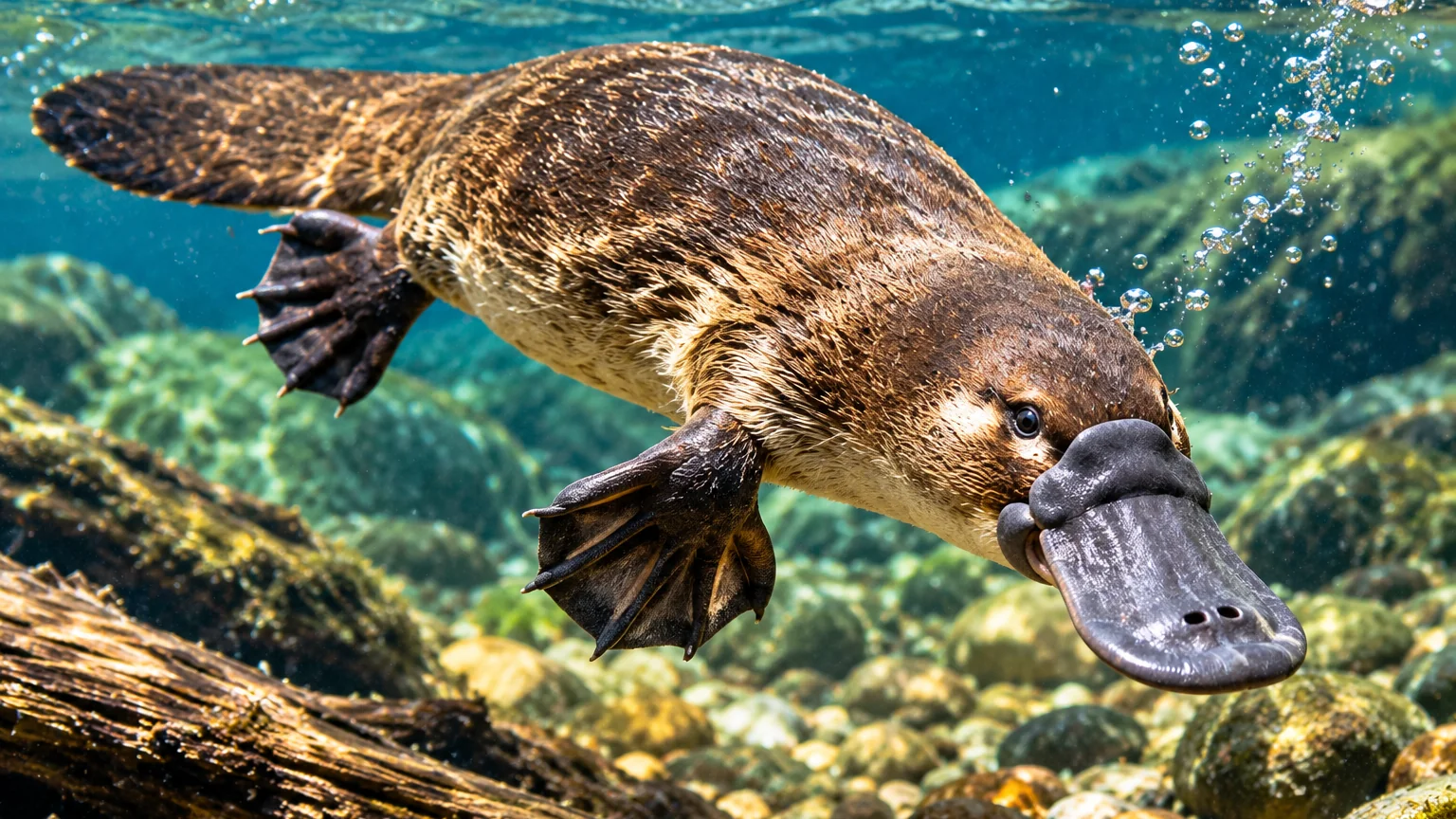
A platypus closes its eyes, ears and nostrils when it dives to look for food. Then it finds dinner with its bill. This is an animal that seems to have reviewed the usual mammal instructions and filed an extensive list of amendments.
The bill becomes an underwater sensor
The platypus lives in freshwater systems in eastern Australia. It is a mammal that lays eggs, has dense waterproof fur, and spends much of its time feeding in water. Its duck-like bill is not a decorative joke. It is an important sensory tool.
According to the Australian Museum, the bill contains receptors sensitive to mechanical pressure and electrical signals. These help the animal detect prey while its usual above-water senses are closed off during a dive.
Small aquatic invertebrates are important food items. A platypus searches riverbeds and other underwater surfaces, collecting food that it can store temporarily in cheek pouches. It later processes its catch at the surface.
Pressure and electrical cues help locate prey
The electrical signals come from living organisms. The animal is not seeing underwater electricity as a colorful glow, and it is not using a metal detector built into its face. Electroreception is a biological sensory ability that helps guide foraging.
Scientists are still investigating the precise way the bill integrates sensory information during prey detection. That uncertainty is worth keeping: a good explanation does not need to pretend every detail is settled.
For the primary evidence, see Australian Museum.
Searching a riverbed without looking
The platypus has another odd feature: adults do not chew with conventional teeth. They use hardened grinding plates to break down food. Apparently the bill’s sensory equipment took priority in the design budget.
Underwater, where visibility may be poor, the strategy makes sense. Close openings that need protection, rely on specialized sensors, and collect food from the bottom. What looks bizarre on land is useful in a stream.
The platypus is not an evolutionary mistake or a mash-up of unrelated animals. It is a highly specialized mammal whose strange-looking features solve real problems. Its bill does far more work than its resemblance to a duck would suggest.
Other animals also rely on unusual ways of detecting their surroundings: octopus suckers can detect chemicals by touch. A platypus bill uses a different combination of sensory receptors.
What a platypus can actually sense
Electroreception detects biological electrical cues, not a detailed visual image. A platypus still has to move through its environment and use information from its other bill receptors. Calling the bill a ‘sixth sense’ is catchy, but the more useful explanation is that it combines specialized kinds of sensory input.
That system is well suited to underwater foraging. Closing the eyes, ears and nostrils protects those openings during a dive, while receptors in the bill continue to provide information about nearby prey. The animal’s unusual face is doing several jobs at once.
Platypuses are also a reminder that mammalian evolution produced more than the familiar placental animals. They are monotremes, an egg-laying mammal lineage. Their reproductive biology and sensory anatomy are both distinctive, but neither makes them less modern or less well adapted to their habitat.