
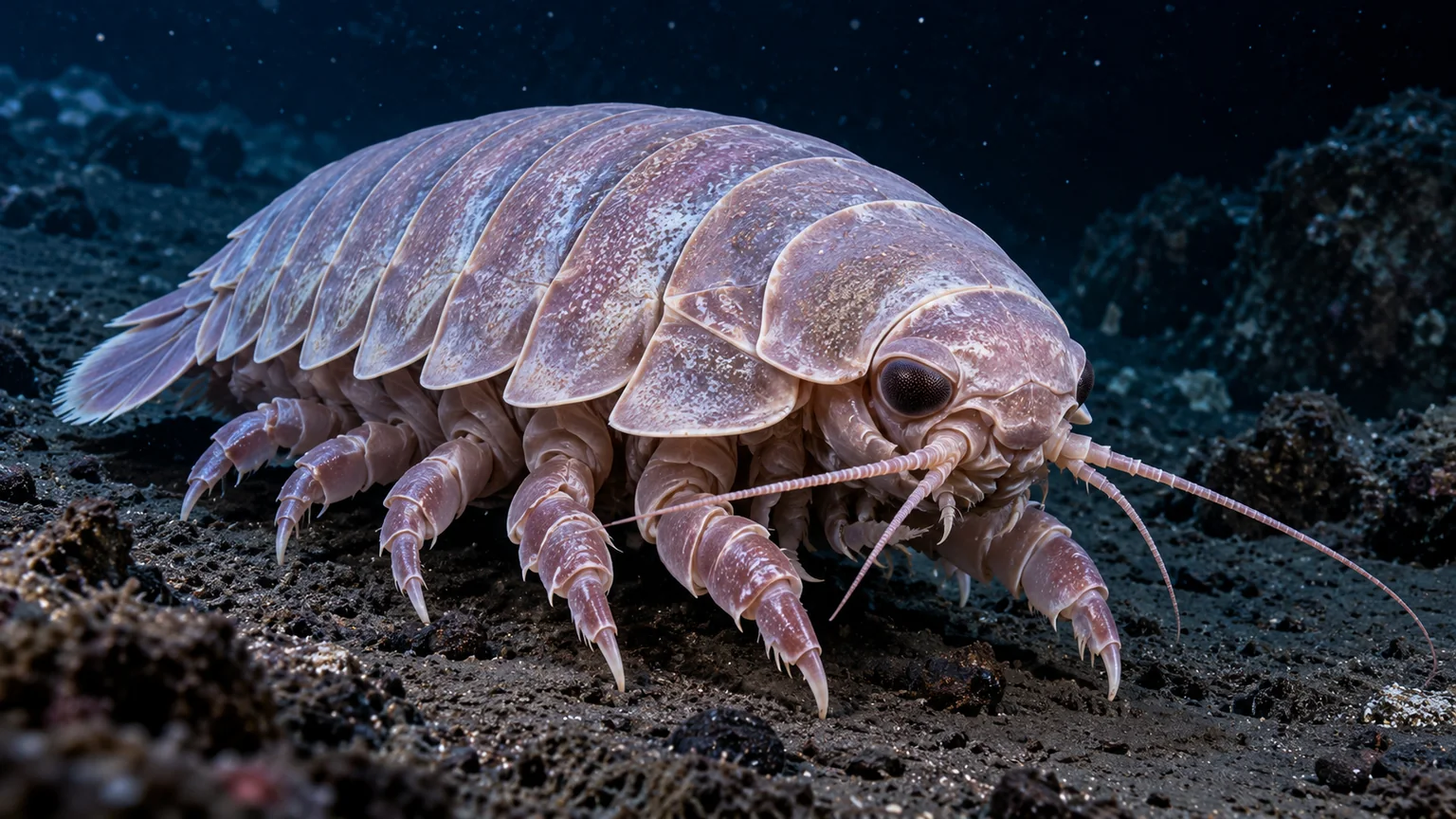
Imagine a pill bug, but roughly the size of a football, creeping across the deep seafloor. That’s the giant isopod. It has the armor, jointed legs and general attitude of something you might find beneath a flowerpot. The difference is that this relative of backyard woodlice lives in an ocean where lunch is not guaranteed.
And yes, some have survived astonishingly long stretches without eating. The important word is some.
A pill bug’s unusually large ocean cousin
Giant isopods are crustaceans in the genus Bathynomus, distant relatives of the tiny isopods that curl up in gardens. Monterey Bay Aquarium describes Bathynomus giganteus as reaching around 16 inches (40 centimeters). It has seven pairs of walking legs, an armored segmented body and two pairs of antennae.
Those antennae are useful in an environment with very little light. The animal explores the seabed using sensory appendages, not a flashlight or an especially convincing look of determination. Large eyes are part of the package too.
Why an isopod can wait so long for dinner
On the deep ocean floor, a fallen fish or a big animal carcass can be a rare feast. Between those events, particles of organic material drift down as marine snow. Giant isopods scavenge that food and sometimes encounter substantial remains. An unreliable supply makes a feast-or-famine feeding strategy useful.
The Natural History Museum recounts a captive giant isopod in Japan that reportedly went five years without eating. That is an extraordinary aquarium observation—not a stopwatch measurement of the average wild isopod’s dinner schedule.
Captive records can tell keepers when an individual did or did not eat. They cannot, by themselves, establish how often the same species feeds on the open seafloor, or guarantee that every individual could endure the same fast.
A 2026 study published in Cell gets closer to explaining how some supergiant isopods manage those gaps. Researchers compared the species Bathynomus jamesi and B. doederleini. The larger species could retain unusually large meals in an expanded stomach and had a lower resting metabolic rate. They also identified an energy-regulating gene called ND1, originally acquired from microbes in an ancient genetic transfer. In experiments on other organisms, that gene helped reduce energy use under cold conditions. It is a fascinating clue, not proof that every giant isopod goes five years without dinner—or that the exact mechanism has been demonstrated in every Bathynomus species.
What they actually eat in the deep sea
Their diet is less science-fiction monster and more cleanup crew: fish remains, crustacean scraps, marine snow and other organic matter. Monterey Bay Aquarium describes them roaming the seafloor for fish carcasses and debris from above. That does not mean they are incapable of taking live prey; it means their role as scavengers is central to understanding them.
Deep-sea carcasses can feed whole communities. When a whale sinks, the resulting whale fall is an enormous temporary source of food. An isopod has not discovered a secret underwater buffet service; it has simply evolved to make the most of opportunities.
Being giant doesn’t make them invincible
That oversized body is a case of deep-sea gigantism, a pattern in which some deep-water animals grow much bigger than shallow-water relatives. Scientists have proposed several explanations, including temperature, oxygen and ecological conditions, but it is too neat to assign every unusually large species a single proven cause.
The animal’s hard exoskeleton is protection, not immunity. Deep-sea life still has predators, environmental pressures and an energy budget. Going for a long time without a meal is survival under scarcity, not a recommendation for skipping lunch.
The strangest thing is the ordinary job
For all their alien-looking armor, giant isopods are part of the seafloor’s recycling system. A fish that falls out of the sunlit ocean becomes food below. That connection helps explain why the deep can support scavengers even where there is no sunlight for plants to grow.
We’ve covered another ocean surprise on BiggleBit: underwater brine pools that look like lakes on the seafloor. In one case the water itself forms the oddity; here it’s an armored crustacean willing to wait for whatever the current brings.
The five-year fasting story is astonishing. But the animal doesn’t need that record to be interesting. It’s a giant roly-poly in the deep ocean, doing an essential cleanup job in a place where the next meal could be a very long way off.