
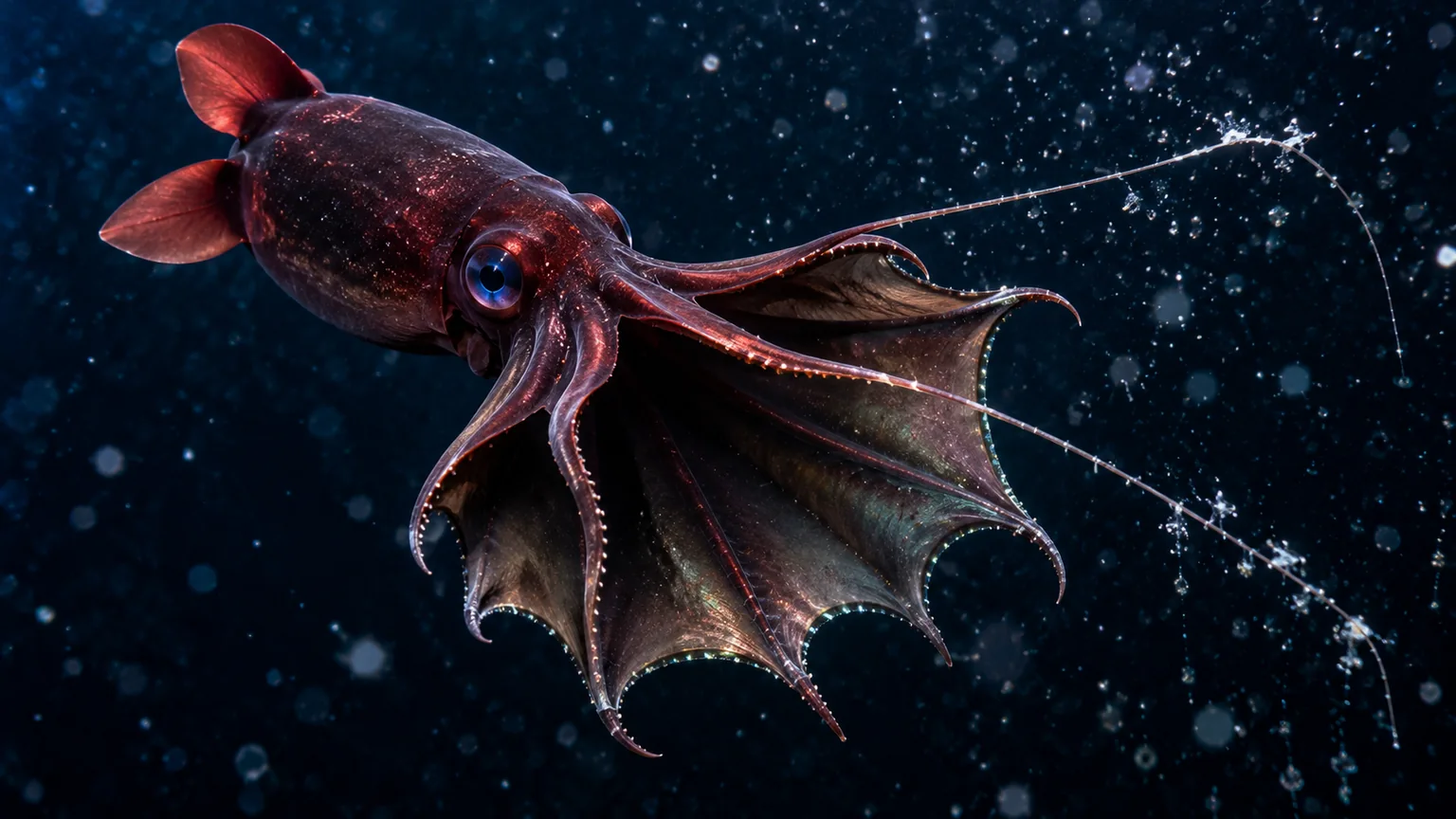
With a name that translates to “vampire squid from hell,” you’d expect something with fangs. Instead, the vampire squid spends much of its life gently collecting tiny scraps falling through the deep ocean. No bloodsucking. No hunt for unsuspecting divers. An impressive name for a creature largely interested in leftovers.
And despite the name, Vampyroteuthis infernalis isn’t a true squid. Its peculiar anatomy places it in its own surviving branch of the cephalopod family tree.
Why it isn’t a squid—or a vampire
The Monterey Bay Aquarium Research Institute (MBARI) describes it as the last living representative of an ancient cephalopod lineage. It has eight web-connected arms, broad fins and two long, retractable feeding filaments. Those filaments aren’t the same grasping tentacles used by predatory squid.
A vampire squid may reach about 30 centimeters (12 inches) in total length. It lives in deep tropical and temperate waters, often about 600–900 meters (2,000–3,000 feet) down, including the oxygen-minimum zone. The cloak-like web and dark body give it a wonderfully theatrical silhouette. The lifestyle is much less theatrical.
Marine snow: a surprisingly messy dinner
In the deep ocean, particles from life nearer the surface drift downward like snow. The mixture includes dead plankton, discarded mucus, fecal pellets and bits of other animals. Scientists call it marine snow. You might call it a cleanup job with an especially unfortunate menu.
Rather than chase fish, the vampire squid extends two thin, sticky filaments and gathers passing particles. When enough material sticks, it pulls a filament through its arms, scrapes off the food and rolls it into mucus-bound packets before eating. Monterey Bay Aquarium describes this mucus-packet method in detail.
A 2012 study by Hendrik Hoving and Bruce Robison used underwater vehicle observations, collected animals and anatomy to establish its detritus-feeding strategy. The diet can also include small zooplankton, so it would be wrong to say the animal never consumes anything alive. Its main feeding strategy is nevertheless very different from an ordinary hunting squid’s.
Surviving where oxygen is scarce
Vampire squid specialize in waters with little dissolved oxygen. They conserve energy with a slow, measured life rather than high-speed pursuit. Their near-neutral buoyancy means they don’t have to spend much energy just staying at a particular depth.
Their food arrives slowly, but a low-energy lifestyle makes that modest supply workable. MBARI’s observations reveal a creature adapted to making the most of an environment that would be difficult for many other cephalopods.
When threatened, the cloak becomes a shield
Its arms are joined by a web of skin. When disturbed, the vampire squid can pull that web over its body, exposing the arm tips in a defensive position sometimes called the “pineapple” posture. Despite the appearance, it has not turned into an inside-out umbrella for a magic trick.
It can also produce glowing mucus that may distract a predator. Unlike many shallow-water cephalopods, it doesn’t rely on a conventional dark ink cloud. The National Ocean Service explains its luminous defensive slime. None of these tricks guarantees escape; they are potential ways to survive an encounter in the darkness.
The creature’s scariest feature is its branding
The vampire squid illustrates why common animal names can be wonderfully misleading. Its webbed arms, dramatic posture and low-light defenses suit the horror-movie title. But its everyday business is collecting tiny sinking leftovers with a pair of sticky lines.
Another deep-water invertebrate has a very different trick: octopuses can taste chemicals with their suckers. Both are cephalopods, but their diets and ways of meeting the world are very different.
Somewhere in the deep, the “vampire squid from hell” is probably gathering its next mucus-wrapped snack. Hollywood owes this animal a less threatening publicist.