
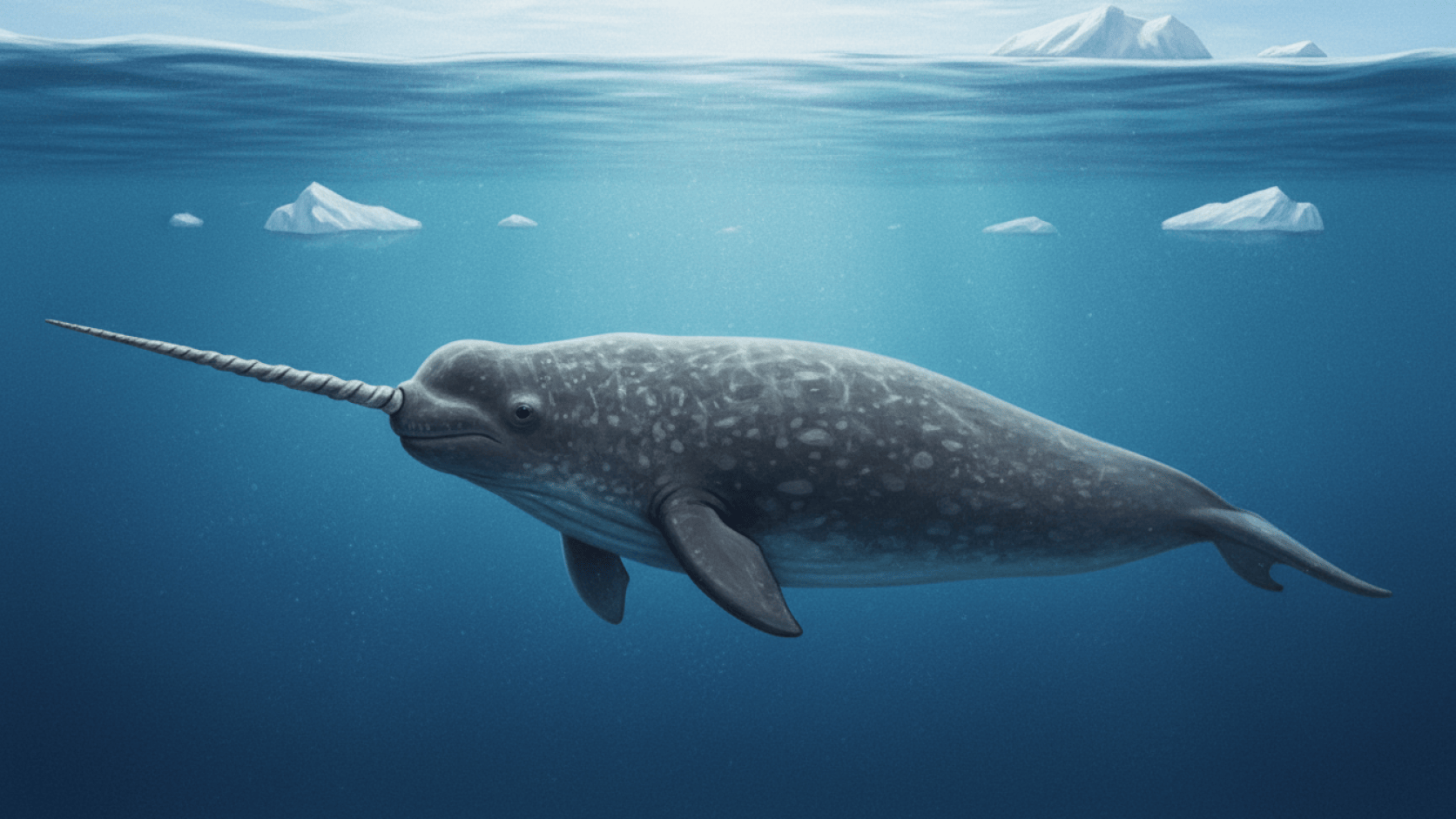
A narwhal’s long spiral tusk is a tooth. Not a horn growing out of its forehead, and not a spear added by an enthusiastic designer. It is usually the animal’s left upper canine, elongated dramatically through the lip.
That makes the so-called unicorn of the sea even stranger than the nickname suggests.
It’s an unusually ambitious canine
Most mammals keep their canine teeth in the mouth. A typical male narwhal grows one into a long, left-spiraling tusk that projects from the front of the head.
The other canine usually remains inside the skull. Some narwhals develop two tusks; a few females also grow one. These are exceptions, not a reason to pretend every narwhal looks the same.
Scientists checked the skulls
Researchers working with museum collections and specimens studied narwhal skull anatomy to clarify exactly which tooth forms the tusk.
A 2012 anatomical study of 131 narwhal skulls found that the tusk originates in the upper jaw’s canine position, establishing it as a canine rather than an incisor or a true horn.
That matters because a horn and a tooth are made and grown differently. A narwhal tusk is tied to tooth development, not the same anatomy as a rhinoceros horn.
What does a narwhal do with a giant tooth?
That is a more complicated question than identifying it. Researchers have investigated several potential roles, including social and sexual signaling and sensory functions. Observations of narwhals using tusks do not reduce the entire structure to one universal purpose.
A 2014 anatomical and sensory study described open channels in the tusk’s outer cementum connected to dentinal tubules and nerve-bearing tissue inside the tooth. In tests involving six live-captured male narwhals, the researchers also reported heart-rate responses when the tusk was exposed alternately to high-salt and fresh water. That supports a sensory ability, but does not show that sensing is the tusk’s only or main purpose in the wild.
There is also direct evidence of a feeding use. In 2017, Fisheries and Oceans Canada reported drone footage from Tremblay Sound, Nunavut, showing narwhals tapping fish with their tusks before eating them. The observation, made with researchers and Inuit community partners, documents one real behavior, not a settled explanation for why the tusk evolved. Researchers still consider sexual selection a likely major function.
The spiral isn’t an accident
The tusk has an unmistakable spiral shape. Its physical form is part of normal growth; it isn’t twisted by a whale deliberately spinning in the ocean.
A 2026 Nature Communications study mapped the tusk from mineralized collagen fibers to its visible twist. The researchers found that the outer cementum follows a left-handed helical pattern while the inner dentine has a right-handed arrangement. That helps explain the long tooth’s unusual structure and mechanical stability, but it does not establish what narwhals use the tusk for.
For another ocean oddity, see the vampire squid, which isn’t a true squid and doesn’t drink blood. Marine-animal names can be an unreliable guide to what is actually happening.
A narwhal looks like a whale carrying a unicorn horn. Anatomically, it’s a whale with one exceptionally dramatic tooth.