
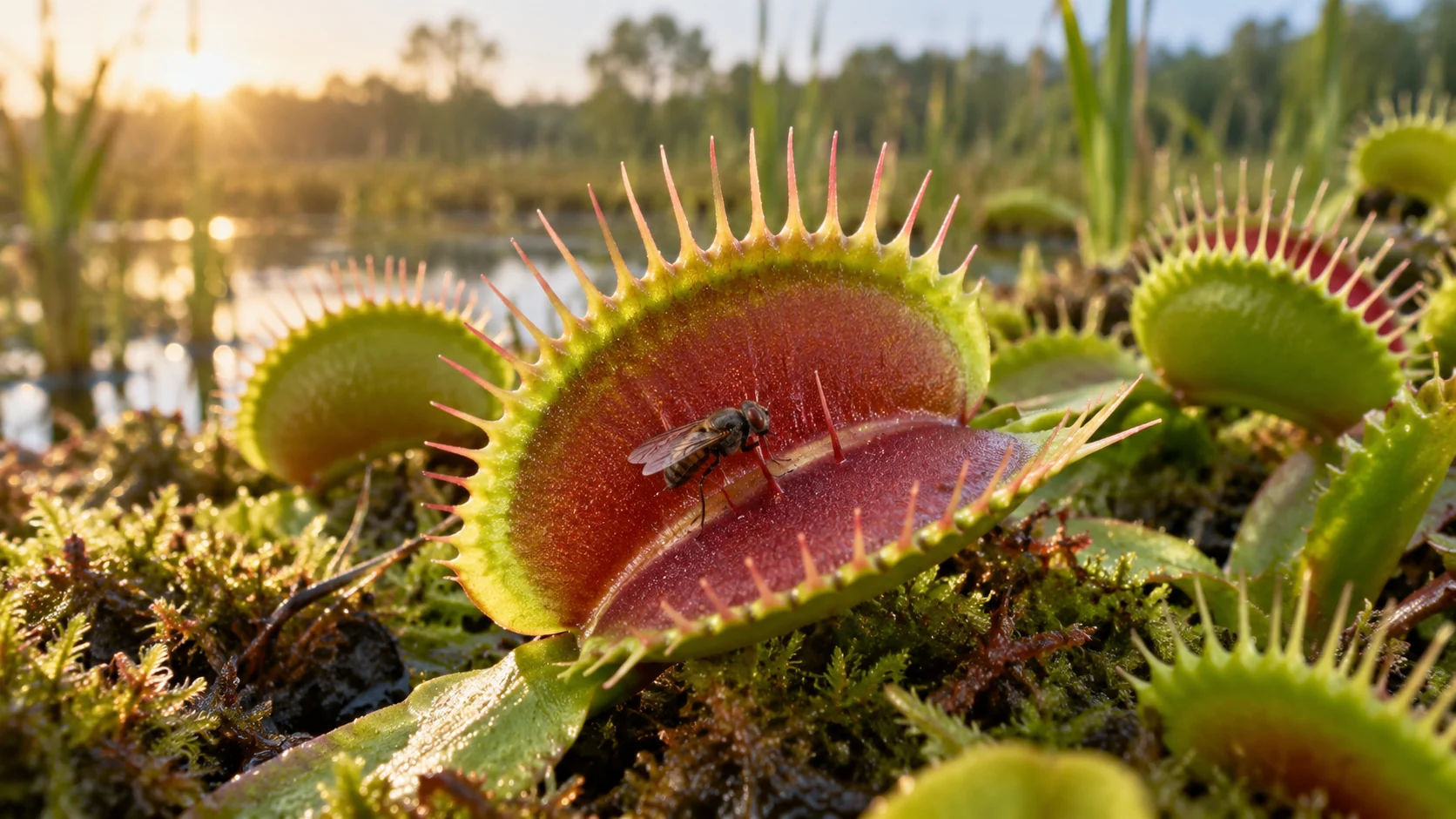
A Venus flytrap doesn’t just snap shut whenever something tickles it. The carnivorous plant responds to a sequence of electrical signals, and the number of signals helps determine whether it closes—and whether it goes to the trouble of digesting a meal. No brain, no calculator, no tiny accountant hiding beneath the soil.
The remarkable part is that the trap’s decision changes as more signals arrive. What looks like one quick bite is a surprisingly elaborate biological process.
Two electrical signals usually set off the trap
A Venus flytrap (Dionaea muscipula) has small, sensitive trigger hairs on the inside of its two leaf lobes. When a hair bends in the right way, the plant generates an electrical impulse called an action potential. It’s a signal moving through plant tissue, not a thought or a miniature animal nervous system.
Under ordinary conditions, two such signals within roughly 30 seconds prompt the lobes to close around a potential victim. A single fleeting stimulus generally isn’t enough. That helps prevent every raindrop or stray bit of debris from setting off the trap, though the plant’s real response depends on the stimulation.
A 2020 study in Nature Plants tracked calcium signaling in engineered Venus flytraps. One stimulus raised calcium levels in cells, and a second raised them further toward the threshold associated with closure. Wait too long between the signals and the effect of the first fades. That’s a biological short-term memory measured in changing calcium concentration, not a plant pondering its choices.
More signals help turn a catch into dinner
Shutting a trap is only part of the story. A captured insect can continue moving and brushing against the hairs after the lobes close. Those movements produce additional electrical signals.
In a 2016 Current Biology study, researchers found that the signal count affected the plant’s digestive machinery. Two signals were enough for rapid closure and activation of a jasmonate-related signaling response. With additional signals, the trap increased expression of genes associated with digestive enzymes and a transporter involved in taking up sodium from prey. The enzyme-gene response appeared after more than three electrical impulses; stronger stimulation produced a larger response in their experiments.
That means the flytrap isn’t automatically committed to a full chemical dinner the instant it snaps. Continuing movement provides further information that something worth processing might be inside.
There is a considerable difference between a leaf shutting and the same leaf mounting a full digestive response. For a plant growing where nutrients can be scarce, that distinction matters.
Here’s the catch: two signals don’t always require two touches
A common version of the flytrap story says it must be touched twice. It’s catchy, and it can be misleading.
Researchers writing in PLOS Biology in 2020 used precision instruments to bend the trigger hairs and record what happened. They showed that, under some conditions, one sustained mechanical touch can generate two action potentials and trigger closure.
The plant responds to the signals, not to a human tally of separate pokes. A flytrap may snap after what looks like one touch, without contradicting the usual two-signal mechanism.
The strangest part isn’t the counting
A Venus flytrap has no neurons to run the show. Its living cells nevertheless transmit electrical information, change calcium levels and switch chemical pathways depending on stimulation. The same basic idea—reading a physical contact signal—also turns up in unexpected animal adaptations: butterflies taste with sensors on their feet.
The flytrap’s trick is more specific than simply ‘counting to five.’ It uses a changing sequence of signals to separate a possible meal from movement that might not be worth pursuing. That’s plenty impressive for a leaf.