
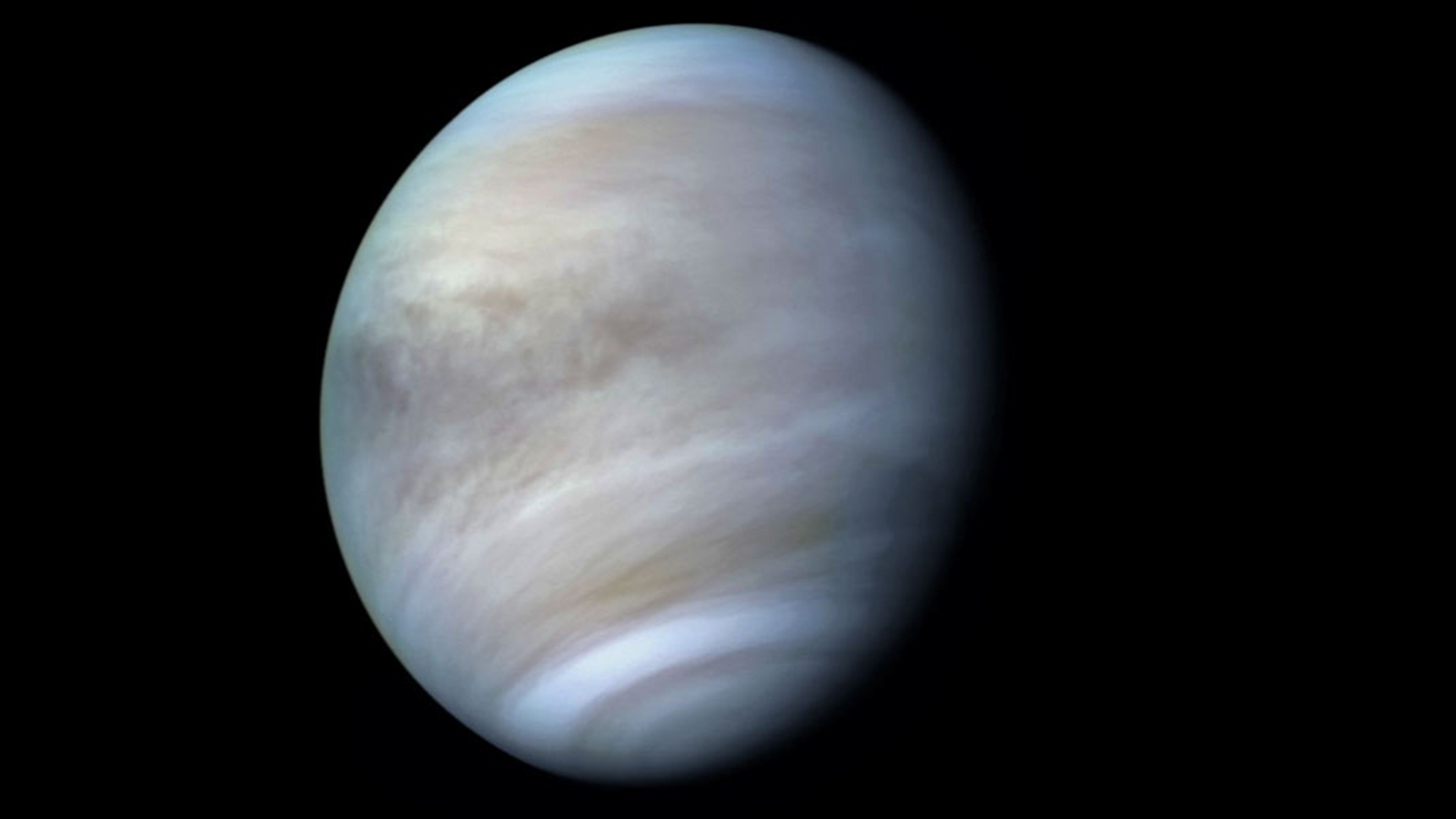
A day on Venus is longer than a year on Venus.
That sounds like somebody dropped a calculator during astronomy class, but the numbers really do work: Venus takes about 243 Earth days to rotate once on its axis and only about 225 Earth days to complete one orbit around the Sun.
So Venus can finish its entire year before it finishes one full spin.

Venus Is in Absolutely No Hurry to Turn Around
Earth gives us a convenient arrangement: roughly 24 hours for one rotation and about 365 days for one trip around the Sun. We built clocks, calendars and an unreasonable number of Monday-morning meetings around it.
Venus did not sign that agreement.
According to NASA’s Venus facts, the planet’s rotation period is about 243 Earth days. Its year—the time required to orbit the Sun—is only about 225 Earth days.
The planet is relatively close to the Sun, so its orbital path is shorter than Earth’s and it moves around the Sun faster. But Venus rotates astonishingly slowly. Put those two facts together and you get a planet where the year ends while the planet is still working on the same rotation.
There Is One Very Venus-Like Catch
“Day” can mean two different things in astronomy, and Venus makes that distinction impossible to ignore.
A sidereal day measures one complete rotation relative to distant stars. That is the roughly 243-Earth-day number, and it really is longer than Venus’s roughly 225-Earth-day year.
But if by “day” you mean the time from one sunrise to the next—a solar day—Venus comes in at about 117 Earth days.
That is still a spectacularly bad place to wait for tomorrow, but it is shorter than the Venusian year.
NASA’s planetary fact sheet gives the orbital period as about 224.7 Earth days and the solar-day length as about 116.75 Earth days. The apparently contradictory numbers are simply measuring different things.
The Sun Also Rises in the “Wrong” Direction
Venus adds another twist: it rotates backward compared with Earth and most of the other planets. Astronomers call that retrograde rotation.
If you could somehow stand on the surface without being crushed by the atmosphere or cooked by temperatures hot enough to melt lead, you would see the Sun rise in the west and set in the east.
NASA says Venus’s surface is around 900 degrees Fahrenheit, with a thick carbon-dioxide atmosphere and clouds containing sulfuric acid. So the backward sunrise is arguably not the first logistical issue on your itinerary.
Why Does Venus Rotate So Slowly?
The honest answer is that scientists can describe Venus’s unusual rotation much more confidently than they can give you one neat origin story for it.
Researchers have investigated several possible influences over the planet’s history, including gravitational tides from the Sun, atmospheric tides and the way momentum moves between Venus’s massive atmosphere and the solid planet. Modern radar measurements have even found that the exact length of Venus’s rotation can vary slightly.
A NASA-indexed study using Earth-based radar observations from 2006 through 2020 measured an average sidereal rotation period of about 243.0226 Earth days and found measurable variations in the spin period.
So the clean internet fact survives the fact-check: one complete Venus rotation takes longer than one Venus orbit around the Sun.
It just comes with the wonderfully annoying astronomical footnote that sunrise-to-sunrise is shorter.
Venus apparently found a way to make both “a day is longer than a year” and “a day is shorter than a year” true, depending on which perfectly legitimate definition of day you use.
The Moon has its own timing surprise: it moves about 1.5 inches farther from Earth each year. For more planetary-grade weirdness from nature, see why octopuses have three hearts—and one stops during jet-propelled swimming.