
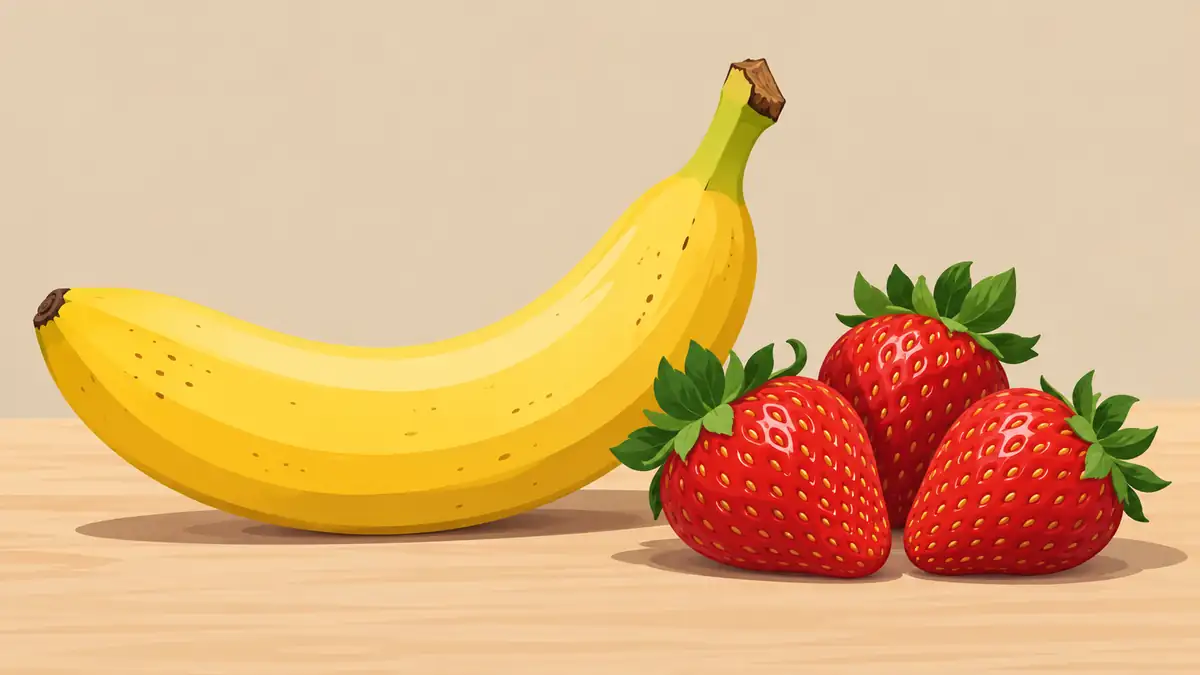
A banana is a berry. A strawberry is not.
This sounds like the kind of fact invented by someone who enjoys starting arguments in the produce aisle, but botanically it is correct. The problem is that everyday English uses “berry” to mean “small, juicy fruit we put on yogurt.” Botany uses the word like a structural engineer with a clipboard.
Why a banana counts as a berry
Botanists classify fruit by how it develops from the flower, not by whether it fits nicely in a cereal bowl. A true botanical berry is a fleshy fruit that develops from a single ovary. Bananas fit that structure.
The North Carolina Extension Gardener Plant Toolbox lists the fruit type of Musa acuminata—the species behind many cultivated bananas—as a berry. It also notes that commercial cultivars are often bred to be seedless. So yes: the long yellow thing with a peel that nobody on Earth casually calls a berry is, scientifically, a berry.
Wild bananas make the classification easier to see because their fruit contains obvious hard seeds. Cultivated bananas have been selected for edible flesh and dramatically reduced seed development, which is much more convenient for breakfast and much less useful for winning an argument based on appearances.
Why a strawberry is not a berry
Strawberries commit the opposite offense. They look like the dictionary illustration for “berry,” but the red fleshy part is not what botanists mean by a berry at all.
Washington State University’s Small Fruit Horticulture Research & Extension Program describes the strawberry as an aggregate accessory fruit. The juicy red tissue is the enlarged receptacle of the flower. The little specks scattered across the outside—the things most of us call seeds—are actually individual dry fruits called achenes. Each achene contains a seed.
The University of Connecticut’s strawberry guide makes the same distinction: the fleshy part is the receptacle, while the many ovaries on the surface mature into the actual fruits.
So the strawberry is basically carrying its real fruits on the outside while wearing an enormous edible flower part underneath them. This is botanically efficient and linguistically hostile.
The grocery store is not a botany textbook
None of this means the produce department has been lying to you. Culinary words and botanical words do different jobs. In cooking, “berry” is a useful category based on size, flavor, texture and how we eat something. In botany, fruit categories describe reproductive structures and how flower parts develop.
That is why tomatoes can be berries, raspberries can fail the berry test, cucumbers can belong to a specialized berry type, and strawberries can somehow lose despite having “berry” right there in the name.
Washington State University’s basic botany guide shows the broader pattern: fruits that look similar on a plate can come from very different flower structures. The categories are not trying to describe lunch. They are describing anatomy.
So which one wins the berry argument?
Banana: berry.
Strawberry: aggregate accessory fruit.
Your smoothie remains unaffected.
And if you enjoy perfectly ordinary things refusing to behave the way their names suggest, Venus has a day that lasts longer than its year. Apparently even planets enjoy this kind of nonsense.