
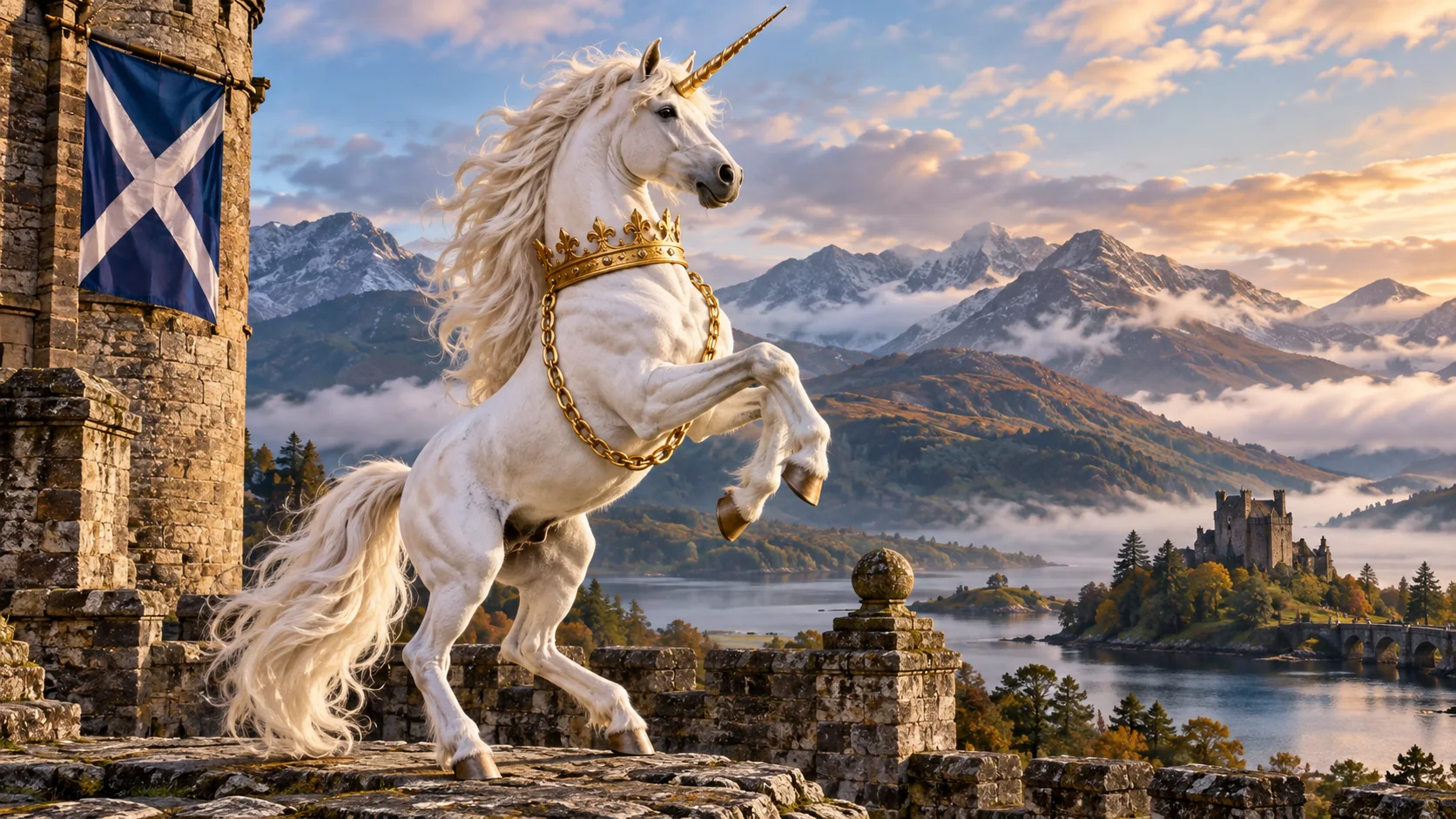
Scotland’s national animal is the unicorn. Not a Highland cow or a red deer. A mythical, one-horned creature you will not find in a wildlife survey, but you will find on royal coats of arms and historic buildings.
That sounds like somebody lost a bet while choosing national symbols. But the unicorn’s place in Scottish history predates souvenir shops by centuries. Its horn isn’t even the most interesting part. Its royal job description is.
Why would Scotland choose a unicorn?
In medieval symbolism, the unicorn wasn’t simply a pretty horse with an unexpected forehead attachment. It represented purity and innocence, but also strength and an unwillingness to be tamed. Those qualities made it useful to rulers looking for a visual shorthand for royal power and independence.
VisitScotland, the country’s national tourism organization, identifies the unicorn as the national animal and traces it through royal history. The Royal Collection Trust also describes the creature as Scotland’s national animal and explains its heraldic importance.
This was a symbolic choice, not a claim that unicorns actually roamed Scotland’s hills. Nobody needed to draw up a unicorn conservation plan.
The unicorn had a place in Scottish royalty long before glitter
According to VisitScotland, unicorn imagery appeared in Scottish royal arms during the reign of William I in the 12th century. By the 15th century, it appeared on gold coins issued under James III. That’s quite a promotion for a creature that never existed.
Before 1603, Scottish royal arms displayed two unicorns supporting a shield. That year James VI of Scotland also became James I of England, and the combined royal arms came to feature Scotland’s unicorn alongside England’s lion. The two national beasts became heraldic colleagues. It’s a partnership with almost no chance of appearing in a wildlife documentary.
Why does Scotland’s unicorn wear chains?
Look closely at the traditional heraldic unicorn. A crown sits around its neck and chains stretch across its body. Not quite the carefree creature of children’s stationery.
The Royal Collection Trust explains that this represents a legendary beast brought under the monarch’s command. Medieval unicorns were supposed to be exceptionally powerful and difficult to control. A ruler who could command such a creature was making an impressively direct point about royal authority.
VisitScotland says the chains may likewise symbolize Scottish kings’ power to tame the untamable. That’s an interpretation of imagery and myth, not evidence of an actual unicorn capture.
You can see unicorns all over Scotland—made of stone
You won’t see a living unicorn in the Highlands, but Scotland has plenty of stone, painted and carved examples. The Royal Collection Trust points to unicorn decorations at Edinburgh’s Palace of Holyroodhouse, including architectural details.
VisitScotland also describes examples at Edinburgh Castle, Stirling Castle and market crosses in towns across the country. On such monuments the unicorn is less a fantasy animal than a record of how earlier generations expressed power and identity.
There is even a National Unicorn Day on April 9, according to VisitScotland. That’s an observance, not a reason to expect government offices to close.
What does a national animal have to do with biology?
Very little, in this case. National emblems don’t have to be animals you could photograph in the wild. A mythological creature can express values people have attached to a place over centuries.
It’s another reminder that familiar categories don’t always mean what we assume. Botanists can tell you bananas are berries and strawberries aren’t. Scotland can tell you its national animal is a unicorn. The interesting part is learning why.
Scotland didn’t run out of real animals. It picked a mythical one with enough history to carry a crown.