
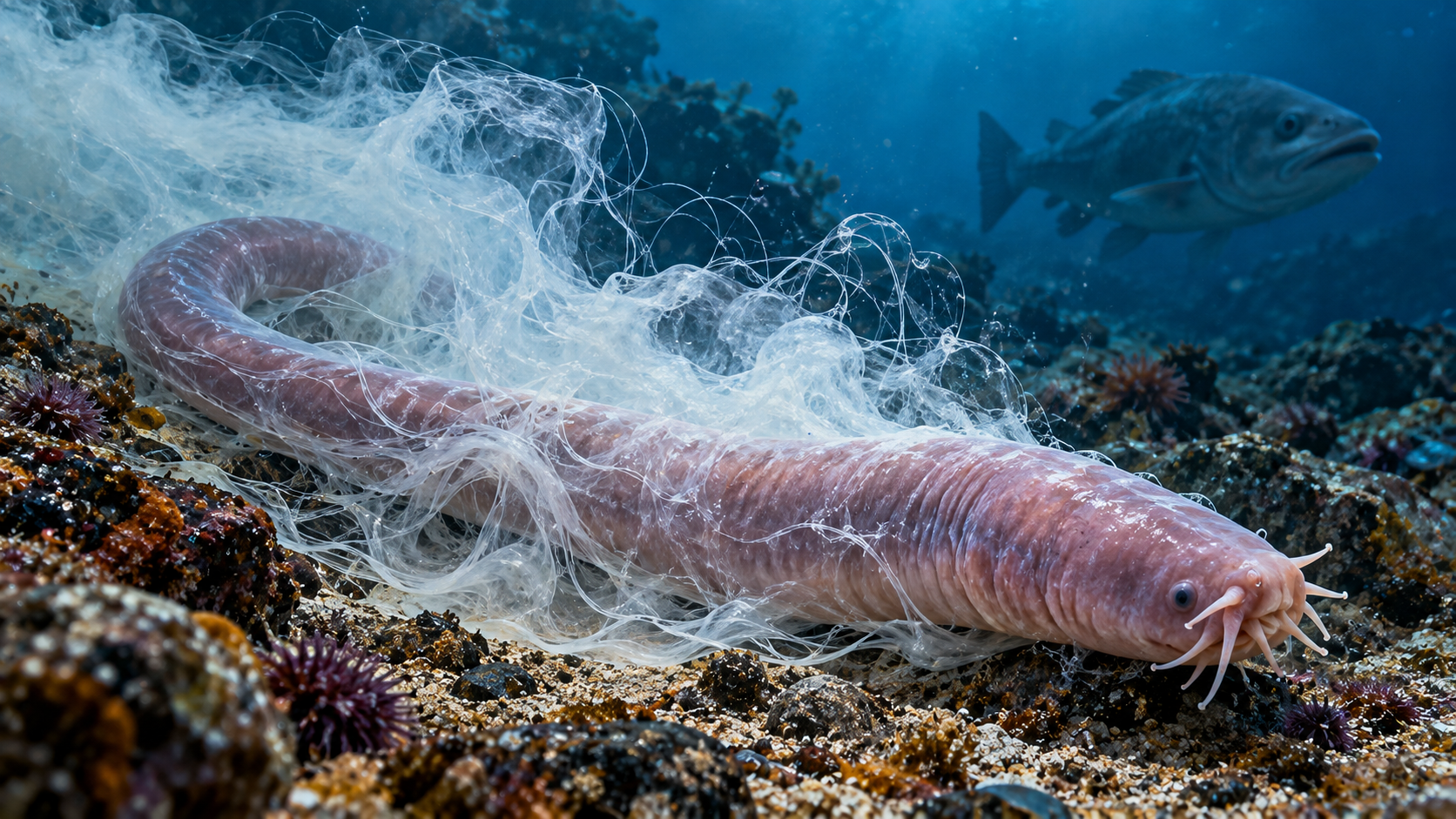
If a predator tries to bite a hagfish, the hagfish does not need claws, armor or a dramatic sprint. It can turn the water around the attacker’s mouth into a cloud of fibrous slime.
The slime is so good at interfering with water flow across gills that researchers have spent years trying to understand how something made mostly of seawater can be such an effective biological clog.
The slime deploys almost instantly
Hagfish have rows of slime glands along their bodies. When attacked, those glands release concentrated material containing mucus and tightly packed protein threads.
Once the material hits seawater and mixes, it expands into an enormous volume of extremely dilute slime. A 2015 review described the deployment as happening in a fraction of a second.
This is not ordinary mucus scaled up. It is a two-part system: mucous components help control flow while long protein threads give the material strength.
The target appears to be the predator’s gills
Researchers have tested the gill-clogging idea directly. A 2006 experiment found that hagfish slime increased resistance to water flowing through artificial and real fish gills.
Then field observations added the part every lab result secretly wants: video of predators actually getting slimed. A 2011 study reported fish predators abandoning attacks after hagfish slime entered the mouth and gill area.
The paper described the slime as an effective defense against gill-breathing predators, not a magical toxin. The problem is mechanical: the slime interferes with the water flow a fish needs across its gills.
See the 2011 predator study.
Even ridiculously dilute slime can still clog
A 2023 study tested how hagfish slime blocks flow and found that it remains effective at extremely low concentrations. The mucus and threads did different jobs: mucus helped create low-permeability clogging, while the threads added mechanical strength and helped the clog keep working.
The researchers estimated effective pore sizes in the slime network on the scale of tens to hundreds of nanometers. In other words, the material does not need to resemble a thick blob of glue to become a serious problem for water moving through gills.
The study is available through Journal of the Royal Society Interface.
Then the hagfish ties itself in a knot
There is one obvious problem with releasing a giant cloud of slime around yourself: now you are also in a giant cloud of slime.
Hagfish can tie their long flexible bodies into an overhand knot and slide that knot along themselves. Research on slime flow suggests this motion may help shear the slime off the hagfish’s own body.
A 2016 study found that hagfish slime behaves differently depending on the direction of force. Flow conditions associated with suction feeding can increase resistance, while shear can make the slime collapse. That combination is almost unfairly convenient: difficult for a predator to pull through its gills, easier for the hagfish to wipe away with a moving knot.
The flow study is summarized at PubMed.
This is less “gross fish” and more materials science
Hagfish slime has attracted attention from researchers interested in fibers, hydrogels and unusual soft materials. The biology works with very little solid material and an enormous amount of water, yet produces a defense that deploys quickly and resists flow in just the right way.
BiggleBit has another deep-sea oddity in giant isopods that can endure very long gaps between meals. Hagfish win a different category: “animal most likely to turn a predator’s own breathing hardware into the reason it gives up.”
Sources: Journal of Experimental Biology (2006); Scientific Reports (2011); Journal of the Royal Society Interface (2023); Scientific Reports (2016).