
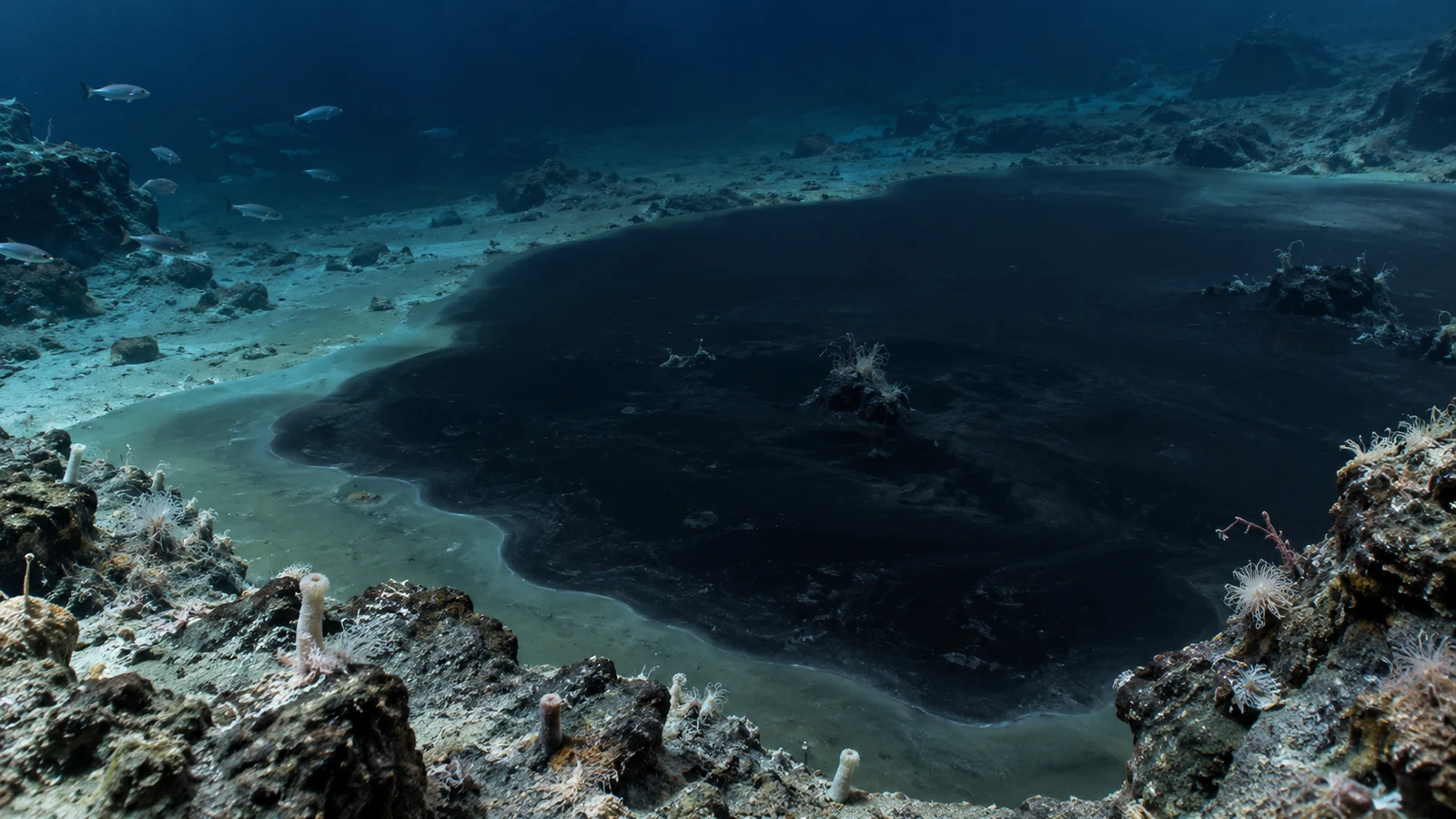
Some parts of the seafloor have shorelines. There is water on both sides, yet one side behaves like a separate lake: a concentrated pool of brine that sits beneath the ordinary seawater around it.
There is no wall holding it in place. The extra salt makes the brine denser, so it collects in depressions and mixes only slowly with the water above. On a remotely operated vehicle’s camera, the boundary can resemble the edge of a dark pond.
Why doesn’t an underwater lake simply mix away?
The answer is density. Dissolved salt adds mass to water, and sufficiently salty brine settles below less dense seawater. NOAA Ocean Exploration describes heavy brine flowing along the bottom and gathering in large pools in the Gulf of Mexico.
It is not a permanent seal. Some water and dissolved materials cross the boundary, but the sharp salt difference limits mixing. Researchers call the transition a halocline. Woods Hole Oceanographic Institution explains that, in some deep basins, the change from ordinary seawater to extremely salty water takes place over a layer only about a meter thick.
That boundary can also look cloudy because drifting particles get trapped at different depths within it. The resemblance to a shoreline is real enough on camera, even though everything is underwater.
Where does all the extra salt come from?
In parts of the Gulf of Mexico, seawater moves through thick layers of buried salt. As it dissolves those deposits and returns through the seafloor, it can emerge as dense brine. NOAA’s cold-seeps factsheet describes how that process produces underwater lakes.
Different basins have different geological histories and chemical mixtures. They are not all identical Gulf of Mexico salt seeps. Woods Hole researchers describe deep hypersaline anoxic basins in the Mediterranean, Red Sea and other regions. Some contain brines as much as ten times saltier than ordinary seawater.
Some pools are dangerous. Their edges can be crowded.
Extreme salt is difficult for many marine animals to tolerate, and some pools also lack usable dissolved oxygen or contain high concentrations of chemicals such as sulfide and methane. A Woods Hole report on the Gulf of Mexico’s so-called Jacuzzi of Despair described brine roughly five times saltier than seawater, with substantial methane. Few ordinary animals entering that pool survive.
But the entire neighborhood is not lifeless. During a 2014 Gulf exploration at a depth of about 1,260 meters, NOAA documented a brine pool bordered by animals including anemones, corals, fish, crustaceans and tubeworms. Those observations describe the pool’s surroundings, not a collection of fish comfortably swimming through the most concentrated brine.
At the salt boundary itself, unusual microbes make use of chemical conditions that exclude many other organisms. Woods Hole researchers describe bacteria, archaea and microbial eukaryotes living along haloclines and feeding on organic particles that collect there.
How do researchers study an ocean-floor lake?
Remotely operated vehicles can descend thousands of feet, observe the dividing line and collect water samples without sending a diver into extreme conditions. The Gulf of Mexico discovery reported by NOAA came during a 2014 expedition looking for cold seeps. Other teams have used sensors lowered by underwater vehicles to measure dissolved gases without bringing every sample back to the surface.
The environment is also a reminder that the word brine covers very different places. At Antarctica’s Blood Falls, iron-rich salty water escapes from beneath a glacier and stains the ice red. An ocean-floor brine pool is a separate geological setting with its own chemistry and living communities.
A camera sees a shoreline; instruments reveal an abrupt shift in salt, oxygen and the organisms that can live there.