
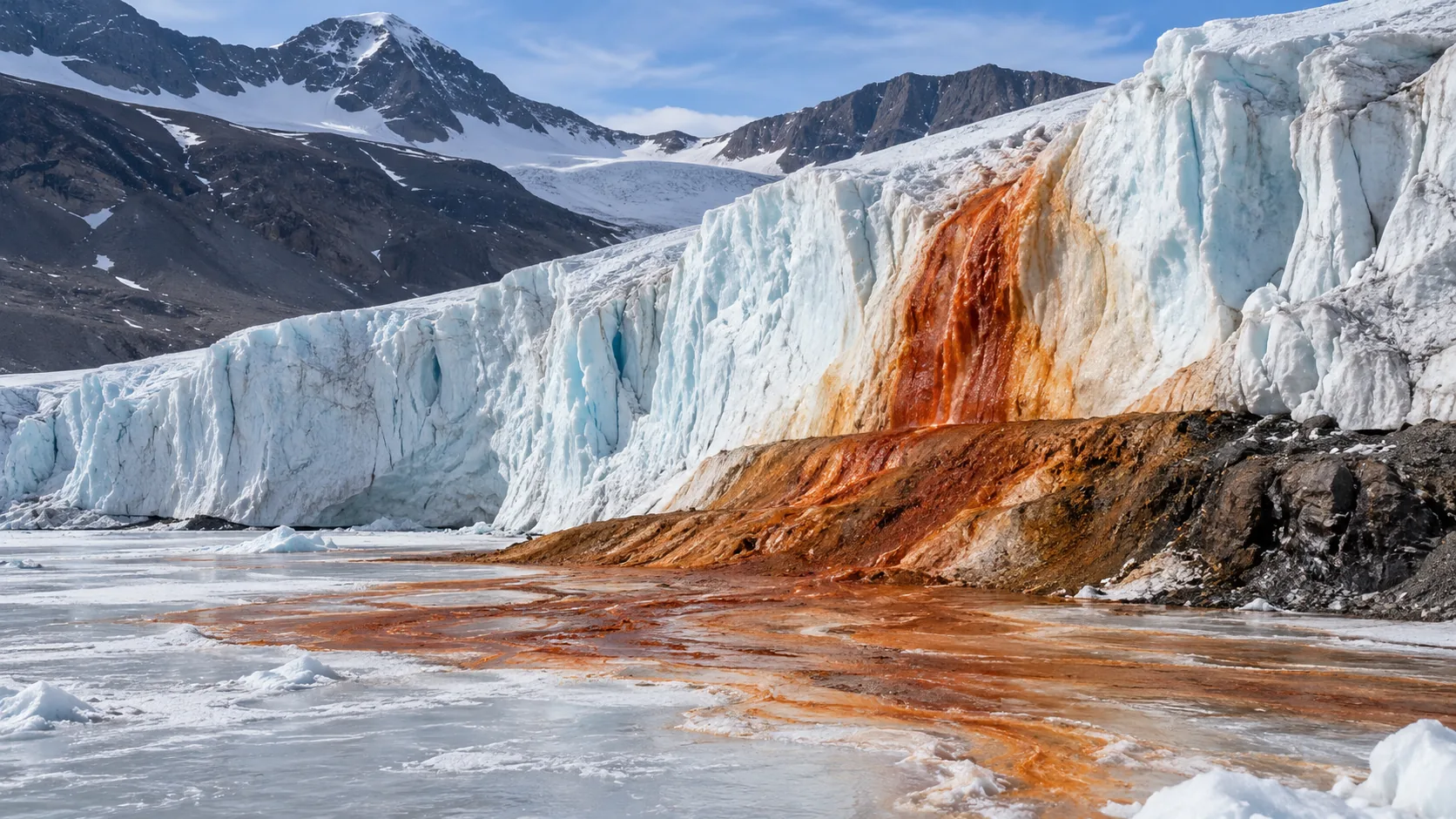
Antarctica has a glacier that appears to bleed. At the end of Taylor Glacier, a red-orange stain fans across the ice. The place is called Blood Falls, and the name sounds like a horror-film location. Fortunately, the explanation involves salty water and iron, not a glacier with a circulatory system.
The strange color comes from brine escaping from within and beneath the glacier in Antarctica’s McMurdo Dry Valleys. And researchers have learned that the reddish material is more complicated than a simple coating of ordinary rust.
Why does Antarctica’s Blood Falls look red?
The water reaching the surface is exceptionally salty and contains dissolved iron. When the iron-rich brine meets air and changes chemically, it can leave a striking red-orange deposit against the white glacier.
A 2022 analysis of material collected at Blood Falls used several laboratory techniques, including electron microscopy and spectroscopy. The researchers found abundant tiny, irregularly structured iron-containing particles, including amorphous nanospheres, but little strong evidence that familiar crystalline iron oxides were dominating the samples.
In other words, describing the falls as “a glacier rusting” captures the broad idea of iron chemistry, but skips what the scientists actually found. The detailed chemistry matters. These particles and their mixtures of elements appear to help give the deposits their color.
How can liquid brine exist in such a cold glacier?
Blood Falls isn’t an endless open waterfall gushing from a melted glacier. The outflow is intermittent, and the source is a hidden system of concentrated salty water.
Salts lower water’s freezing point, so brine can remain liquid at temperatures that would freeze ordinary freshwater. Scientists have found that Taylor Glacier contains channels and reservoirs where this dense fluid can move while much of the surrounding ice remains cold.
A 2017 study in the Journal of Glaciology used radar observations and other evidence to investigate the hidden brine pathways. The result was a picture of a surprisingly active liquid-water system inside an otherwise cold glacier.
The precise timing of each release is not fully established. Glacier movement, pressure and the way brine interacts with the ice are all part of the research picture. Scientists do not need to pretend they know the exact schedule of every red trickle to understand where it comes from.
There’s life in the hidden water, too
The brine beneath the ice is also of interest to microbiologists. Earlier research identified a community of microorganisms in the unusual salty, low-light environment. That does not mean the organisms are “bleeding” into the lake or that microbes alone are responsible for the visible red stain.
It means the place offers two puzzles at once: how salt-rich water travels through freezing conditions, and how microorganisms can persist in such an isolated environment.
Why researchers study Blood Falls for clues beyond Earth
Antarctica’s Dry Valleys are cold, dry and salty, making them useful comparisons for certain possible environments on Mars and icy worlds elsewhere in the solar system. The scientists behind the 2022 materials study examined how mineral deposits might help point to subsurface conditions capable of supporting life.
That interest connects Blood Falls to other Antarctic biological oddities. Some Antarctic fish, for example, have evolved in unusually cold waters. BiggleBit’s story about icefish with nearly colorless blood covers a different adaptation to the same unforgiving continent.
The punchline is that Blood Falls isn’t blood, and the glacier isn’t exactly melting into a red river. It is a rare glimpse of salty, iron-bearing water emerging from a cold world hidden beneath the ice. Antarctica managed to make groundwater look dramatic without adding a single drop of actual blood.