
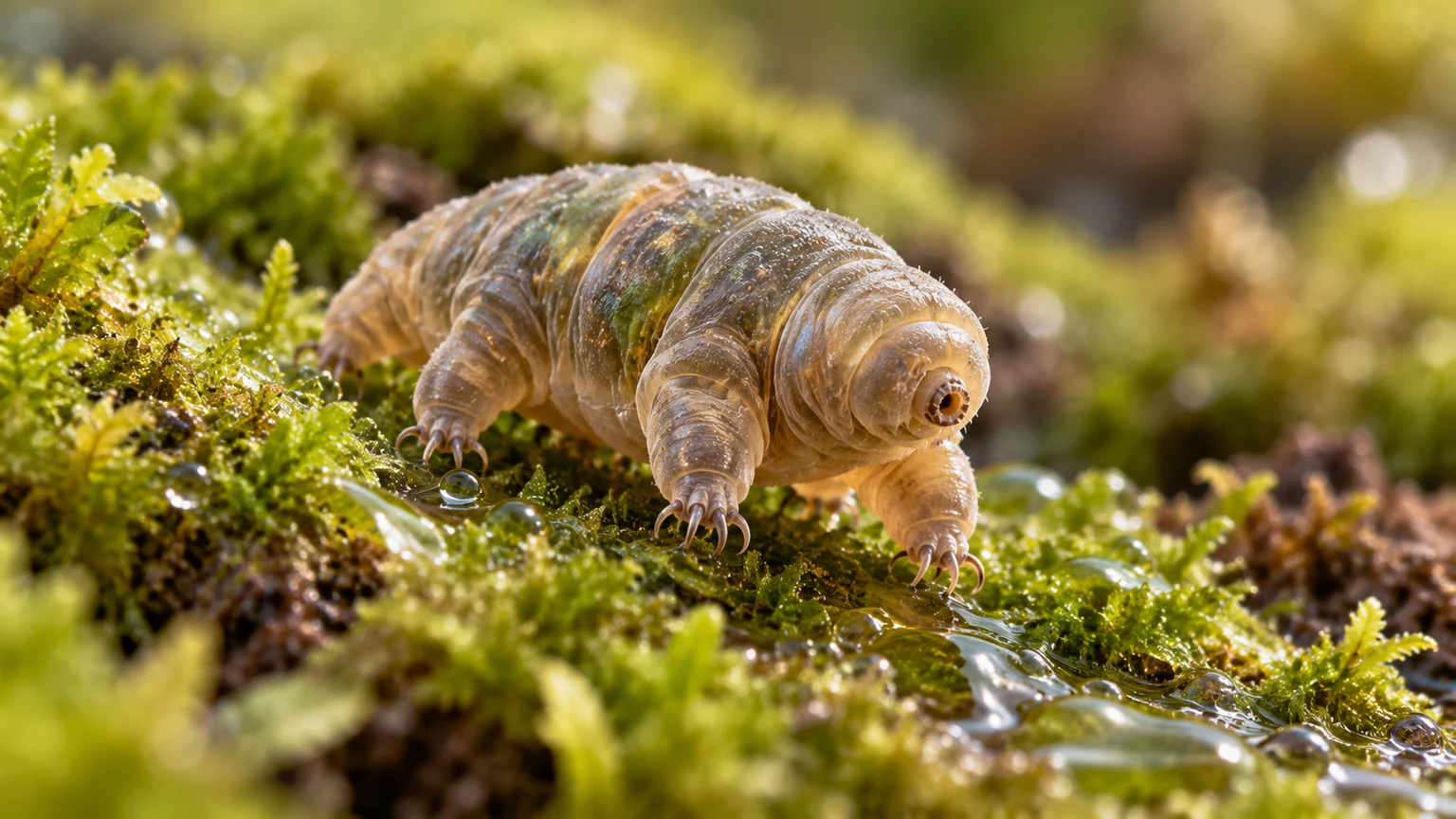
Tardigrades can survive being dried out almost completely. For an animal whose nickname is ‘water bear,’ this seems like a fairly aggressive approach to avoiding water.
Drying out without dying
These tiny, eight-legged animals inhabit damp environments, including mosses and films of water. They are famous for surviving stresses that would destroy many other animals. But the viral version—an indestructible creature that can shrug off absolutely anything—gets ahead of the evidence.
One important survival strategy is entering a dormant, desiccated state when conditions become hostile. Metabolic activity drops sharply. The animal is not carrying on its ordinary life without water; it is enduring a difficult interval until conditions improve.
Research supported by the U.S. National Science Foundation has investigated proteins and sugars involved in this protection. The chemistry matters because drying can damage cells and their internal machinery. Survival requires more than just having tough skin.
How proteins help protect a drying cell
In the 2022 study described by NSF, researchers found that a sugar called trehalose works together with a tardigrade-specific protein called CAHS D to help protect against drying. No single molecule makes every tardigrade invincible, and the results do not mean all species use exactly the same protection. The interesting biology is how different molecules cooperate to help cells endure a severe loss of water.
The animals are not immortal. They can be killed, and tolerance varies with species, conditions and exposure time. Their reputation comes from specific documented survival capabilities, not an exemption from biology.
For the primary evidence, see U.S. National Science Foundation.
Why scientists study this survival strategy
Scientists care about the underlying mechanisms because protecting cells from drying has possible applications beyond tiny animals. Learning how proteins and other molecules stabilize biological systems may eventually inform work on preserving sensitive materials.
The useful question is not ‘Could a tardigrade survive everything?’ It is ‘How does a living cell survive losing the water it normally needs?’ That is a much stranger and more scientifically productive story.
For another unusual survival strategy, wood frogs can survive freezing during winter. That is a different biological mechanism from tardigrade desiccation.
Survival does not mean indestructibility
It is easy to confuse a survival experiment with ordinary life. A tardigrade that endures drying has not necessarily been feeding, growing or reproducing during the stressful period. Returning to activity requires conditions to improve, and not every individual necessarily survives a given treatment.
Researchers therefore have to specify the species, the stress, its intensity and how long it lasts. A result from one experimental setup should not become a blanket claim about every water bear. The popular shorthand ‘indestructible’ hides the interesting biological question: which cellular protections work under which conditions?
Desiccation tolerance is particularly useful to study because water normally supports the chemistry and structure of living cells. Understanding how some organisms temporarily preserve those structures could help explain broader patterns of stress resistance, even if practical applications remain an active research question.