
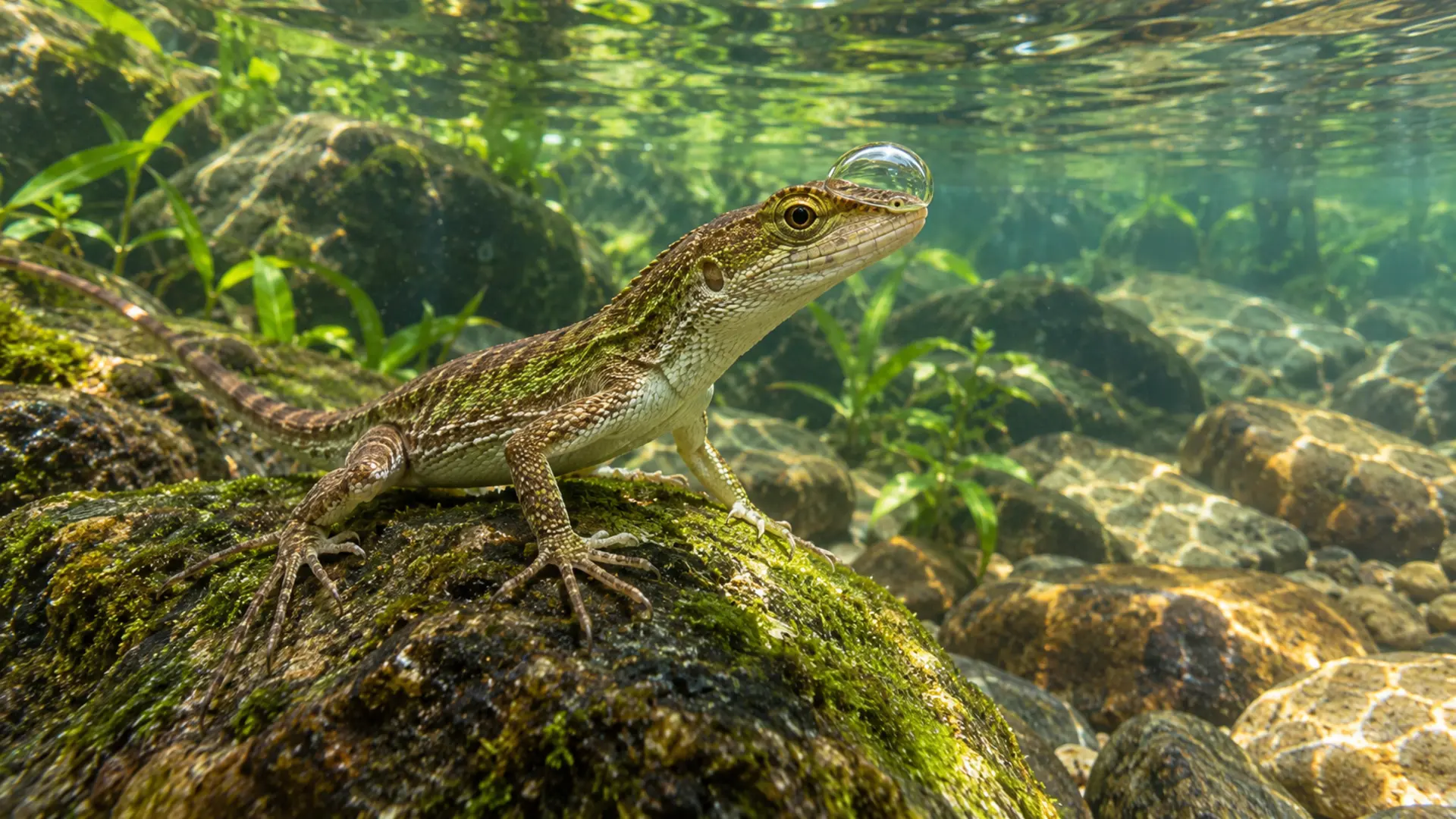
A water anole can disappear into a Costa Rican stream and take a small supply of air with it. The bubble sits over the lizard’s nostrils like a clear cap, expanding and shrinking as the animal breathes.
It looks like a visual trick, but an experiment found that the bubble changes how long the lizard can remain underwater. Water anoles allowed to use it normally stayed submerged about 32% longer on average than lizards whose bubble formation had been temporarily impaired.
The lizard carries extra air on its skin
Anolis aquaticus lives around rocky streams in southwestern Costa Rica and western Panama. When danger appears, it can dive, press close to a submerged surface and wait.
The lizard’s water-repelling skin holds a thin layer of air. During a dive, air moves toward the head and forms a larger bubble over the snout. The anole exhales into that bubble and draws air back in, repeating the cycle while it stays below the surface.
Researchers had filmed this “rebreathing” behavior before, and measurements showed that oxygen inside the bubble declined during a dive. That suggested the lizard was actually using the air. What remained uncertain was whether the bubble gave it a meaningful advantage.
The experiment stopped the bubble without blocking the nostrils
For a 2024 study in Biology Letters, researcher Lindsey Swierk tested 30 water anoles near a Costa Rican stream. Twenty-eight trials were completed.
The animals were assigned to two groups. Control lizards received water on the bubble-forming skin around the snout. For the other group, Swierk applied a thin layer of emollient to the same skin, reducing its ability to hold air while leaving the nostrils unobstructed.
All of the control lizards produced normal bubbles. The treated animals either made only tiny bubbles at the nostrils or none at all. After accounting for body mass and year, normal bubble use was linked to dives that lasted about 32% longer on average.
That result does not mean every bubble adds exactly the same amount of time. It does show that the behavior is more than a side effect of wet skin.
Hiding underwater buys time, but it has a cost
Water anoles are small enough to interest birds and snakes. Diving turns the stream into a temporary refuge, and a longer dive may give a predator time to lose interest.
Earlier observations recorded dives lasting at least 16 minutes. That is not the average from the 2024 bubble experiment, but it shows what the lizards can do in the right circumstances. A separate Binghamton University study of diving anoles found another side of the bargain: time in cool water can lower body temperature, in some cases by as much as 6°C.
The stream offers safety, but it is not a free hiding place. The bubble helps stretch the useful part of a dive without erasing the costs of being a cold-blooded animal in cool water.
It is a scuba tank, not a proven physical gill
The study supports what researchers call the “scuba tank” explanation. Air trapped on and around the body becomes available to the lizard because the bubble carries it to the nostrils.
A more dramatic possibility is that the bubble also works as a physical gill, exchanging gases with the surrounding water. Some insects can do that, but the Binghamton team has treated it as an open question for water anoles. The 2024 experiment tested dive time, not a complete gas-exchange mechanism.
Bubbles can perform very different jobs underwater. BiggleBit’s pistol-shrimp story follows a cavitation bubble that collapses with a snap and a flash. The water anole’s bubble is quieter: a reusable pocket of air that helps a small lizard wait out trouble.
No miniature tank, mask or flippers are involved. Just water-repelling skin, trapped air and a remarkably effective way to stay hidden.