
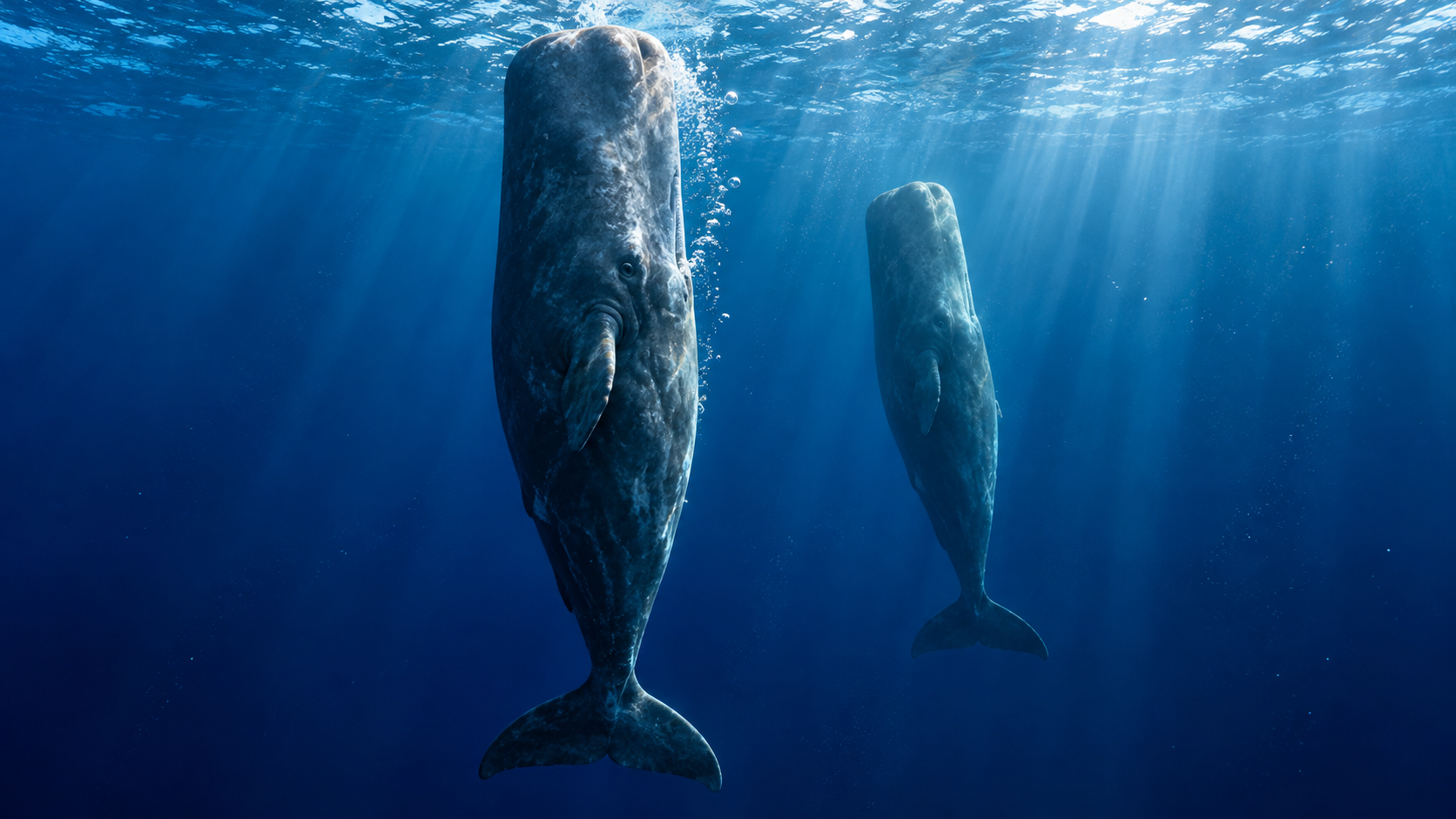
Sperm whales have a resting position that looks less like sleep and more like someone hit pause. They drift just below the ocean surface with their enormous bodies nearly vertical—head-up in some observations, head-down in others—barely moving.
Researchers have known about these strange “drift-dives” for years. A 2026 study added another wonderfully odd detail: while resting, the whales release bubbles that appear to help them stay neutrally buoyant instead of slowly floating upward.
The whales basically park themselves upright
In 2008, researchers using suction-cup tags described a stereotyped resting behavior in wild sperm whales. During shallow drift-dives, the animals became unusually still and held a near-vertical posture below the surface. Those resting dives made up about 7.1% of the tagged recording time in that study.
The scientists treated the behavior as strong evidence of sleep or rest, but there is an important limit: nobody was recording the whales’ brain waves. “Sleeping” is the likely interpretation, not a tiny underwater sleep clinic with EEG wires.
The original work is described in Current Biology.
Then researchers noticed the bubbles
A 2026 study in the Journal of Experimental Biology examined tagged sperm whales off Norway. Ten of 42 tagged whales showed primarily head-down resting dives suitable for the buoyancy analysis, and the researchers recorded bubble releases during those resting periods.
The team combined the tag data with a model of tissue density, drag and onboard gas volume. Their conclusion: releasing gas helped the whales reduce positive buoyancy and remain submerged while resting.
The 2026 paper also found that the whales appeared to begin resting dives with less gas than they carried during deep foraging dives.
Why would a resting whale need a buoyancy adjustment?
Sperm whales are breath-hold divers. As a whale drifts upward toward lower pressure, gas in its lungs expands. That expansion can make the animal more buoyant, which is inconvenient if the whole point is to hover quietly below the surface.
Releasing some gas can counter that rise. It is a little like adjusting a scuba buoyancy compensator, except the equipment is a 40-ton mammal and the control panel is apparently “blow bubbles.”
The researchers also noted another possibility: some of the released gas could be related to off-gassing carbon dioxide or nitrogen. The study supports a buoyancy function, but it does not mean every bubble has only one job.
Vertical rest may save energy
The posture keeps the animals near the surface, where they can eventually breathe, without requiring them to keep swimming. The 2026 researchers suggested that resting below the wave zone may also buffer the whales from surface motion.
That makes the weird posture look less weird. A whale that spends much of its life making extremely deep foraging dives has a good reason to make rest as cheap as possible.
We still do not know exactly what their brains are doing
Toothed whales are famous for unihemispheric sleep, in which one side of the brain rests while the other remains more alert. But the sperm-whale drift-dive studies did not directly measure brain activity, so researchers remain cautious about saying exactly how these animals sleep.
We have another cetacean sleep story on BiggleBit: dolphins can rest one brain hemisphere at a time. Sperm whales may be doing something different—or something we have not yet measured properly.
Either way, the visible part is remarkable enough: one of the world’s largest predators can stop, turn nearly vertical, release a few bubbles and hang under the surface like a very large, very sleepy submarine.
Sources: Current Biology (2008); Journal of Experimental Biology (2026); University of St Andrews.