
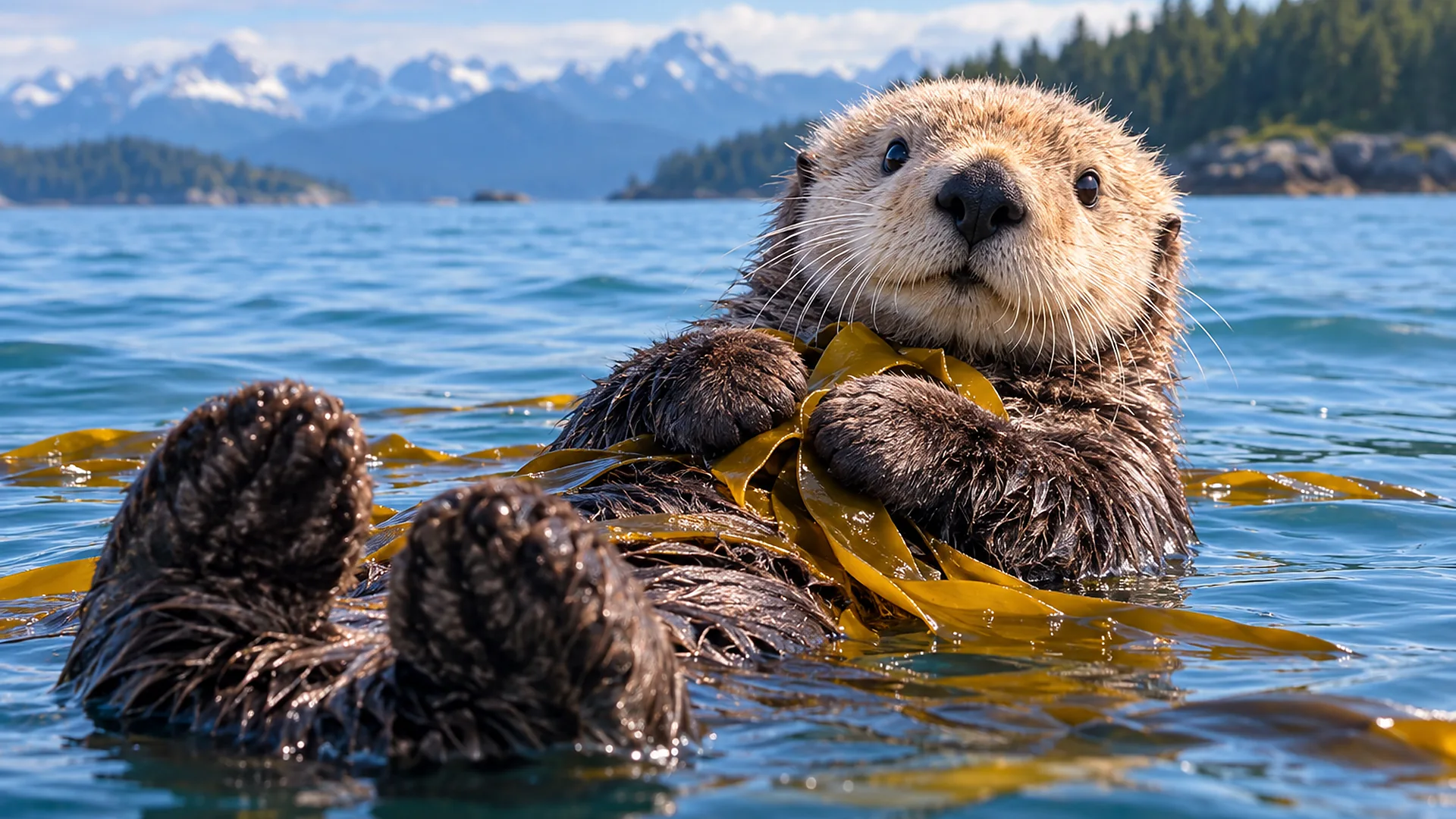
Sea otters sometimes wrap themselves in kelp so they can sleep without drifting away. The ocean provides neither beds nor guardrails, so the otters use the nearest available seaweed as a remarkably low-tech anchor. This is a real behavior, although the internet’s sweeter claim that sea otters always hold hands while sleeping is much less useful as a universal description.
Why do sea otters sleep floating on their backs?
Sea otters spend an extraordinary amount of time in the water, including time spent resting and grooming. Their dense fur traps air that helps insulate them and contributes to buoyancy. Floating belly-up keeps the face above the surface and offers a convenient way to rest, groom and handle food.
Water is still moving beneath them. Wind and currents can carry a sleeping animal away from a favored resting area. A sea otter resting among kelp fronds may wind the vegetation around its body or hold onto it, reducing the risk of drifting off while it sleeps.
NOAA’s Office of National Marine Sanctuaries explicitly describes sea otters wrapping themselves in kelp to rest without drifting away. NOAA’s Sea Otters 101 video transcript follows an otter that lays kelp across her belly before a nap.
What is a raft of sea otters?
A group of resting sea otters floating together is called a raft. The term refers to their social arrangement, not a structure built of wood. Rafts can be small or extraordinarily large. The U.S. Department of the Interior notes that researchers have observed aggregations of more than a thousand sea otters, and describes their use of seaweed to remain together.
Resting in groups may create the impression that the animals are deliberately weaving an enormous communal hammock. Sometimes otters are simply floating near one another. The kelp attachment is the well-supported practical part of the story; not every raft needs a romantic script.
Do sea otters really hold hands while asleep?
Images and videos of sea otters touching paws have helped popularize that idea. Otters can make contact, but the viral phrase that they have to hold hands so they do not drift apart overstates the evidence. Kelp anchoring and group resting are better-documented explanations for the familiar behavior.
The distinction matters because a catchy caption can quickly become a supposed biological rule. There is no need to diminish how unusual these animals are to make them cuter. Floating in seawater with your dinner on your chest and a piece of seaweed as a seat belt is already a remarkable day.
Why kelp forests matter to otters
Kelp forests are rich marine habitats, not just an improvised bedroom. The long seaweed supports complex communities of fish, invertebrates and other animals. Sea otters eat sea urchins, among other prey, and in some coastal ecosystems their feeding can reduce grazing pressure on kelp. That relationship helps explain why otters and kelp are so often discussed together in conservation science.
But otter populations, diets and local ecological effects vary. Sea otters do not single-handedly manage every kelp forest in the same way. The sounder picture is an interconnected coastal food web, with otters acting as influential participants in many places.
The world’s most practical bedtime routine
So yes, sea otters can tuck themselves into kelp when resting. It is less a sentimental group cuddle than an effective answer to the basic question, “How do I take a nap without waking up somewhere else?” For more unusual marine biology, see the sea slugs that borrow chloroplasts from algae. The ocean has an impressive collection of unconventional life hacks.