
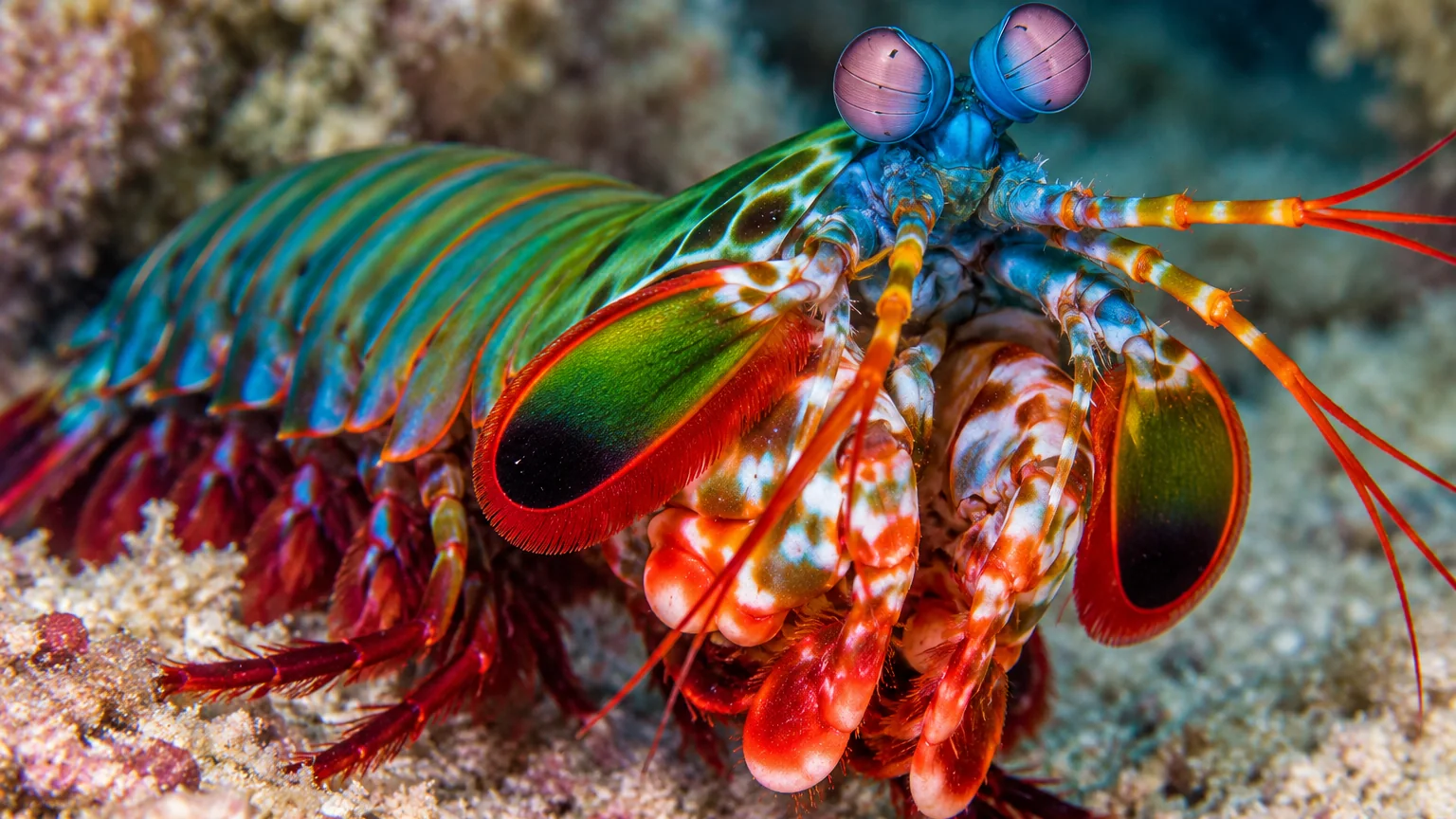
A peacock mantis shrimp doesn’t just hit its dinner. It can strike so quickly that the water beside its club briefly turns to vapor, then collapses into a second jolt. Apparently, one punch wasn’t enough.
The spring-loaded club behind the punch
The animal is a crustacean, not a shrimp in the familiar dinner-plate sense. Some mantis shrimp spear prey, while the so-called smashers use club-shaped hunting limbs to break hard shells. The peacock mantis shrimp is a particularly well-studied smasher.
Researchers studying these strikes used high-speed cameras to understand movements too fast for ordinary video. The club accelerates through water at remarkable speed, even though water ordinarily resists fast movement. The trick involves storing elastic energy in the limb’s spring-like structures before releasing it suddenly.
The strike creates a low-pressure zone in the surrounding water. Vapor bubbles form, then collapse. This phenomenon is called cavitation. The collapsing bubbles can produce an additional force after the direct impact of the club.
Cavitation adds force after the hit
That does not mean every mantis shrimp punch makes a glowing underwater explosion visible to the naked eye. The measured phenomenon happens on a tiny scale and in a fraction of a second. The science is already plenty dramatic without turning the animal into a superhero.
The mechanical lesson is intriguing: muscles alone do not explain how fast the appendage moves. The animal loads a spring and releases it like a biological catapult. Engineers study such systems because storing and releasing energy can produce movements that muscles or motors alone cannot easily match.
The primary 2005 study by Patek and Caldwell measured a direct impact force followed by a separate force from collapsing cavitation bubbles. Duke University’s Patek Lab explains the mechanics in more detail.
Breaking shells with a biological hammer
The payoff for the shrimp is practical. A snail shell is an obstacle between the hunter and lunch. The punch, plus the water’s own response, helps overcome it. A creature small enough to hide in a reef crevice has managed to make fluid physics part of its cutlery.
Other animals have equally surprising tools for finding food: octopuses can taste with their suckers. The mantis shrimp solves a different problem with a spring-loaded strike.
The water supplies the second jolt
Cavitation is not a second swing by the shrimp. It is the water responding to a sudden pressure change. When a vapor pocket collapses, the surrounding liquid rushes back in. That distinction explains why a researcher can describe both the club’s direct impact and a subsequent effect from the water without claiming the animal has two separate weapons.
The striking limb also has to survive its own performance. The club is a repeatedly loaded biological structure, not a disposable hammer. Understanding how its components handle impact is part of the reason mantis shrimp attract attention from scientists who study materials as well as animal movement.
Not every mantis shrimp uses the same equipment. The difference between spearers and smashers matters: a story about cavitation-producing clubs describes particular smashing species, not a universal trick shared by every member of the group.