
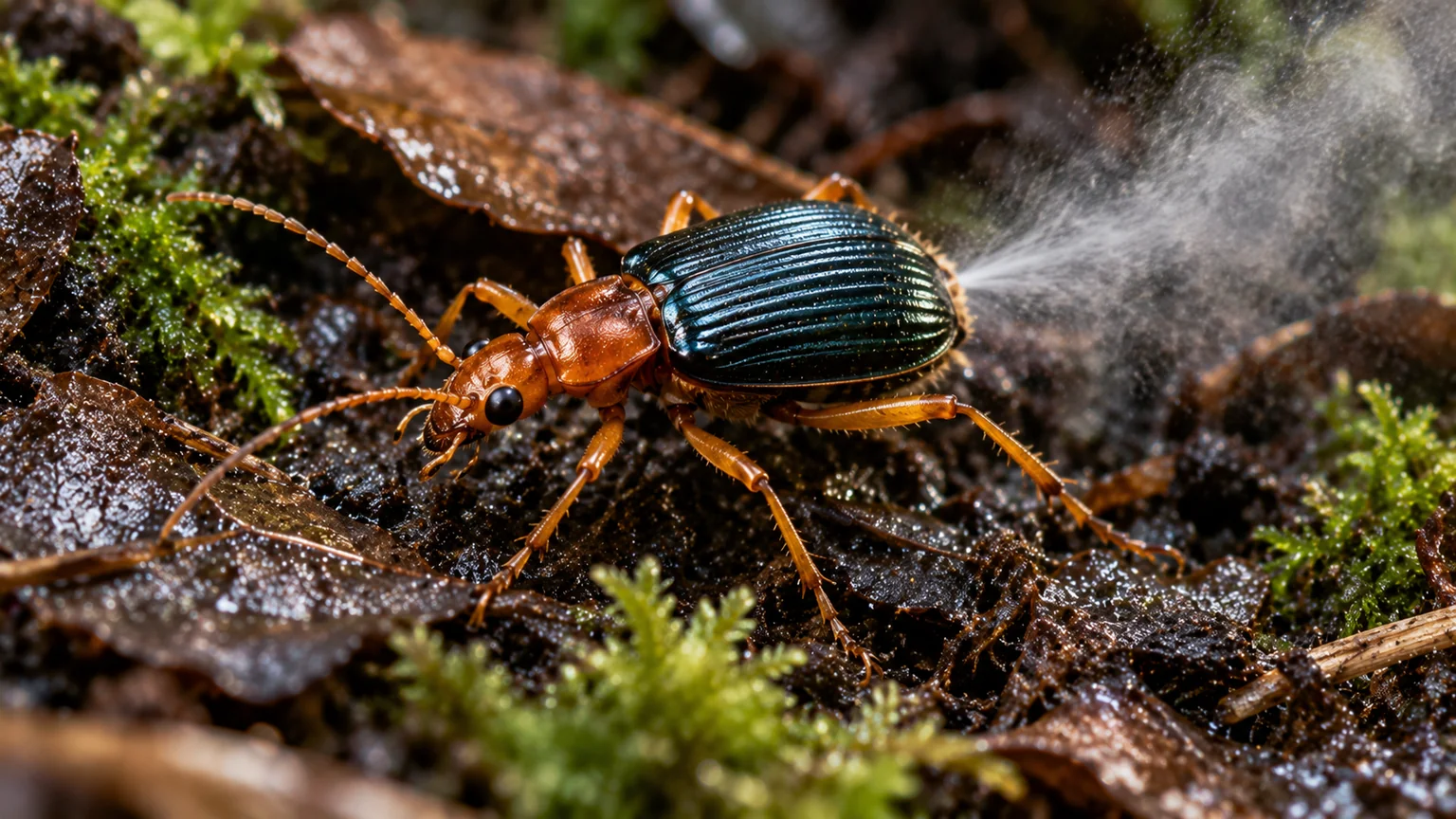
A beetle barely longer than your fingernail can fend off an attacker by firing a hot, irritating spray from the tip of its abdomen. It sounds like an insect with a built-in squirt gun and an unreasonable engineering department. But the most interesting part isn’t the temperature. It’s the timing.
Bombardier beetles don’t simply leak a noxious liquid. In the group scientists studied, the spray comes out as a rapid series of separate pulses.
What makes this tiny beetle a bombardier?
Bombardier beetles are ground beetles, not one single species. Some, including members of the tribe Brachinini, use a specialized gland near the rear of the body to produce a defensive jet. A predator may be surprised by the noise, heat and irritating chemicals. That doesn’t mean every beetle species has the same spray or that every predator is deterred.
It also isn’t breathing fire. The defense is a short-range jet of heated liquid, not a flame or an explosion that blows the beetle apart. The distinction helps keep the story impressive without giving the beetle an imaginary flamethrower.
A series of pulses rather than one long squirt
Researchers documented fast spray pulses decades ago. In a 1990 Science study of one bombardier beetle species, they measured about 500 pulses per second. That’s far too fast for someone to count by watching a beetle under a rock.
But how could its body produce repeated bursts so quickly? Scientists suspected that the beetle’s internal plumbing was doing more than simply opening and closing a hole. The question became whether the pulses were actively timed, or whether the pressure changes themselves helped create the rhythm.
The beetle’s remarkable pressure-control system
In 2015 a team at MIT, the University of Arizona and Brookhaven National Laboratory used fast X-ray imaging to watch what happened inside living beetles. The research published in Science showed that flexible internal structures move in response to rising and falling pressure. This helps regulate the flow between storage and reaction chambers and produces repeated bursts.
In other words, the beetle doesn’t need someone inside its abdomen pressing a tiny button hundreds of times per second. The physical system helps regulate itself. MIT’s explanation of the study describes how these structures withstand and control the pressure without destroying the animal.
The jet is extremely hot in the studied beetles—reported at roughly the temperature of boiling water. Yet it is released in short pulses, and the organism is adapted to make and direct it. That is a biological engineering achievement, not evidence that the beetle is generally immune to heat.
What a defensive jet can and cannot do
A short-range, irritating spray is useful against some would-be predators. But it isn’t a weapon with guaranteed accuracy or an unlimited supply. The effect depends on the beetle, the threat and the circumstances.
Some beetles can direct the nozzle toward the source of danger. The word bombardier is good branding, but the science concerns a small glandular defense, not an actual miniature artillery shell. It is the kind of detail that makes a field guide more interesting than a monster movie.
Why scientists study the tiny system
Researchers interested in materials and fluid flow study bombardier beetles because their bodies demonstrate a natural way to generate and control repeated pressure pulses. The 2015 paper focused on the mechanism rather than promising a ready-made human device. Biomimicry is a research inspiration, not a guaranteed invention.
Another underwater animal uses pressure changes in an entirely different way: mantis shrimp can make collapsing cavitation bubbles during a strike. One gets its effect from a fast moving club, the other from internal gland chemistry. Same lesson, different machinery: biology has more engineering tricks than a hardware store.
For a beetle trying to survive a predator’s attention, the science boils down to a much simpler instruction: make the attacker regret dinner.