
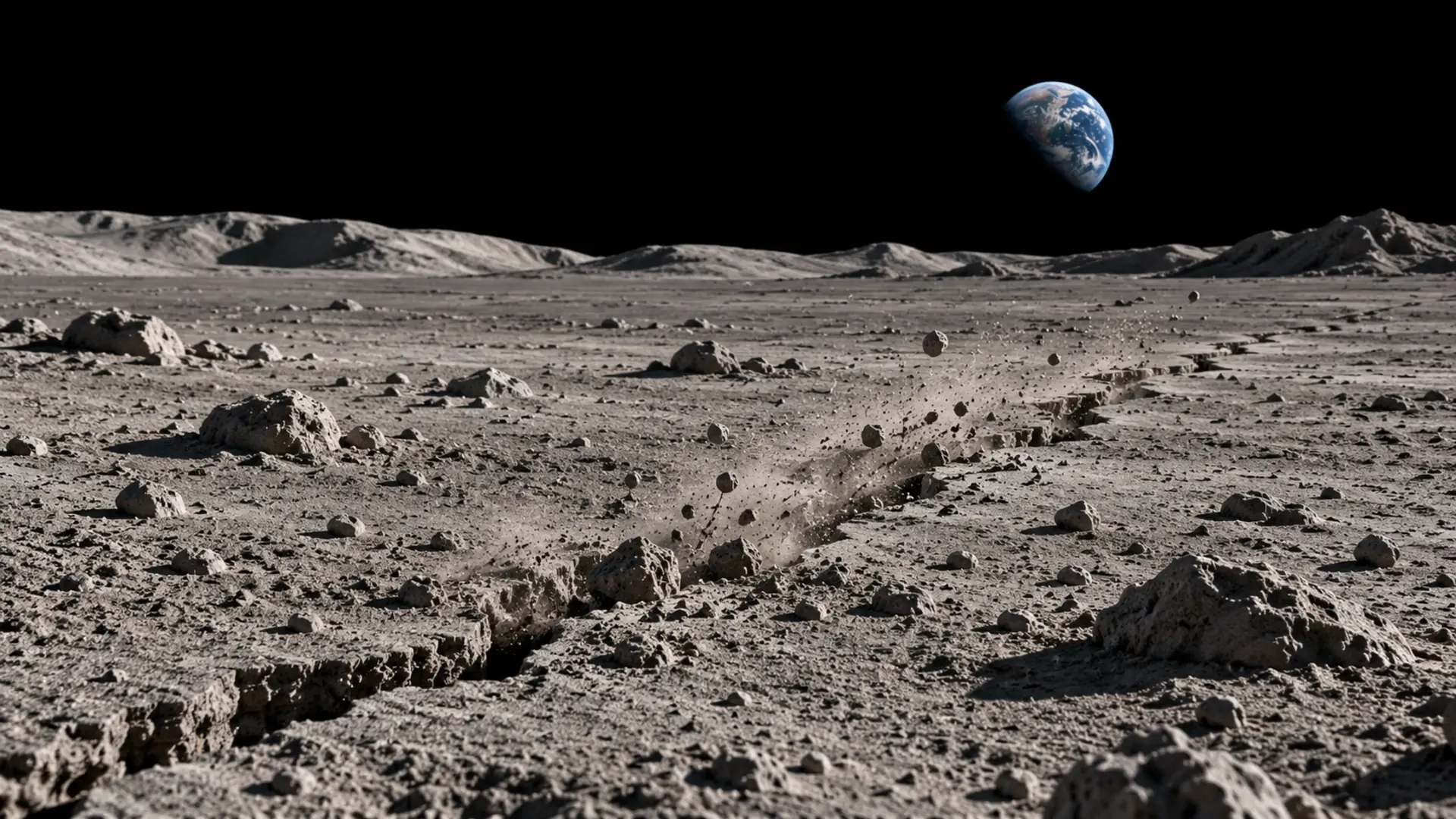
The Moon has no shifting tectonic plates, no oceans and no traffic, but it is not quiet. Seismometers left by Apollo astronauts picked up thousands of vibrations from deep inside the Moon, its cooling crust, meteorite impacts and the severe temperature swing between lunar night and day.
The longest signals are the surprise. NASA says some moonquakes can keep the ground moving for hours. That does not mean hours of one violent jolt. It means seismic energy fades far more slowly than a typical earthquake signal on Earth—a stubborn tail of shaking that matters when you plan to leave equipment on the surface for years.
Apollo left the Moon with four listening posts
Apollo 11 carried the first seismometer to the lunar surface in 1969. It worked for only about three weeks, but later astronauts placed more capable instruments at the Apollo 12, 14, 15 and 16 landing sites. Those stations formed a four-site network that sent data home until September 1977, according to NASA’s history of the experiment.
A 2026 NASA update says the Apollo network recorded about 13,000 moonquakes and other ground vibrations. The “other” part matters: the instruments heard natural quakes, meteorite strikes and deliberate spacecraft impacts. All of those signals helped scientists probe a world they could not drill into.
The Moon shakes for more than one reason
NASA groups natural lunar seismic activity into four broad sources. Deep moonquakes happen hundreds of miles below the surface as Earth’s gravity repeatedly tugs and stretches the Moon. That same Earth-Moon interaction is part of the larger story behind the Moon’s slow drift away from our planet, although the two effects are not the same measurement.
Shallow moonquakes come from faults in the brittle crust as the Moon cools and contracts. NASA’s moonquake overview places these events roughly 20 to 30 kilometers down and says they can reach about magnitude 5.5. Meteoroid impacts add another source. Near the surface, rock also expands and contracts through the enormous temperature change from lunar night to lunar day, producing small thermal quakes.
A dry, fractured crust lets the signal linger
On Earth, water and warmer rock help absorb and scatter seismic energy. The Moon’s cold, extremely dry crust does much less damping. Its battered upper layers are also full of cracks, so waves can ricochet through the fractured material instead of dying away quickly.
That is why “moonquake” can be misleading if it makes you picture an ordinary earthquake in a gray setting. Some shallow events lasted more than 10 minutes in Apollo data, while NASA’s more recent hazard work warns that lunar shaking can persist for hours. The duration describes a long, gradually fading seismic signal—not a movie-style fissure ripping open nonstop.
Future lunar hardware has to be ready
The strongest shallow moonquakes are rare and much weaker than Earth’s biggest earthquakes. NASA says they pose little risk to astronauts during a short visit. Long-lived equipment is a different calculation: extended shaking could disrupt operations, loosen surface material or threaten structures placed close to an active fault.
NASA completed the Lunar Environment Monitoring Station, or LEMS, in 2026. The compact package carries two sensitive seismometers and is designed to monitor the Moon’s south polar region for years after astronauts deploy it. At the time of NASA’s announcement, it was still awaiting assignment to a mission.
Apollo proved that the Moon is seismically alive in its own slow, dry way. The next instruments should reveal how often its faults move—and give engineers better numbers for building on ground that may keep trembling long after the first jolt is over.