
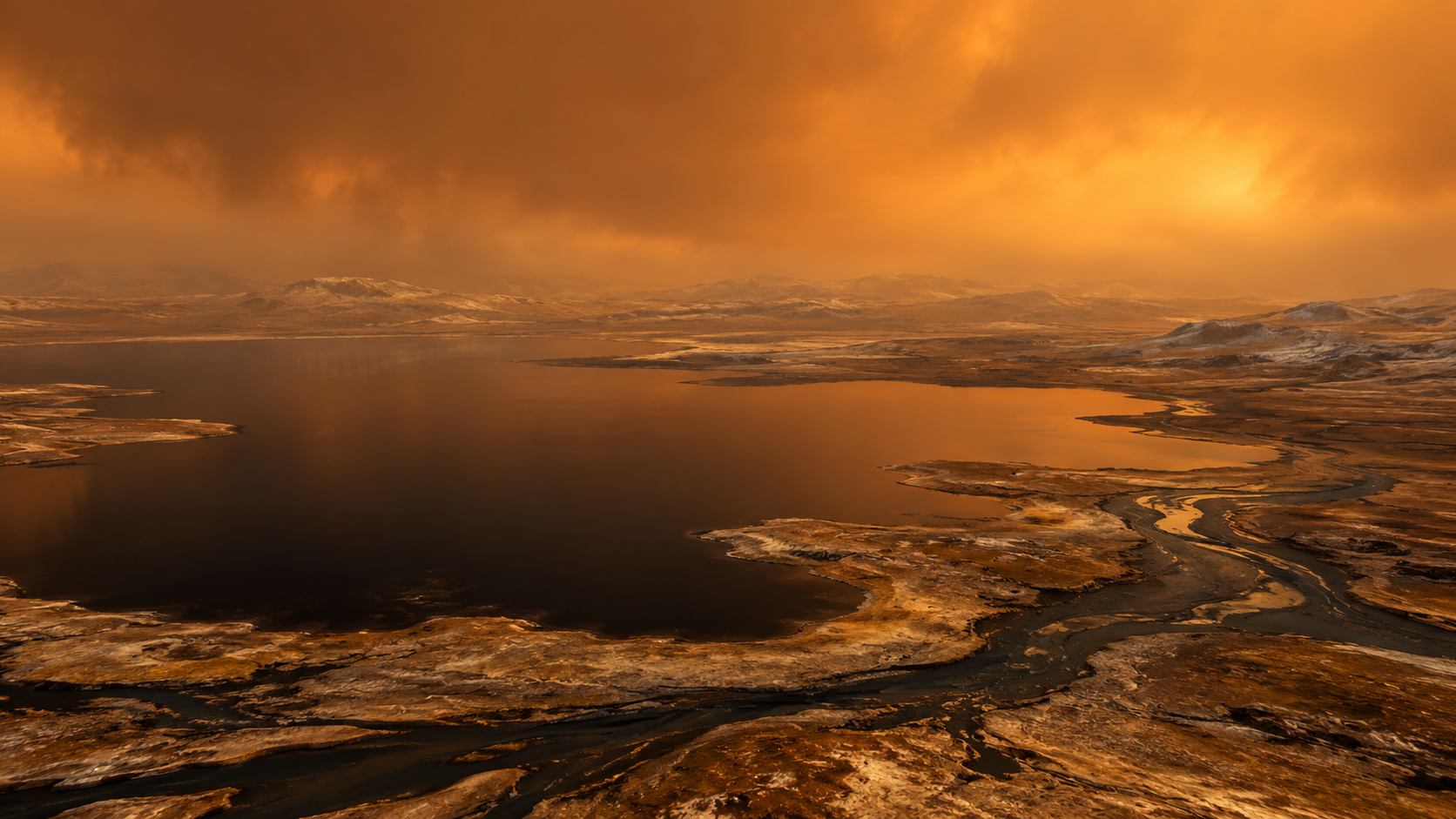
Saturn’s moon Titan has rain, rivers, lakes and seas. The startling part is what fills them: liquid methane and ethane, substances most of us know as gases.
NASA’s Cassini spacecraft spent years peering through Titan’s orange haze and revealed a world that seems familiar until you check the temperature. This is weather, but it is not beach weather.
Real lakes, not just dark patches
NASA’s Cassini mission overview describes lakes and seas of liquid hydrocarbons near Titan’s poles, along with broad fields of dunes closer to the equator. Radar measurements let scientists study the surface even where the thick atmosphere hides it from ordinary cameras.
Some northern lakes are rich in methane. An analysis of Cassini data published by NASA in 2019 found that several smaller northern lakes are made mostly of methane, while the southern Ontario Lacus has been measured as a mixture of methane and ethane.
Why doesn’t the methane simply boil away?
On Earth, methane is normally a gas. Titan is far colder. Its surface temperature is around minus 290 degrees Fahrenheit, or minus 179 Celsius, according to NASA’s Titan facts. Under Titan’s conditions, hydrocarbons can remain liquid at the surface.
Water ice, meanwhile, can be hard enough to function as rock. A river channel on Titan may be carved through icy material by liquid methane, rather than carved through stone by water.
Titan has its own version of a water cycle
Earth’s water evaporates, forms clouds, falls as rain, and flows into rivers and lakes. Titan follows a similar pattern with methane and other hydrocarbons. Cassini observed changes in Titan’s clouds and seasonal atmosphere, while radar mapped rivers, lakes and seas on the ground.
That is an analogy, not a claim that Titan has Earthlike weather everywhere or all the time. Some regions appear dry. The largest standing liquid bodies lie in polar areas, and the seasons move far more slowly than ours.
There may be ordinary water below all this
Titan probably also has a subsurface ocean of liquid water mixed with other materials, beneath an outer layer of ice. That possible underground ocean is separate from the methane and ethane on the surface. The combination gives scientists two very different environments to study.
NASA says Titan is a major target for future exploration, but no spacecraft has found life there. Interesting chemistry is not the same thing as evidence of organisms.
It’s a place with weather but no umbrellas worth packing
Think of Titan as a distant example of familiar processes using unfamiliar ingredients: precipitation, erosion, lakes, shorelines, and an atmosphere doing much of the work. Even the word “lake” is perfectly appropriate. Just don’t imagine taking a swim.
For a second planetary surprise, BiggleBit has covered water ice hiding in sunless craters on Mercury. The solar system keeps rearranging our expectations about where liquids and ice belong.
Sources: NASA Titan Facts; NASA Cassini Titan overview; NASA 2019 Cassini lake analysis.