
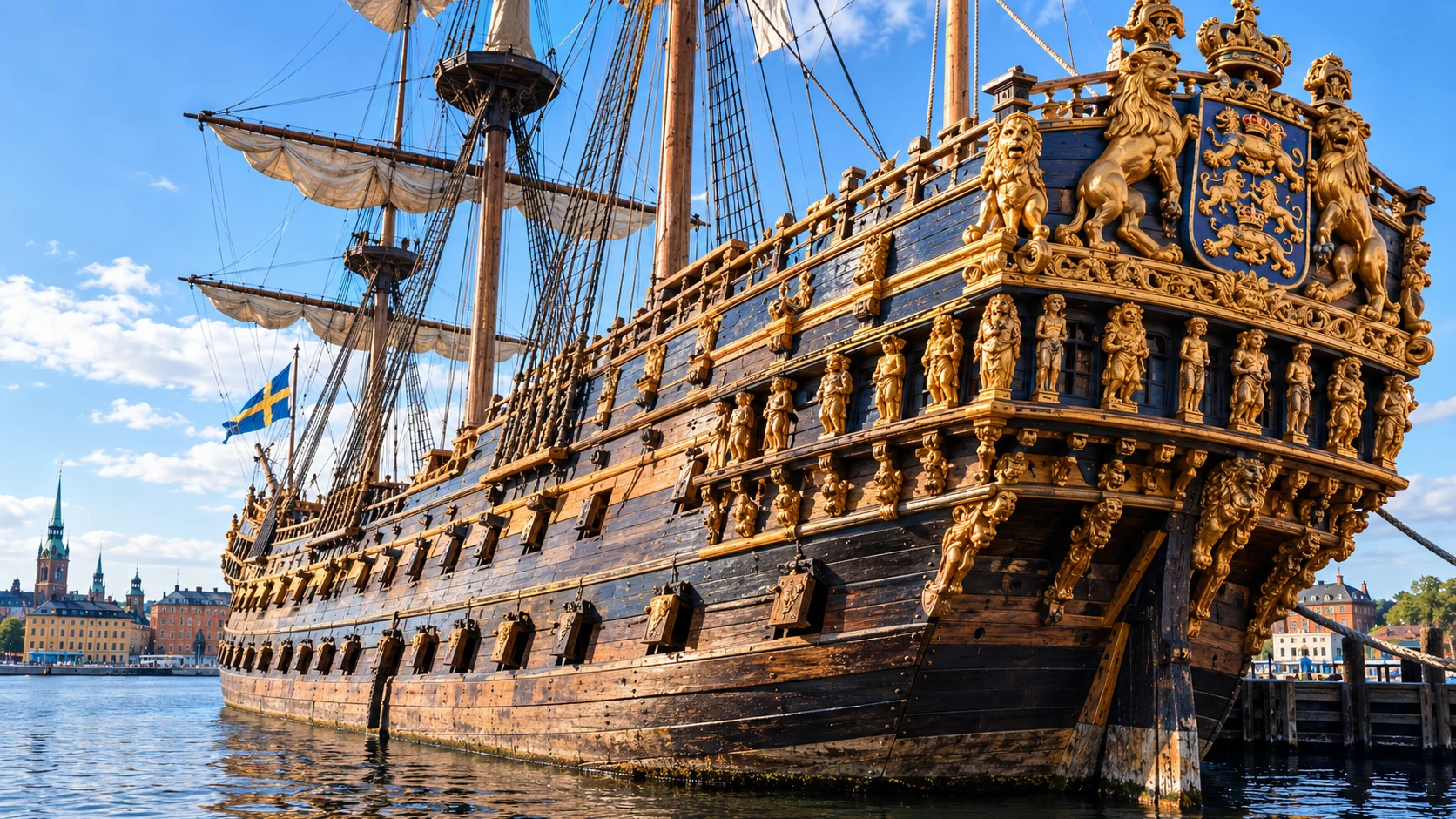
The Swedish warship Vasa had barely begun its first voyage when it started taking on water. On August 10, 1628, people crowded Stockholm’s waterfront to watch a powerful new ship leave the harbor. About 20 minutes into the trip, the vessel was sinking. Roughly 30 people died.
Four centuries later, we know a great deal about what went wrong. The ship itself is still around, and the museum built to house it has pieced together the disaster from records, surviving objects and the unusually well-preserved hull.
A showpiece with a serious balance problem
King Gustav II Adolf commissioned Vasa for the Swedish navy in 1625. Building began the next year. The warship stretched about 69 meters long and carried 64 cannons, with elaborate carved decorations high above the waterline. It was meant to be an imposing presence in the Baltic.
But that high structure made the ship dangerously unstable. The Vasa Museum’s own explanation is straightforward: the vessel was too tall and narrow for the amount of hull below the water. Its center of gravity sat too high. Even a modest gust could push it over farther than the crew could safely correct.
The warning appeared before anyone set sail
There had been a warning. During preparations, 30 men ran from one side of the deck to the other to test how the ship rolled. It tilted alarmingly. The demonstration was stopped because the people in charge feared it might capsize while still tied up.
That episode is part of the museum’s documented Vasa timeline. It is tempting to judge the builders by modern engineering standards, but seventeenth-century shipwrights lacked the mathematical methods now used to predict stability. They relied heavily on experience with earlier vessels. Vasa pushed those methods beyond their limits.
A gust, open gunports and a quick sinking
When Vasa finally left the palace waterfront, the lower cannon ports were open. The ship first leaned in a light gust and recovered. Then a stronger gust sent it farther onto its side. Water poured through the open lower ports into the gun deck, and the crew could not recover control.
The Vasa Museum’s disaster account says the ship came to rest at a depth of about 32 meters. Its masts were still visible above the surface. People escaped by swimming or climbing into small boats, but 30 crew members and guests did not survive. The tragedy happened within sight of the city.
The sinking was avoidable in principle: closed gunports would have kept that sudden flood of water out. The underlying instability would still have required substantial changes before the ship could sail safely.
Stockholm got its ship back 333 years later
The wreck remained on the harbor bottom until the twentieth century. Searcher Anders Franzén located it in 1956. Divers and engineers then spent years preparing a complicated lifting operation. On April 24, 1961, Vasa surfaced after 333 years underwater.
Keeping the raised ship intact was another challenge. Waterlogged wood can crack and shrink as it dries. Conservators chose polyethylene glycol, or PEG, a water-soluble wax-like material, and sprayed the hull with it for 17 years, from 1962 to 1979. Gradual drying and further conservation followed.
Researchers are still working to protect the surviving wood. The museum describes problems caused by chemical changes and weakening timber, and continuing preservation research helps guide the work.
The lesson survives in the hull
Today the original ship stands in Stockholm’s Vasa Museum. Its carved figures and enormous wooden structure make the failed voyage tangible. There is no need to invent a mysterious cause: the design, the test before departure and the water rushing through open gunports tell the story plainly.
For another historical construction story where the evidence matters as much as the legend, the Loretto Staircase in Santa Fe has a fascinating paper trail of its own. The Vasa, meanwhile, made a journey nobody planned: from the bottom of Stockholm harbor to a museum, more than three centuries after setting out.